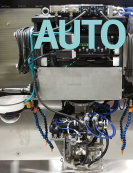
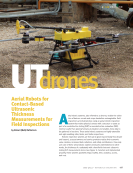
w ME FEATURE J U L Y 2 0 2 1 • M A T E R I A L S E V A L U A T I O N 679 A utomated robotic systems are becoming prevalent in many aerospace manufacturing applications, such as laser ablation, sanding, drilling, final assembly, and painting. There are signifi- cant advantages to using automated robotic systems for inspec- tion purposes as well: versatility, speed, and repeatability, to name a few. This paper explores using an automated robotic system for the nondestructive testing (NDT) of composite parts. It has a focus on phased array ultrasonic testing (PAUT) but highlights modularity principles in the system that are not coupled to a single inspection method. Because of the articulation inherent in multi-axis robots, inspections of contoured structures become straightforward if the system modules are designed correctly. Examples of such modules, and their advantages when interfaced to an automated robotic system, are included in this paper. It is the author’s intent to show how these system modules might maximize robot capabilities for a broad range of aerospace inspections while keeping a simplistic design that is modular, fast, and straightforward to use. When compared to other aerospace manufacturing processes already using automated robotic systems, the use of robots for NDT seems not only prudent but a favorable goal. This paper offers practical building blocks for achieving this goal. Automated Robotic Systems for Nondestructive Testing of Aerospace Composite Structures by Barry A. Fetzer NDT

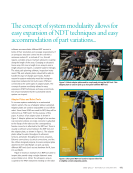
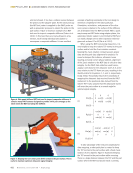
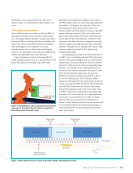
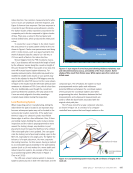
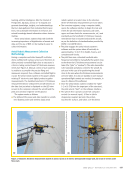
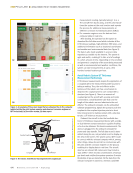
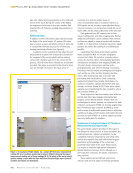
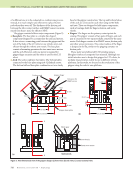
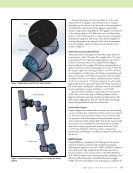
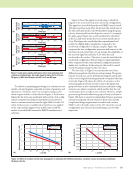
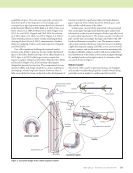
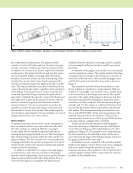
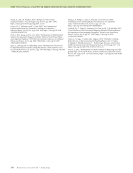
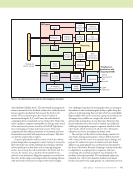
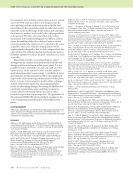
680 M A T E R I A L S E V A L U A T I O N • J U L Y 2 0 2 1 ME FEATURE w automated robotic systems for aerospace ndt Introduction Robots offer versatility beyond the traditional gantry system, which is a large metal frame structure with a bridge attachment. For example, longer aerospace parts are dealt with by simply installing additional robot track, which can be shimmed and bolted in most circumstances. A variety of part configurations can be handled with different end of arm tools (EOATs) that the robot can pick up to perform the inspections. In this manner, the NDT software and instrumentation remains the same, and when done properly, path planning software for motion control becomes easily adaptable for different part configurations. Aerospace parts such as wing skins, fuselage sections, and horizontal stabilizers all have contours associated with their part surfaces. These contours are fully represented in their CAD models and can be pulled directly into the robot simulation and programming software. When this is done, the Cartesian coordinate (X, Y, Z) of the contoured part surface is mapped to the 3D coordinate system of the simulator. This is needed for verification of part coverage and robot axis behavior as well as collision avoidance for safety purposes. While the robot with six degrees of freedom is flexible enough to perform NDT on these contoured parts, the system architecture must account for the 3D environment of the robot to provide a 2D C-scan output (Brekow et al. 2014 Munikoti et al. 2012). The 2D C-scan output is well known in the industry for analysis of ultrasonic NDT data and must represent the dimensions of the contoured surface to some reasonable tolerance. The design of the automated robotic system in this paper presents modules created to make an easy progression from a mechanical system with six degrees of freedom to an output display having two dimensions. The C-scan output will be generated from a PAUT instrument inter- faced to the articulated robot. Design of the EOAT and robot path planning is done in such a way as to minimize transformational requirements between the two coordinate systems. System Modularity When designing an automated robotic system for a broad range of NDT applications, it is beneficial to select system modules that offer easy interfacing to external devices. An example is shown in Figure 1. In this instance, there are multiple EOATs used to perform inspections for a broad range of applications (for example, skin panels, stiffeners, or fuselage sections). In addition, the EOATs can employ multiple NDT methods and techniques such as PAUT, laser UT, and thermal/infrared testing (IR). These tools can be easily swapped in and out of the system with the use of mechanical adapter plates located on the tool center point (TCP) or the flange of the robot. Also shown in Figure 1 is a positional triggering module (PTM). This will be discussed later in more detail. The PTM provides electronic pulses to tell the inspection instrument when to collect the NDT data. In this example, the inspection instrument is a PAUT instru- ment using linear array sensors, and the array sensors are designed into the robot EOATs. Why place emphasis on system modularity? Ideally, it is preferred that the robot path planning Six-axis robot with track Programmable logic controller Local positioning system Positional triggering module Inspection instrument Adapter plate Adapter plate Robot tool 2 Adapter plate Robot tool 1 Adapter plate Robot tool 3 Figure 1. System modules for an automated robot system.
ASNT grants non-exclusive, non-transferable license of this material to  .
All rights reserved. © ASNT 2026. To report unauthorized use, contact: customersupport@asnt.org