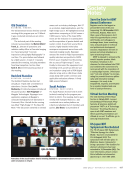
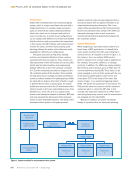
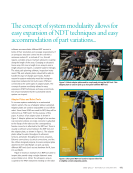
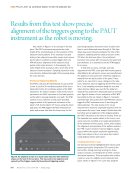
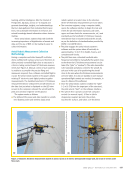
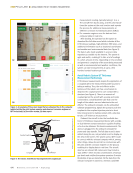
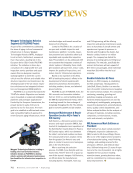
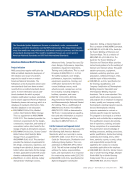
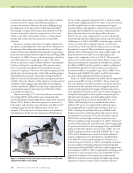
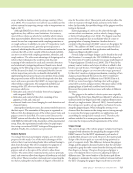
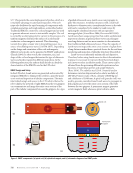
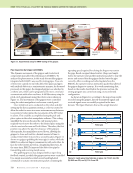
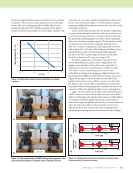
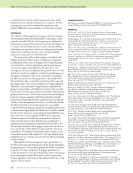
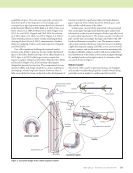
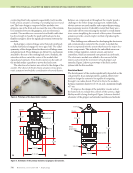
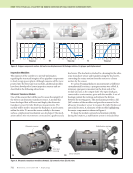
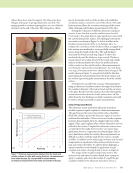
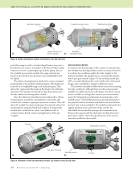
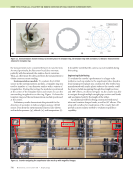
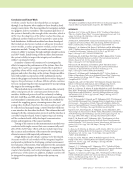
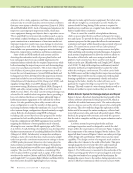
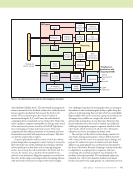
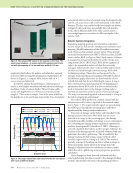
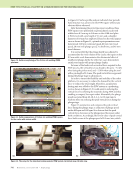
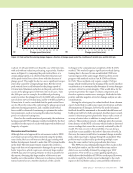
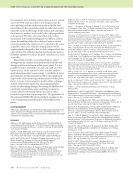
J U L Y 2 0 2 1 • M A T E R I A L S E V A L U A T I O N 681 software accommodates different NDT sensors in terms of their resolution and coverage requirements. If an aerospace structure comes into the cell with a minimum radius of 1 m instead of 5 m, this will require a smaller array to maintain ultrasonic coupling along the length of the array. Changing an ultrasonic linear array 100 mm in length to an array 64 mm in length should not require a complete system redesign. The robot path planning software, inspection instru- ment, PTM, and adapter plates should all be able to handle this type of change quite easily. Another reason for system modularity would be having two inspection instruments fed by the same PTM and connected to the same types of adapter plates. The concept of system modularity allows for easy expansion of NDT techniques and easy accommoda- tion of part variations that the automated robotic system can inspect. Adapter Plates and Robot Tools To increase system modularity in an automated robotic system, the use of adapter plates is adopted. Adapter plates are used to swap EOATs on and off the robot. Since these EOATs are used for NDT, they will be referred to as “NDT tools” for the purpose of this paper. A picture of an adapter plate is shown in Figure 2. Adapter plates can be thought of as mechan- ical connectors where one male connector is attached to the flange of the robot and the corresponding female connector is attached to the NDT tool. There is usually a collision sensor between the NDT tool and the adapter plate, as shown in Figure 2. The adapter plates allow for water throughput to ultrasonic sensors, pneumatic throughput to linear actuators, Ethernet connections, electrical connections, and the like. When designed properly, the same adapter plate attached to the robot flange can pick up many different NDT tools (such as test hardware for IR, laser UT, and PAUT). Figure 3 shows an example of an NDT tool used to inspect skin panels using a single ultrasonic array sensor (Fetzer et al. 2014). The ultrasonic array is coupled to the PAUT instrument residing on the robot Collision sensor Water and pneumatic ports Figure 2. Robot adapter plate used to couple and pick up the NDT tool. This adapter plate is used to pick up a skin panel stiffener NDT tool. Collision sensor Linear actuator Ultrasonic array probe Figure 3. Skin panel NDT tool used to inspect either flat or slightly curved composite panels. The concept of system modularity allows for easy expansion of NDT techniques and easy accommodation of part variations...

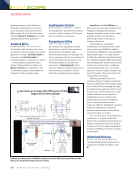
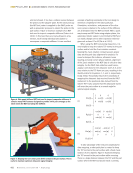
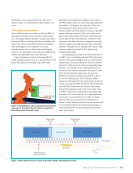
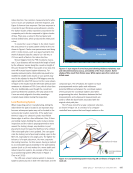
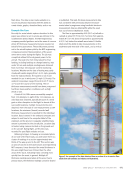
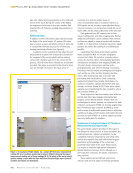
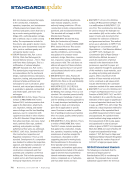
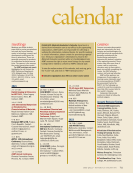
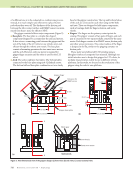
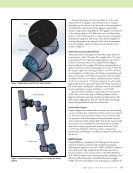
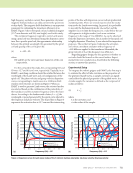
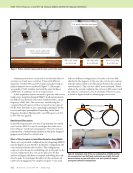
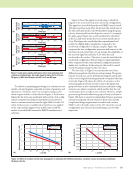
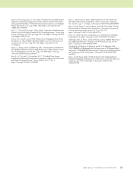
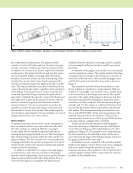
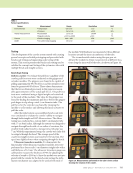
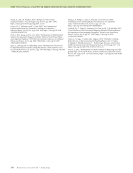
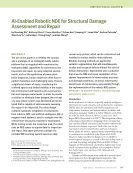
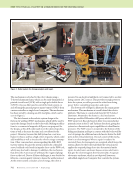
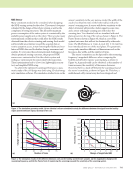
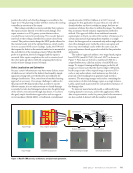
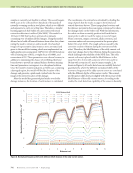
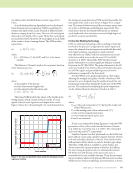
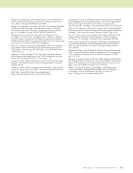
682 M A T E R I A L S E V A L U A T I O N • J U L Y 2 0 2 1 arm (not shown). It too has a collision sensor between the probe and the adapter plate. As the robot picks up this NDT tool, water is supplied to the PAUT probe as well as pneumatic pressure to extend the probe to the part surface. Figure 4 shows an example of an NDT tool used to inspect composite stiffeners (Fetzer et al. 2019). In this tool, there are many ultrasonic array sensors, each having individual articulation to encompass a composite stiffener. It is an excellent example of putting complexity in the tool design to minimize complexity for the robot path plan. Orientation, articulation, and pressure of the ultra- sonic sensors relative to the surface of the stiffeners are all designed into the NDT tool itself. With a quick way to swap out NDT tools using adapter plates, the automated robotic system is not limited to PAUT and can easily change over to other inspection technolo- gies such as laser UT or IR (Tat et al. 2017). When using the NDT tools during inspection, it is very helpful to keep the robot’s TCP normal to the part surface and to hold the Z-axis rotation constant. Keeping the Z-axis rotation constant assures proper data stitching and data alignment for analysis. For some techniques (for instance, ultrasonic beam steering and eddy current phase rotation), alignment of the Z-axis rotation to the NDT data is critical to data integrity. For the PAUT data collection used herein, angular corrections for the ultrasonic tool’s X, Y, and Z axes relative to the TCP frame are zero, resulting in the identity matrix for Equations 1, 2, and 3, respectively (Craig 2004). This greatly reduces the complexity of mapping the ultrasonic data received from the PAUT instrument to the positional data derived from the robot’s TCP. It also assures that the ultrasound waves will enter the part surface at a normal angle for optimal signal integrity. (1) (2) (3) To take advantage of the reduced complexity for data mapping, a robot path plan is created to keep the TCP normal to the part surface with a fixed Z-axis rotation of zero degrees. Figure 5 illustrates keeping the TCP normal to the part surface while scanning. There is a large distance between the TCP and the part surface where the NDT tool would reside. Currently, Rx(’) = 1 0 0 0 cos(’) &sin(’) 0 sin(’) cos(’) % $ # # # " ! Rx 0) ( = I Ry(’) = cos(’) 0 sin(’) 0 1 0 &sin(’) 0 cos(’) % $ # # # " ! Ry 0) ( = I Rz(’) = cos(’) &sin(’) 0 sin(’) cos(’) 0 0 0 1 % $ # # # " ! Rz 0) ( = I ME FEATURE w automated robotic systems for aerospace ndt Figure 4. Skin panel stiffener NDT tool used to inspect composite stiffeners. It contains many PAUT sensors designed to provide 100% part coverage as the robot moves the NDT tool along the stiffener. Figure 5. Keeping the tool center point (TCP) normal to the part surface. This is useful to maintain optimum ultrasonic signal integrity.
ASNT grants non-exclusive, non-transferable license of this material to  .
All rights reserved. © ASNT 2026. To report unauthorized use, contact: customersupport@asnt.org