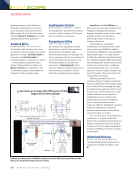
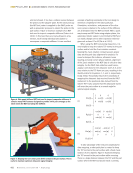
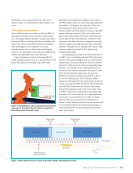
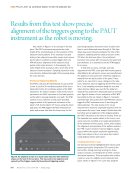
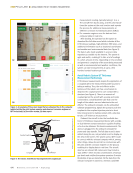
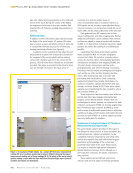
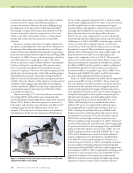
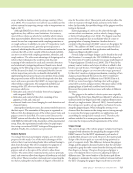
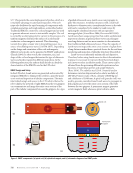
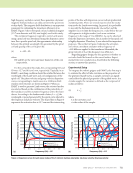
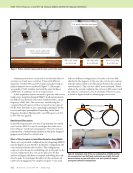
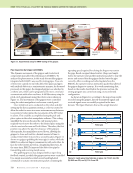
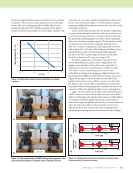
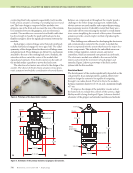
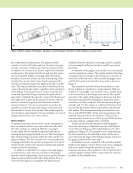
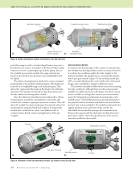
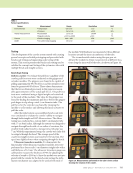
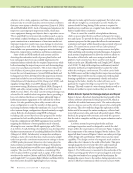
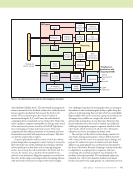
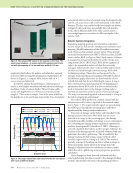
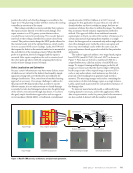
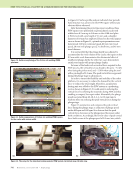
J U L Y 2 0 2 1 • M A T E R I A L S E V A L U A T I O N 683 this distance is not represented in the 2D C-scan system output, so a translation for the Z offset is not used. PAUT Inspection Instrument Phased linear arrays are heavily used for the NDT of aerospace composite parts. Benefits include resolu- tion, sensitivity, balance along the crystal, and inspec- tion speed. When combined with the articulation and speed of a robot, the benefits of both technologies offer advantages for the inspection of curved aerospace parts such as skin panels and fuselage sections. One advantage is the reduced complexity of motion path planning in the index direction. Figure 6 illustrates a robot performing NDT of a small composite panel. There is a raster pattern on the panel indicating the robot path plan, which was generated by the simulation software. The output of the PAUT system will be a C-scan that maps ultrasonic data within a 2D display. To create the C-scan, the robot moves the linear array sensor in the scan direction while collecting ultrasonic data at a predeter- mined sampling resolution. At the end of the scan path in the raster pattern, the robot moves the array up the panel in the index direction. During the next scan pass, the robot returns in a negative scan path direction, again collecting ultrasonic data. This raster pattern is repeated for the majority of the panel. Edge scanning might be needed to fill in gaps along irregular panel edges. Local positional accuracy in the index direction of an NDT C-scan is established by the PAUT instrument and the linear array. Variables such as element pitch, element step, and array offsets are used to calculate where the ultrasonic focal points are along the index direction. For example, if the center spacing of one element to the adjacent element in the array is 2 mm pitch and the element step is two, the spacing between the ultrasonic focal points will be 2 mm × 2 or 4 mm (Tumsys et al. 2014 Olympus 2004). Ultrasonic responses from the focal points are placed in the C-scan by the PAUT instrument. This is repeated until the PAUT instrument has electronically swept through the elements used in the linear array. Since the PAUT instrument is essentially scanning through the array in the index direction, the robot needs only to provide a course index move to align the linear array for the next scan pass. This is illustrated in Figure 7, which shows an index move over a part held in a horizontal position. The index move includes a small overlap of the array to properly align the ultra- sonic focal points. Index direction Scan direction Figure 6. Illustrating the robot scan pattern using a linear array sensor. Scan and index directions are typical for the creation of an ultrasonic C-scan. Robot index move 1 Linear array Anomaly X Y Z Ultrasonic focal point resolution Part surface Linear array Linear array Robot index move 2 Figure 7. Robot index moves for a linear array sensor along a horizontal part surface.

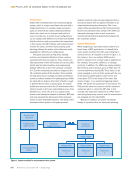
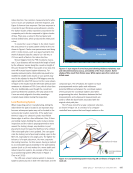
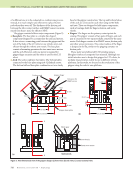
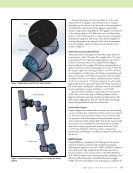
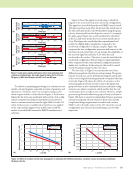
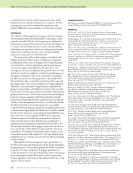
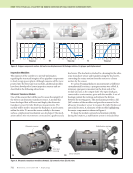
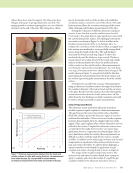
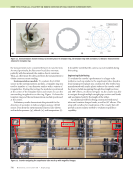
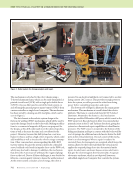
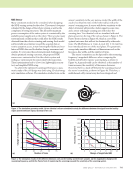
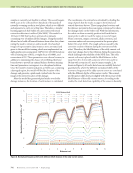
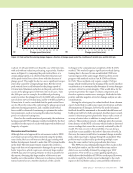
684 M A T E R I A L S E V A L U A T I O N • J U L Y 2 0 2 1 Also shown in Figure 7 is an anomaly in the test piece. The PAUT instrument represents the index length of the anomaly based on the resolution of the ultrasonic beam patterns. If the anomaly is located between two adjacent scan paths, proper index moves by the robot in addition to proper triggers from the PTM will assure alignment of the ultrasonic focal points in the index direction. In this example, the index length of the anomaly is six to seven hits of the ultrasonic beam resolution. Sampling resolution in the scan direction defines the length of the anomaly along the scan direction. Positional Triggering Module The PTM is critical to the dimensional accuracy of the C-scan. It ties the 3D coordinate system of the articu- lated robot to the 2D coordinate system of the PAUT instrument. The system designer must decide how to synchronize the PAUT instrument to the robot position as the robot is moving along the scan path. The PTM used for C-scan collection in this paper provided triggers relative to the positional movement of the robot’s TCP. As the robot’s TCP moves along the robot path plan, the PTM triggers the PAUT instrument to pulse and receive data from the linear array. As the part being inspected becomes thicker, it takes more time to send ultrasound waves through it. This time delay may cause hysteresis between the time of the ultrasonic sampling and the physical location of the TCP when the data was taken. Since hysteresis becomes more severe with increased scan speed and part thickness, it is essential to test the PTM triggers for accuracy. To help test accuracy, coverage, and data alignment of the PTM, a test part with known patterns detectable by the ultrasonic sensor was manufactured. The patterns in the panel were created by milling out material from the back surface of the panel. These patterns are expected to cause changes in the ultra- sonic response. External triggering by the PTM was set for a 2 mm sampling resolution along the scan and index direction. Water was used for the delay line material that couples the ultrasound waves to the test part. Figure 8 shows a C-scan created by a PAUT NDT tool similar to the one shown in Figure 3. Transistor- transistor-logic (TTL) pulses from the PTM were used to trigger the PAUT instrument every 2 mm along the robot path plan. The data shown in the C-scan measured the ultrasonic amplitude response from the array sensor for every 2 mm sample. Results from this test show precise alignment of the triggers going to the PAUT instrument as the robot is moving. There are five separate scan passes shown in the C-scan, and every scan pass recorded an accurate representation of the symmetry of the squares, circles, and triangles. The alignment and symmetry of the patterns assured the PTM created consistent external triggers equally spaced within the system resolution requirements. Edge scans shown in the C-scan were also created using diagonal robotic path plans. Creating the Final C-scan The previous sections highlighted three robotic path planning principles: keeping the TCP normal to the part surface during scanning keeping the Z-axis rotation constant and keeping the Z offset constant during the inspection. These principles were used to create a C-scan of a slightly curved composite test panel, shown in Figure 9. The curve was along the ME FEATURE w automated robotic systems for aerospace ndt Results from this test show precise alignment of the triggers going to the PAUT instrument as the robot is moving. Figure 8. An amplitude C-scan of an acrylic glass test piece with milled-out shapes on the back of the test piece. This was used to test alignment and symmetry of the triggers created by the positional triggering module.
ASNT grants non-exclusive, non-transferable license of this material to  .
All rights reserved. © ASNT 2026. To report unauthorized use, contact: customersupport@asnt.org