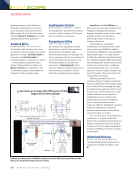
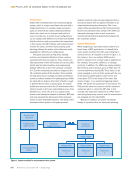
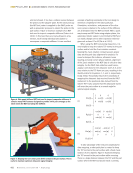
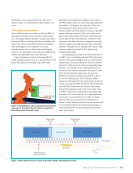
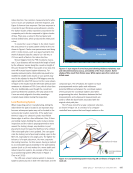
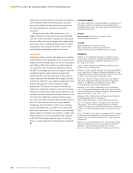
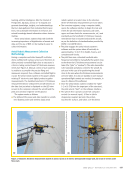
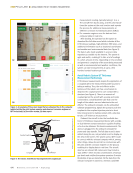
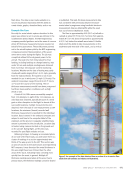
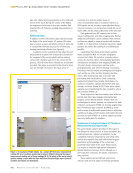
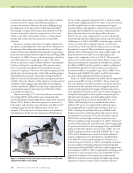
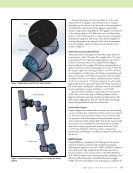
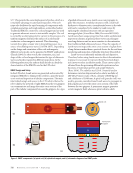
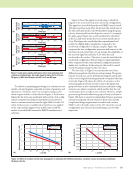
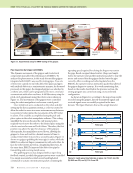
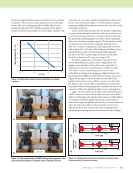
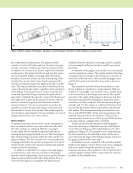
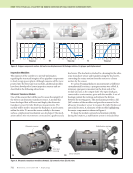
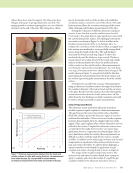
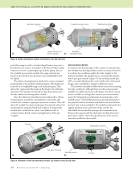
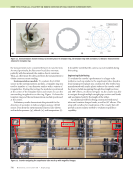
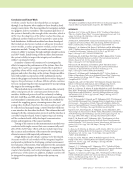
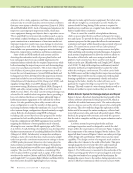
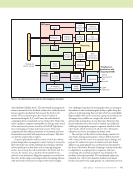
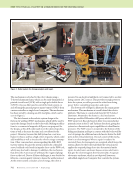
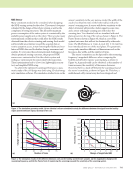
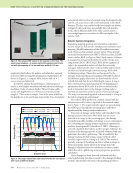
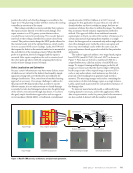
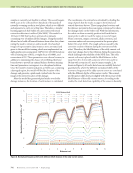
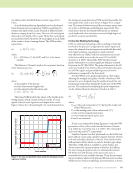
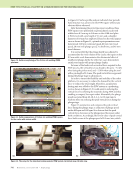
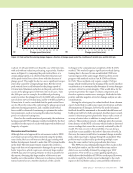
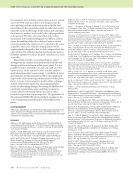
J U L Y 2 0 2 1 • M A T E R I A L S E V A L U A T I O N 685 index direction. Two common measurements for ultra- sonic C-scans are amplitude and time response, and Figure 9 shows a time response. The time response is converted to part thickness using ultrasonic velocity. The darker shades of blue represent areas where the composite part is thicker compared to lighter shades of blue. There was a cutout in this test panel and several drilled holes, which produced the white pixel colors. To create the C-scan in Figure 9, the robot moved the array sensor in a raster pattern similar to the one shown in Figure 6. Twelve scan passes were used along with 11 index moves, each scan pass having 66 mm worth of ultrasonic data for a total of 12 × 66 mm, or 792 mm worth of data in the index direction. Should triggers from the PTM module be inaccu- rate, C-scan distances will not match the length of travel by the ultrasonic sensor along the curved arc length of the part. Should the PTM be inaccurate or too slow, this error will increase beyond system tolerances. For severely contoured parts, robot paths may need to be modified to smaller index moves or scan speeds may need to be adjusted to keep the PTM triggers correctly aligned with the robot TCP moves. For the C-scan shown in Figure 9, the results show the left index (vertical) ruler measures at a distance of 790.5 mm, which is less than 2% error. Additionally, even though the curved test panel had thickness variations, the ramp areas in the C-scan are nicely aligned in the data, revealing a constant Z-axis rotation during the inspection. Local Positioning System When inspecting parts in manufacturing, telling the robot where the part is located is an important step because subsequent parts may not be located in the same precise location every time. If the parts have trimmed edges, the ultrasonic probe must follow these edges to within a few millimeters. Also, if there are tooling clamps holding the parts in place during inspection and the robot is preprogrammed to move around the tooling clamps, any deviation in part placement would increase the likelihood of a collision if the robot path plan is not updated. One can appre- ciate the tooling cost of precisely locating a part in the NDT cell, especially for very large parts. The tighter the tolerance is for part placement, the more expensive the tooling becomes. For this reason, having a method to accommodate typical variability in the part loading system (such as 10 mm) makes for a more stable and robust inspection system. An example of this is the local positioning system (LPS) shown in Figure 1 (Troy et al. 2015). The LPS uses a laser/camera system to measure target locations placed on both the robot base and the composite part. The LPS allows the system to reuse preprogrammed motion paths and addresses potential differences between the coordinate system of the part and the coordinate system used when programming the robot. Deviations between the first measurements and subsequent measurements are used to offset the base frame associated with the original robot path plan. The LPS was tested for a large composite structure, as shown in Figure 10. It consisted of a computer- controlled laser system that read target markers on the 6.5 mm thick 6.5 mm thick 14.5 mm thick Ramp area Ramp area Figure 9. C-scan output of curved test panel showing thickness variations, scan and index dimensional accuracy, and stability of the Z-axis rotation. Darker shades of blue result from thicker areas. White regions were from cutout and drilled areas. Target markers for structure Target markers for robot Local positioning system Z X Y Figure 10. Local positioning system measuring 3D coordinates of targets in the work cell.

686 M A T E R I A L S E V A L U A T I O N • J U L Y 2 0 2 1 robot and composite structure. Positional coordinates were established with the first composite structure and used to offset the robot base frame attached to the robot path plan for subsequent composite structures. During testing of the LPS’s performance, the large composite structure was moved approximately 150 mm in the X direction to represent a subsequent structure. After shooting the targets and updating the base frame of the existing robot path plan, the robot start position was corrected to within 2 mm on the representative subsequent composite structure. Conclusion Automated robotic systems offer significant versatility and flexibility for NDT applications. The inspection of a large variety of aerospace parts can be accommodated with different NDT tools, which are quickly swapped on and off the robot. It would be difficult to perform the NDT of a fuselage structure or an engine cowl with a traditional gantry system without designing the system specific to the part structure. In this paper, a system approach was provided with design principles to tailor the robot for C-scan output, irrespective of the specific part structure. These principles include keeping the TCP normal to the part surface during inspection, using linear arrays for electronic scanning, keeping a constant skew angle during inspection, and creating instrument sampling resolution relative to the TCP movement. Although examples of linear arrays were discussed, NDT methods and techniques such as laser UT or IR could also be used. System module testing was demonstrated to verify C-scan coverage, C-scan pixel alignment, and alignment of robot path plan to part placement. In this manner, the automated robotic system is proving to be versatile, scalable, and flexible. Since the use of automated robotic systems in the NDT technology domain is now in its infancy, there is a huge potential for advancement and growth. w ACKNOWLEDGMENTS The author would like to acknowledge the contributions to this paper and the technologies herein by Mike Bloom, Christopher Brown, Hien Bui, Justin Serrill, Kareem Shehab, Hong Tat, and Jim Troy. AUTHOR Barry A. Fetzer: The Boeing Co., Renton, WA barry.a.fetzer@boeing.com CITATION Materials Evaluation 79 (7): 678–686 https://doi.org/10.32548/2021.me-04224 ©2021 American Society for Nondestructive Testing REFERENCES Brekow, G., H.-J. Montag, R. Boehm, D. Brackrock, and J. Kitze, 2014, “Ultrasonic Testing Using Matrix Arrays for Discontinuity Detection,” Materials Evaluation, Vol. 72, No. 9, pp. 1131–1136 Craig, J., 2004, Introduction to Robotics: Mechanics and Control, 3rd ed., Prentice Hall Fetzer, B., J. Serrill, and K. Shehab, 2019, Automated Ultra- sonic Inspection of Elongated Composite Members Using Single-Pass Robotic System, US Patent 20200393418, filed 11 June 2019, and issued 17 December 2020 Fetzer, B., C. Brown, K. Bray, M. Duncan, and S. Walton, 2014, Non-Destructive Ultrasonic Inspection Apparatus, Systems, and Methods, US Patent 9,664,652, filed 30 October 2014, and issued 30 May 2017 Munikoti, V., M. Pohl, D. Sabrautzki, and D. Tscharntke, 2012, “Discontinuity Rating Using Distance Gain Size Tech- nique for Phased Array Ultrasonic Testing,” Materials Evalu- ation, Vol. 70, No. 12, pp. 1365–1371 Olympus, 2004, “Introduction to Phased Array Ultrasonic Technology Applications,” available at https://www.olympus-ims.com/en/books/pa/pa-intro Tat, H., W. Tapia, B. Fetzer, G. Georgeson, M. Freet, and J. Thompson, 2017, Thermography Inspection for Near- Surface Inconsistencies of Composite Structures, US Patent 10,677,715, filed 22 November 2017, and issued 9 June 2020 Troy, J., B. Fetzer, S. Lea, and G. Georgeson, 2015, Location Calibration for Automated Production Manufacturing, US Patent 9,740,191, filed 12 February 2015, and issued 22 August 2017 Tumsys, O., and E. Jasiuniene, 2014, “The Focusing of the Ultrasonic Phased Array in the Case of Non-Contact NDT Methods,” Electronic Measurements, Vol. 20, No. 3, pp. 44–47, https://doi.org/10.5755/j01.eee.20.3.3638 ME FEATURE w automated robotic systems for aerospace ndt
ASNT grants non-exclusive, non-transferable license of this material to  .
All rights reserved. © ASNT 2026. To report unauthorized use, contact: customersupport@asnt.org