DANIEL HOKE
Corporate Quality Assurance Leader, INVISTA
SILSBEE, TX
HOW DID YOU FIRST BECOME
INVOLVED IN NDT?
Both of my parents were already
involved in NDT. When I turned
18, they sent me to a 40-hour radi-
ation safety training. Next thing I
know, I’m in the back of an X-ray
room—and I’ve been doing it ever
since.
COULD YOU DESCRIBE
YOUR CURRENT ROLE?
I’m a corporate quality assurance
leader for Invista, which is on
the owner-user side of things. I
review procedures, reports, film
quality, and make sure every-
thing’s successful with a project.
We deal with probably six inspec-
tion companies during a project,
ranging from Texas to Canada
and around the world.
OUR READERS MIGHT BE FAMILIAR
WITH YOUR NDT-RELATED
3D PRINTING PROJECTS,
WHICH YOU POST ABOUT ON
LINKEDIN. HOW DID YOU GET
STARTED WITH THOSE?
A few years back, I started taking
drafting classes on my own time.
Once you get into drafting, it’s
not too difficult to make a 3D
model. I thought it would be a
game-changer to have models
of the plants. Eventually, I started
designing my own stuff—figures,
key chains, USB drives, even a giant
cup shaped like an X-ray camera.
3D printing is cheap. It’s terrifying
to some people because they
think they can mess it up, but it’s
gotten really user-friendly. If you
want to learn, I recommend a site
called Udemy. Along the way, you
learn engineering techniques and
the principles behind them. And
then you get into different mate-
rial properties—some are better
for tensile strength, others for
heat—which connects back to NDT.
Understanding why we use carbon
steel, stainless steel, or Inconel 800
starts to make more sense.
YOU’VE ALSO BEEN CREATING
VIRTUAL REALITY EXPERIENCES
FOR NDT. CAN YOU TELL
US MORE ABOUT THAT?
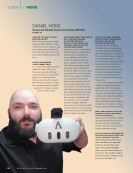
After learning 3D modeling, I
stumbled upon a course where I
can take my 3D model and learn
how to manipulate it in a 3D space.
You can build a heat exchanger in
a 3D modeling program, drop it
into virtual reality, and train people
to take it apart and teach them
how the heat exchanger works
and get hands-on experience. It’s
not going to replace real experi-
ence, but it can prepare you for
what you may see and how every-
thing works.
You can be certified in any NDT
method and still not have seen
everything. With 3D modeling,
teaching, and now laser 3D scan-
ning, you can take these complex
models and include these defects
they haven’t seen. You can see
what methods are good for which
indications, which parts, and learn
how to apply techniques correctly.
WHAT ADVICE WOULD YOU GIVE
SOMEBODY WHO’S INTERESTED
IN A CAREER IN NDT?
Apply to all the inspection compa-
nies and take the first job you can
get. Stick around. Find a good
mentor. Learn as much as you can.
Listen more than you talk.
DO YOU HAVE ANY PERSONAL OR
PROFESSIONAL MILESTONES THAT
YOU’RE WORKING TOWARD?
Virtual reality training that’s acces-
sible, affordable, and retainable.
Education shouldn’t be out of
reach. It should be affordable,
where you don’t have to take out
a loan for it. You should be able to
still work and learn what you need
to do out in the field.
SCOPE
|
ATWORK
66
M AT E R I A L S E V A L U AT I O N • M AY 2 0 2 5
Corporate Quality Assurance Leader, INVISTA
SILSBEE, TX
HOW DID YOU FIRST BECOME
INVOLVED IN NDT?
Both of my parents were already
involved in NDT. When I turned
18, they sent me to a 40-hour radi-
ation safety training. Next thing I
know, I’m in the back of an X-ray
room—and I’ve been doing it ever
since.
COULD YOU DESCRIBE
YOUR CURRENT ROLE?
I’m a corporate quality assurance
leader for Invista, which is on
the owner-user side of things. I
review procedures, reports, film
quality, and make sure every-
thing’s successful with a project.
We deal with probably six inspec-
tion companies during a project,
ranging from Texas to Canada
and around the world.
OUR READERS MIGHT BE FAMILIAR
WITH YOUR NDT-RELATED
3D PRINTING PROJECTS,
WHICH YOU POST ABOUT ON
LINKEDIN. HOW DID YOU GET
STARTED WITH THOSE?
A few years back, I started taking
drafting classes on my own time.
Once you get into drafting, it’s
not too difficult to make a 3D
model. I thought it would be a
game-changer to have models
of the plants. Eventually, I started
designing my own stuff—figures,
key chains, USB drives, even a giant
cup shaped like an X-ray camera.
3D printing is cheap. It’s terrifying
to some people because they
think they can mess it up, but it’s
gotten really user-friendly. If you
want to learn, I recommend a site
called Udemy. Along the way, you
learn engineering techniques and
the principles behind them. And
then you get into different mate-
rial properties—some are better
for tensile strength, others for
heat—which connects back to NDT.
Understanding why we use carbon
steel, stainless steel, or Inconel 800
starts to make more sense.
YOU’VE ALSO BEEN CREATING
VIRTUAL REALITY EXPERIENCES
FOR NDT. CAN YOU TELL
US MORE ABOUT THAT?
After learning 3D modeling, I
stumbled upon a course where I
can take my 3D model and learn
how to manipulate it in a 3D space.
You can build a heat exchanger in
a 3D modeling program, drop it
into virtual reality, and train people
to take it apart and teach them
how the heat exchanger works
and get hands-on experience. It’s
not going to replace real experi-
ence, but it can prepare you for
what you may see and how every-
thing works.
You can be certified in any NDT
method and still not have seen
everything. With 3D modeling,
teaching, and now laser 3D scan-
ning, you can take these complex
models and include these defects
they haven’t seen. You can see
what methods are good for which
indications, which parts, and learn
how to apply techniques correctly.
WHAT ADVICE WOULD YOU GIVE
SOMEBODY WHO’S INTERESTED
IN A CAREER IN NDT?
Apply to all the inspection compa-
nies and take the first job you can
get. Stick around. Find a good
mentor. Learn as much as you can.
Listen more than you talk.
DO YOU HAVE ANY PERSONAL OR
PROFESSIONAL MILESTONES THAT
YOU’RE WORKING TOWARD?
Virtual reality training that’s acces-
sible, affordable, and retainable.
Education shouldn’t be out of
reach. It should be affordable,
where you don’t have to take out
a loan for it. You should be able to
still work and learn what you need
to do out in the field.
SCOPE
|
ATWORK
66
M AT E R I A L S E V A L U AT I O N • M AY 2 0 2 5