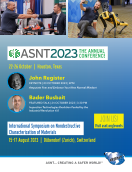
ASNT… Creating a Safer World!® Grow your knowledge. Grow your career. KNOWLEDGE TO GROW PROFESSIONALLY ASNT.ORG/EDUCATION ON DEMAND Access video recordings from previous conferences, featured speakers, ASNT webinars, and so much more. REFRESHER COURSES Let ASNT help you prepare for your Level III exam. Refresher courses are structured around the same body of knowledge as the ASNT NDT Level III exams. See the website for the course schedule. WEBINARS Whether you’re an entry-level technician wanting to expand your knowledge of NDT or an experienced manager wishing to stay abreast of NDT developments, you’ll want to tune into ASNT Education webinars. Explore a variety of topics ranging from the latest in cutting-edge NDT techniques to expert advice for hands- on applications to leadership skills and management of NDT programs. 2307 ME July dup.indd 9 6/19/23 3:41 PM

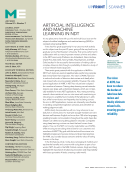
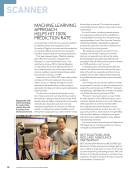
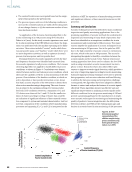
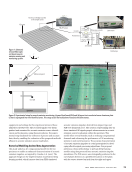
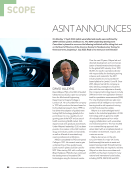
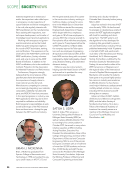
MACHINE LEARNING APPROACH HELPS HIT 100% PREDICTION RATE A research team led by Tao Sun, associate professor of materials science and engineering at the University of Virginia, has made new discoveries that can expand additive manufacturing in aerospace and other industries that rely on strong metal parts. Their peer-reviewed paper, “Machine Learning Aided Real-Time Detection of Keyhole Pore Generation in Laser Powder Bed Fusion,” was published 6 January 2023 in Science Magazine and addresses the issue of detecting the forma- tion of keyhole pores, one of the major defects in a common additive manufacturing technique called laser powder bed fusion, or LPBF. Introduced in the 1990s, LPBF uses metal powder and lasers to 3D print metal parts. But porosity defects remain a challenge for fatigue-sensitive applications like aircraft wings. Some porosity is associated with deep and narrow vapor depressions, called keyholes. The formation and size of the keyhole is a func- tion of laser power and scanning velocity, as well as the material’s capacity to absorb laser energy. If the keyhole walls are stable, it enhances the surrounding material’s laser absorption and improves laser manufacturing efficiency. If, however, the walls are wobbly or collapse, the material solidifies around the keyhole, trapping the air pocket inside the newly formed layer of material. This makes the material more brittle and more likely to crack under environ- mental stress. Sun and his team, including materials science and engineering professor Anthony Rollett from Carnegie Mellon University and mechanical engi- neering professor Lianyi Chen from the University of Wisconsin-Madison, developed an approach to detect the exact moment when a keyhole pore forms during the printing process. “By integrating operando synchrotron X-ray imaging, near-infrared imaging, and machine learning, our approach can capture the unique thermal signature associated with keyhole pore generation with sub-millisecond temporal resolution and 100% prediction rate,” Sun said. In developing their real-time keyhole detection method, the researchers also advanced the way a state-of-the-art tool—operando synchrotron X-ray imaging—can be used. Utilizing machine learning, they additionally discovered two modes of keyhole oscillation. “Our findings not only advance additive manufac- turing research, but they can also practically serve to expand the commercial use of LPBF for metal parts manufacturing,” said Rollett, who is also the co-director of the Next Manufacturing Center at CMU. “Porosity in metal parts remains a major hurdle for wider adoption of the LPBF technique in some industries. Keyhole porosity is the most challenging defect type when it comes to real-time detec- tion using lab-scale sensors because it occurs stochastically beneath the surface,” Sun said. “Our approach provides a viable solution for high-fidelity, high-resolution detection of keyhole pore gener- ation that can be readily applied in many additive manufacturing scenarios.” The team’s research is funded by the Department of Energy’s Kansas City National Security Campus managed by Honeywell FM&T. NDT SOLUTIONS AND NDE LABS ANNOUNCE PARTNERSHIP NDT Solutions (New Richmond, WI) and NDE Labs (Benbrook, TX) have announced a strategic partner- ship to deliver a single point of contact for all nonde- structive engineering and testing services. With over 50 years of combined experience in nondestructive inspection, this alliance positions the two companies at the forefront of Industry 4.0. SCANNER Zhongshu Ren (left) and Tao Sun display the results of their research. Ren is the first author of the Science journal article. 10 M A T E R I A L S E V A L U A T I O N • J U L Y 2 0 2 3 2307 ME July dup.indd 10 6/19/23 3:41 PM PHOTO CREDIT: TOM COGILL FOR UVA ENGINEERING
ASNT grants non-exclusive, non-transferable license of this material to  .
All rights reserved. © ASNT 2026. To report unauthorized use, contact: customersupport@asnt.org