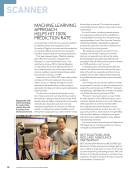
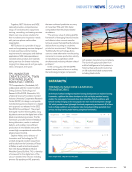
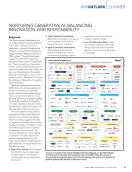
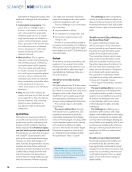
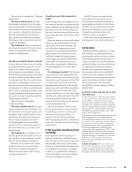
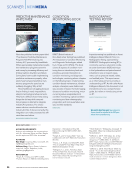
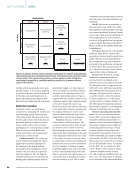
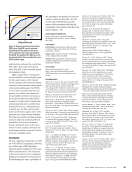
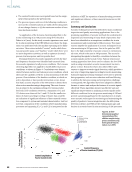
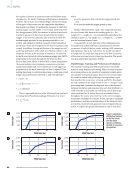
Together, NDT Solutions and NDE Labs will provide a comprehensive range of nondestructive equipment, training, consulting, and testing services. Clients can now access solutions for their nondestructive inspection needs with just one phone call to either organization. NDT Solutions is a provider of equip- ment and engineering services designed to meet exacting customer testing requirements for aerospace and defense applications. NDE Labs specializes in nondestructive product and materials testing services for diverse industries, ranging from deep-sea oil and gas explo- ration, aerospace, and space. TPI, WINDSTAR CREATE DIGITAL TWIN FOR WIND BLADE MANUFACTURING TPI Composites Inc. (Scottsdale, AZ) collaborated with the Center for Wind Energy Science, Technology and Research (WindSTAR, Alexandria, VA), a National Science Foundation–funded Industry-University Cooperative Research Center (IUCRC), to design a composite manufacturing process based on a digital twin approach as released in the 2022 WindSTAR Annual Report. The project leveraged machine learning (ML), using big data to serve as the digital twin of the blade manufacturing process. This ML framework provides real-time feedback during fabrication, results in reduced defects, and enables more efficient production of wind blades versus the current high computational costs of the physics-based models. Stephen Nolet, senior director of Innovation and Technology for TPI, worked alongside student researchers and faculty from the University of Texas at Dallas, as well as technical experts from Olin Epoxy (Midland, MI) and Westlake Epoxy (Stafford, TX), to develop a framework for the digital twin of the vacuum-assisted resin infusion molding process. By applying an ML approach, the team achieved predictive accuracy of more than 95% with 100× faster computation than the physics-based simulations. “The primary value of utilizing [an] ML framework is leveraging historical results and data to inform current manufac- turing at a pace that significantly reduces defects from occurring in a real-time production environment,” Nolet explains. “Additionally, this technology allows users to create alternative manufacturing scenarios to increase production velocity in manufacturing operations while simultaneously reducing infusion-related problems.” In the coming year, the WindSTAR research team plans to focus on scaling the technology to larger components with greater manufacturing complexity. The work will apply tools taken from artificial intelligence to find patterns in historical data and predict outcomes on full-scale wind blade components including blade shells. INDUSTRYNEWS |SCANNER DATAFACTS |TRENDS IN MACHINE LEARNING FRAMEWORKS At the heart of artificial intelligence/machine learning developments are machine learning frameworks, a platform that allows developers to build and deploy machine learning models. The most popular frameworks have been Tensorflow, PyTorch, and Keras, with PyTorch recently emerging as the most popular. One more recent development is Google JAX, which provides a more lightweight functional programming environment. All of these tools are freely available to use (companies make money by providing specialized cloud services and deep learning model training using these frameworks). Source: Google Trends, 1 May 2016 to 25 May 2023. J U L Y 2 0 2 3 • M A T E R I A L S E V A L U A T I O N 11 2307 ME July dup.indd 11 6/19/23 3:41 PM

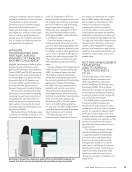
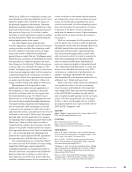
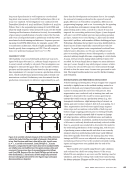
TPI is an inaugural member of the WindSTAR IUCRC Industrial Advisory Board and is looking forward to contrib- uting to more exciting projects as it enters its ninth year of partnership in 2023. The WindSTAR Center is operated jointly by the University of Massachusetts Lowell and the University of Texas Dallas and supported by 18 industry members, including TPI. NEW ASTM STANDARD PRACTICE FOR MATRIX ARRAY UT In response to the growing demand for matrix array ultrasonic testing (MAUT) standards, ASTM International has recently published E3370-22: Standard Practice for Matrix Array Ultrasonic Testing of Composites, Sandwich Core Constructions, and Metals used in Aerospace Applications. The stan- dard has its origins in ASTM E2580-17: Standard Practice for Ultrasonic Testing of Flat Panel Composites and Sandwich Core Materials used in Aerospace Applications, which is intended for use with single-element transducers. The new E3370-22 is designed specifically for use with non-phased, matrix array trans- ducers. Such transducers operate with an isotropic matrix array of elements with a small pitch and high count (e.g., 128 × 128 elements at 0.25 mm pitch), oper- ating in straight beam (i.e., 0°) mode. As such, they are unique in being capable of live C-scan generation. As it sits between conventional straight beam ultrasonic testing and phased array, MAUT has previously been under- represented by international standards. Dolphitech Defense CEO Jason Smith commented, “We are delighted by the publication of this standard by ASTM International. It provides our customers with a great starting point for building their own inspection procedures, through detailing all aspects that need to be considered. This document will also pave the way for further matrix array UT stan- dards, with ASME and ISO standards already in the pipeline.” The standard itself covers two modes of operation, Test Procedure A: Pulse Echo, and Test Procedure B: Through Transmission. In addition, general consid- erations such as quality assurance provi- sions, test apparatus, physical reference standards, and reporting requirements are all discussed in detail. For more infor- mation, visit astm.org. AVONIX IMAGING EXPECTED TO BECOME SUBSIDIARY OF NIKON AMERICAS Two companies in the industrial X-ray and computed tomography (CT) market have agreed to further their collabora- tion in providing innovative X-ray and CT systems and services. Nikon Americas Inc. (NAI) (Melville, NY), a subsidiary of Nikon Corp., has executed an equity purchase agreement with Avonix Imaging LLC (Maple Grove, MN) that will make Avonix a subsidiary of NAI, subject to applicable regulatory clearances and other customary closing conditions. The two organizations have worked together since 2015 to bring to market configurable X-ray and CT systems for companies needing nondestructive inspection of their products. The unique strengths of each company comple- ment the other to deliver X-ray solutions tailored to customers’ specific inspection needs. “Nikon’s proprietary rotating target X-ray sources and proven software combined with our expertise in the design of configurable systems, controls, and product handling create a custom- ized experience for our clients, which can contribute to their efficiency and profit- ability,” said Brian Ruether of Avonix. Together, the companies will further advance the development of new prod- ucts while enhancing their capabilities to support businesses in innovative indus- tries, such as automotive, medical device, and aerospace. SIEMENS, DELOITTE DEMONSTRATE INDUSTRY 4.0 INNOVATION VIA SMART FACTORY Siemens Digital Industries Software (Plano, TX) has announced the opening of eXplore Live at The Smart Factory @Wichita, an experience center convened by Deloitte (New York, NY) that is said to marry an ecosystem of world-leading organizations with busi- ness strategy and cutting-edge tech- nology to demonstrate Industry 4.0 innovation. Located on Wichita State University’s Innovation Campus in Wichita, Kansas, The Smart Factory includes a fully operational production line and experiential labs for devel- oping and exploring the innovative capabilities of smart manufacturing. A founding member of The Smart Factory @Wichita along with Deloitte and other ecosystem members, Siemens developed the eXplore Live space as a 3000 foot2 area dedicated to hands-on learning opportunities for companies SCANNER |INDUSTRYNEWS The Smart Factory @Wichita, based at Wichita State University in Kansas. 12 M A T E R I A L S E V A L U A T I O N • J U L Y 2 0 2 3 2307 ME July dup.indd 12 6/19/23 3:41 PM PHOTO CREDIT: SIEMENS DIGITAL INDUSTRIES SOFTWARE, DELOITTE
ASNT grants non-exclusive, non-transferable license of this material to  .
All rights reserved. © ASNT 2026. To report unauthorized use, contact: customersupport@asnt.org