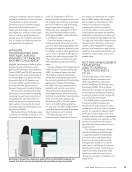
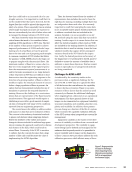
looking to modernize, reshore, localize, or regionalize operations in North America. The eXplore Live space will enable Siemens to expand customer engage- ments with a showcase focused on design and optimization using a closed- loop digital twin. It will also enable explo- ration of industry digital threads and provide space for innovation workshops and co-creation and help empower the next generation of engineers. WAYGATE TECHNOLOGIES AND PARTNERS AMONG WINNERS OF FARADAY BATTERY CHALLENGE Waygate Technologies, a Baker Hughes business (Huerth, Germany), and its partners, the UK Battery Industrialisation Centre (UKBIC) and PXL-ICE, are among the winners of the most recent round of the Faraday Battery Challenge funding competition led by UK Research and Innovation (UKRI), a public body spon- sored by the British Department for Business, Energy and Industrial Strategy. The consortium funding is for a feasi- bility study to look at ways of potentially increasing the yield and productivity of UK gigafactories with data based on advanced industrial computed tomog- raphy systems. If successful, this could eventually lead to the development of a digital twin at UKBIC. The Faraday Battery Challenge invests in research and facilities in the UK to drive the growth of a strong battery business in the UK. Established in 2017, the recently extended program aims to steer the development of battery technologies that are cost-effective, high performing, longer range, faster charging, long- lasting, safe, and sustainable. The total amount of this latest funding round is £27.6 million (US$34.7 million) allocated to 17 different projects. One of the largest challenges for scaling up battery cell production is the pace to achieve high-quality battery cell throughput to meet the demand for elec- tric vehicles, as well as other applications, such as marine, aerospace, off-highway vehicles, and static energy storage. The other is the ability to increase the yield while maintaining quality and limiting waste. Last year, Waygate Technologies signed a Memorandum of Understanding with UKBIC, the national battery industrial- ization facility, to look at developing a solution that could significantly improve the yield and productivity of future battery gigafactories. Waygate Technologies and UKBIC have also partnered on the availability and use of an open access and industrial X-ray computed tomog- raphy digital solution, which should also contribute to significantly reducing battery waste in future battery gigafactories. According to UKRI, a 1% yield improve- ment in a 20 GWh battery gigafactory can save over £21 million (US$26 million) a year and reduce the waste of raw mate- rials, including rare earth minerals. The feasibility approach in the awarded project is intended to lead to the creation of a framework for a digital twin of UKBIC battery cell samples. It is also to explore and leverage the effec- tiveness of computed tomography scanning as an advanced analytical tool. Quality defects could—should the project get the go-ahead—be identified, analyzed, and resolved much faster and more accurately through digital twinning. This approach will enable a faster process development in the factory and ensure greater quality. Waygate Technologies’ ambition is to leverage the data from the inspection processes across the life cycle of batteries, reduce waste, and ensure greater safety. NIST RISK MANAGEMENT FRAMEWORK AIMS TO IMPROVE TRUSTWORTHINESS OF AI The US Department of Commerce’s National Institute of Standards and Technology (NIST) has released its Artificial Intelligence Risk Management Framework (AI RMF 1.0), a guidance document for voluntary use by organiza- tions designing, developing, deploying, or using AI systems to help manage the many risks of AI technologies. The AI RMF follows a direction from Congress for NIST to develop the framework and was produced in close collaboration with the private and public sectors. It is intended to adapt to the AI landscape as technologies continue to develop, and to be used by organizations in varying degrees and capacities so that society can benefit from AI technolo- gies while also being protected from its potential harms. “This voluntary framework will help develop and deploy AI technologies in ways that enable the United States and other nations and organizations to enhance AI trustworthiness while managing risks based on our demo- cratic values,” said Deputy Commerce Secretary Don Graves. “It should accel- erate AI innovation and growth while advancing—rather than restricting or damaging—civil rights, civil liberties, and equity for all.” By creating a framework for a digital twin, quality defects can be identified, analyzed, and resolved much faster and more accurately than with any traditional inspection method. J U L Y 2 0 2 3 • M A T E R I A L S E V A L U A T I O N 13 2307 ME July dup.indd 13 6/19/23 3:41 PM CREDIT: WAYGATE TECHNOLOGIES

Compared with traditional software, AI poses a number of different risks. AI systems are trained on data that can change over time, sometimes signifi- cantly and unexpectedly, affecting the systems in ways that can be difficult to understand. These systems are also “socio-technical” in nature, meaning they are influenced by societal dynamics and human behavior. AI risks can emerge from the complex interplay of these technical and societal factors, affecting people’s lives in situations ranging from their experiences with online chatbots to the results of job and loan applications. The framework equips organizations to think about AI and risk differently. It promotes a change in institutional culture, encouraging organizations to approach AI with a new perspective—including how to think about, communicate, measure, and monitor AI risks and its potential positive and negative impacts. The AI RMF provides a flexible, struc- tured, and measurable process that will enable organizations to address AI risks. Following this process for managing AI risks can maximize the benefits of AI tech- nologies while reducing the likelihood of negative impacts to individuals, groups, communities, organizations, and society. The framework is part of NIST’s larger effort to cultivate trust in AI technolo- gies—necessary if the technology is to be accepted widely by society, according to Under Secretary for Standards and Technology and NIST Director Laurie E. Locascio. “The AI Risk Management Framework can help companies and other organiza- tions in any sector and any size to jump- start or enhance their AI risk management approaches,” Locascio said. “It offers a new way to integrate responsible practices and actionable guidance to operation- alize trustworthy and responsible AI. We expect the AI RMF to help drive develop- ment of best practices and standards.” The AI RMF is divided into two parts. The first part discusses how organiza- tions can frame the risks related to AI and outlines the characteristics of trustworthy AI systems. The second part, the core of the framework, describes four specific functions—govern, map, measure, and manage—to help organizations address the risks of AI systems in practice. These func- tions can be applied in context-specific use cases and at any stages of the AI life cycle. Working closely with the private and public sectors, NIST has been developing the AI RMF for 18 months. The docu- ment reflects about 400 sets of formal comments NIST received from more than 240 different organizations on draft versions of the framework. NIST released statements from some of the organiza- tions that have already committed to use or promote the framework. The agency also released a companion voluntary AI RMF Playbook, which suggests ways to navigate and use the framework. NIST plans to work with the AI community to update the framework peri- odically and welcomes suggestions for additions and improvements to the play- book at any time. An updated version of the playbook was released in spring 2023. In addition, NIST plans to launch a Trustworthy and Responsible AI Resource Center to help organizations put the AI RMF 1.0 into practice. The agency encourages organizations to develop and share profiles of how they would put it to use in their specific contexts. Submissions may be sent to AIFramework@nist.gov. NIST is committed to continuing its work with companies, civil society, govern- ment agencies, universities, and others to develop additional guidance. The agency issued a roadmap for that work. The framework is part of NIST’s broad and growing portfolio of AI-related work that includes fundamental and applied research along with a focus on measure- ment and evaluation, technical standards, and contributions to AI policy. SCANNER |INDUSTRYNEWS www. .com • 2000 ASME &RFT tubes in stock -Same day shipping • Custom calibration standards • Mock-up exchangers /tube testing bundles • EDM notches, holes and flaws • S • Spiral notches &tube expansions • Corrosion simulation 14 M A T E R I A L S E V A L U A T I O N • J U L Y 2 0 2 3 2307 ME July dup.indd 14 6/19/23 3:41 PM CREDIT: N. HANACEK/NIST
ASNT grants non-exclusive, non-transferable license of this material to  .
All rights reserved. © ASNT 2026. To report unauthorized use, contact: customersupport@asnt.org