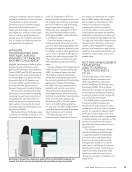
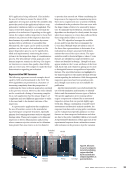
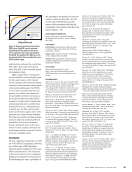
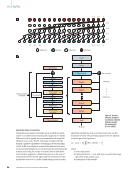
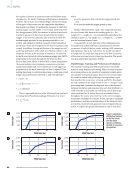
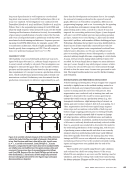
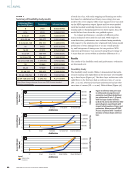
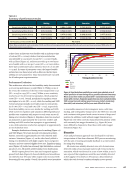
NDEOUTLOOK |SCANNER NURTURING GENERATIVE AI: BALANCING INNOVATION AND RESPONSIBILITY Background The authors started collaborating with an artificial intelligence (AI) agent (GPT-3) in April 2021. Their early work was published in Journal of Nondestructive Evaluation in August 20211, followed by couple of briefs in Materials Evaluation’s NDE Outlook2,3. Recently they began engagement with GPT-4, which has addressed several quirks of its predeces- sors. There is a spectrum of generative AI tools now accessible spreading across all forms of media—text, audio, video, and very soon 4D experiential. The market- place war is getting fierce, and so is the need to govern it. The figure4 shows how the landscape of generative AI is getting busier by the day. Within the nondestructive evaluation (NDE) sector, AI is already assisting with predictive maintenance, automated quality control, automatic defect recog- nition, and control of robotics in manu- facturing. While these examples highlight the potential benefits of AI integration in industry operations, they also empha- size the need to balance innovation with potential risks and governance issues. The “Vulnerable World Hypothesis,” proposed by Professor Nick Bostrom5 (Director, Future of Humanity Institute, Oxford University), suggests that there is a significant probability that our world may become highly vulnerable to certain future technologies, which could lead to catastrophic consequences. The scenarios highlight the need for global coordination and safety measures to prevent existential risks. AI risk and safety, when looked at using the hypoth- esis’ framework, can be classified in the following four ways: Ñ Type I (Easy Nukes): Technologies that could be easily weaponized and deployed by individuals or small groups, causing widespread destruction. Ñ Type II (Sensitive Innovations): Beneficial technologies that require strict regulation and control to prevent misuse or accidents. Ñ Type III (Gradually Destructive): Technologies that pose risks that accumulate over time and could lead to long-term harm or degradation of our environment, society, or global stability. Ñ Type IV (Unforeseen Risks): These are unknown risks associated with the development of new technolo- gies that we cannot currently predict or anticipate. This is just a snapshot of the artificial intelligence (AI) tools landscape as captured by Nahigian and Fonseca on 17 November 2022, before the release of ChatGPT. Today, there are over a thousand apps leveraging the power of GPT. The only purpose of this graphic is to illustrate the spread of generative AI, which has a low barrier to entry. J U L Y 2 0 2 3 • M A T E R I A L S E V A L U A T I O N 17 2307 ME July dup.indd 17 6/19/23 3:41 PM CREDIT: BASE10.VC

Generative AI deployment poses a few additional challenges and vulnerabilities, such as: Ñ Instrumental convergence. This posits that an intelligent agent (human, non-human, or machine) with unbounded but apparently harmless goals can act in surpris- ingly harmful ways, as it begins to pursue instrumental goals—a goal that is pursued not for its own sake, but rather because it is believed to be a necessary or useful step toward achieving some other desired outcome. Ñ Moloch effect. This is a game- theoretic concept characterized by the relentless pursuit of efficiency and optimization at the expense of human values and well-being. In modern society, this takes the form of a hyper-competitive global economy, where individuals and institutions are driven to maximize their productivity and profits, often at the expense of the environ- ment, social justice, and individual freedoms. Ñ Bias. Almost all AI is biased, by quality and quantity of data, as well as the algorithms. Bias driving bias toward extremes, and rendering based on one’s preference in any aspect, make it particularly dangerous. Up Until Now We have been viewing generative AI as another tool that we can harness for productivity, comfort, and solving chal- lenging scientific problems. We have held a viewpoint that AI will not replace your job, but the person using them will. Several diverse use cases that emerged with ChatGPT substantiate this view- point at the current state of technology. However, we know technology is not static. Futurists, thought leaders, security marshals, and even fiction writers are showing us all sorts of possible scenarios. Crafted videos already show the dark side of innovation. The discussions in social media are raising additional ques- tions and concerns: Where is it going? Can it take over humanity? Should we pause AI development for a few months and let the regulations catch up? The true challenge in our current situa- tion is we have: Ñ no precedence to follow, Ñ no regulation to comply with, and Ñ tremendous opportunities moti- vating its use. And this is compounded by speed of innovation and possibility of a multiplying effect when combined with other digital technologies such as IoT, 3D printing, and extended reality. Outlook Since there is no direct precedence, the question is: Can we learn from similar developments from the past? Turns out we might be able to, albeit with signif- icant additional challenges. Here are a few to think about: Should we treat it like nuclear energy? Bill Gates believes6 that “AI is like nuclear energy—both promising and dangerous.” Elon Musk is convinced7 that it is far more dangerous than nukes. There is little doubt that it can be easily weaponized and deployed by individuals or small groups, causing widespread destruction. This is clearly a type-I vulnerability: “Easy Nukes.” The way to address this is: through international norms, agreements, and regulatory frameworks to guide the responsible development and deploy- ment of AI technologies, including collab- oration between governments, industry, and academia to address AI safety concerns. We should not wait for digital Hiroshima to happen. Is it time to put an “Artificial General Intelligence (AGI) Nonproliferation Treaty” in place? The challenge is: when compared to nuclear, it is much harder to enforce, as there is hardly any barrier to entry to the AI development world. Also, AGI prolifer- ates on its own, a part of its instrumental goals. Should we treat it like publishing or the World Wide Web? The paper publishing industry was the first disruption of the information sector, permitting rapid spread across the globe through affordable paper copies of the original manuscripts. Then came the internet, which made large amounts of information search- able and accessible instantly around the globe. Generative AI is taking it to the next level, democratizing knowl- edge, not just information. Generative AI combined with social media has the potential to create fakes indistin- guishable from reality, with potential to confuse and misguide masses. This is a type-II vulnerability: “Sensitive Innovation.” The way to address this is: by encour- aging transparency in AI development and implementation, as well as creating systems of accountability to ensure that AI systems are developed and used in ways that align with human values, intellectual property rights, and data sovereignty. The challenge is: publishing was a standalone phenomenon with a high degree of traceability without direct phys- ical impact, whereas AI can interact with so many other technologies, diluting any accountability and traceability efforts, and simultaneously amplifying the influence, through control of physical devices and equipment. An AGI is an independent agent, after all. Should we treat it like fossil fuels? Fossil fuels revolutionized mobility and shrunk the world. But over time, they have significantly contributed to climate change. This is the class of innovation that poses risks accumulating over time and could lead to long-term harm or degra- dation of our environment, society, or global stability. SCANNER |NDEOUTLOOK NDE Outlook focuses on possibility thinking for NDT and NDE. Topics may include technology trends, research in progress, or calls to action. To contribute, please contact Associate Technical Editor Ripi Singh at ripi@inspiringnext.com. 18 M A T E R I A L S E V A L U A T I O N • J U L Y 2 0 2 3 2307 ME July dup.indd 18 6/19/23 3:41 PM
ASNT grants non-exclusive, non-transferable license of this material to  .
All rights reserved. © ASNT 2026. To report unauthorized use, contact: customersupport@asnt.org