IN DEVELOPMENT The following section provides a summary of new standards, drafts, and revisions that may be of interest to the nondestructive testing and evaluation (NDT/E) community. This summary is provided in Materials Evaluation on a quarterly basis in January, April, July, and October. For the latest informa- tion, please visit the website of the standards provider. PROJECT INITIATION ANSI procedures require notification by ANSI- accredited standards developers of the initiation and scope of activities expected to result in new or revised American National Standards. The following is a list of proposed actions and new standards that have been received recently from accredited standards developers. To view information about additional standards for which a project initiation notification has been submitted, and to search approved American National Standards, please visit ansi.org, which is a database of standards information. Note that this database is not exhaustive. Ñ BSR/AWS C6.3M/C6.3-202x, Recommended Practices for Friction Stir Welding. This is a revision of ANSI/AWS C6.3M/C6.3-2023. This standard provides recommended practices intended to be applicable to all industries for friction stir welding and processing of aluminum and other material and material alloys and addresses design considerations, fabrication, and quality assurance. Ñ BSR/AWS C3.6M/C3.6-202x, Specification for Furnace Brazing. This is a revision of ANSI/AWS C3.6M/C3.6-2022 AMD2. This specification provides the minimum fabrication, equipment, material, process, and procedure requirements, as well as inspection requirements for the furnace brazing of steels, copper, copper alloys, and heat- and corrosion-resistant alloys and other materials that can be adequately furnace brazed (the furnace brazing of aluminum alloys is addressed in AWS C3.7M/C3.7, Specification for Aluminum Brazing). This specification provides criteria for classifying furnace brazed joints based on loading and the consequences of failure and quality assurance criteria defining the limits of acceptability in each class. This specification defines acceptable furnace brazing equipment, materials, and procedures, as well as the required inspection for each class of joint. Ñ BSR/AWS C3.7M/C3.7-202x, Specification for Aluminum Brazing. This is a revision of ANSI/AWS C3.7M/C3.7-2011 (R2021). This specification presents the minimum fabrication, equipment, material, process procedure, and inspection requirements for the brazing of aluminum by all of the processes commonly used—atmosphere furnace, vacuum furnace, and flux processes. Its purpose is to standardize aluminum brazing requirements for all appli- cations in which brazed aluminum joints of assured quality are required. It provides criteria for classifying aluminum brazed joints based on loading and the consequences of failure and quality assurance criteria defining the limits of acceptability of each class. Ñ BSR/AWS D14.9/D14.9M-202x, Specification for the Welding of Hydraulic Cylinders. This is a revision of ANSI/AWS D14.9/D14.9M-2022. This specification provides standards for the design and manufacture of pressure containing welded joints and structural welded joints used in the manufacture of hydraulic cylinders. Manufacturer’s responsibilities are presented as they relate to the welding practices that have been proven successful within the industry in the production of hydraulic cylinders. Included are clauses defining procedure qualification, performance qualification, workmanship, and quality requirements, as well as inspection requirements and repair requirements. Ñ BSR/API 579-1/ASME FFS-1-202x, Fitness-For- Service. This is a revision of ANSI/API 579-1/ ASME FFS-1-2021. This standard provides guidance for conducting FFS assessments using methodologies specifically prepared for pressurized equipment. The fitness-for-service guidelines provided in this standard can be used to make run-repair-replace decisions to help determine if components in pressurized equipment containing flaws that have been identified by inspection can continue to operate safely for some period of time. Ñ BSR/ASME B31P-202x, Standard Heat Treatments for Fabrication Processes. This is a revision of ANSI/ASME B31P-2017. This standard provides requirements for heat treatment of piping assemblies that meet the requirements of ASME B31 code sections. These require- ments apply to (a) preheating, (b) postweld heat treatment (PWHT), (c) postforming heat treatment (PFHT) required by the ASME B31 code sections for other fabricated assemblies including forming operations such as bending, and (d) heat treatments required by contract documents. Ñ BSR/AWS D10.4M/D10.4-202x, Guide for Welding Austenitic Stainless Steel Piping and Tubing. This is a revision of ANSI/AWS D10.4M/ D10.4-2023. This document presents a detailed discussion of the metallurgical characteristics and weldability of many grades of austenitic stainless steel used in piping and tubing. The delta ferrite content as expressed by ferrite number is explained, and its importance in minimizing hot cracking is discussed. Several figures and tables illustrate recommended joint designs and procedures. Annex A presents infor- mation on the welding of high-carbon stainless steel cast pipe and fittings. CALL FOR COMMENT ON PROPOSALS LISTED The public comment period has passed for the following draft American National Standards, which are currently in review. Ñ BSR/AWS D14.0/D14.0M-202x, Machinery and Equipment Welding Specification. This is a revision, redesignation, and consolidation of ANSI/AWS D14.3/D14.3M-2018, ANSI/ AWS D14.4/D14.4M-2019, ANSI/AWS D14.5/ D14.5M-2009, and AWS D14.1/D14.1M. This specification establishes design, manufacture, quality, inspection, and repair requirements for carbon, low-alloy, and alloy steel welded connections in machinery and equipment. It addresses topics including weld joint design, workmanship, quality acceptance criteria, nondestructive examination methods (visual, radiographic, ultrasonic, magnetic particle, and liquid penetrant), repair of weld defects, and post-weld heat treatment. J U L Y 2 0 2 3 • M A T E R I A L S E V A L U A T I O N 23 2307 ME July dup.indd 23 6/19/23 3:41 PM

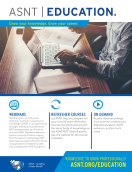
Ñ BSR/ASME TDP-1-202x, Prevention of Water Damage to Steam Turbines Used for Electric Power Generation: Fossil-Fueled Plants. This is a revision and redesignation of ANSI/ ASME TDP-1-2013. This standard includes recommended practices concerned primarily with the prevention of water damage to steam turbines used for fossil-fuel-fired electric power generation. The practices address damage due to water, wet steam, and steam backflow into a steam turbine. The practices are applicable to conventional steam cycle, combined cycle, and cogeneration plants. The practices cover design, operation, inspection, testing, and maintenance of those aspects of the following power plant systems and equipment concerned with preventing the induction of water into steam turbines: (a) motive steam systems, (b) steam attemperation systems, (c) turbine extraction/admission systems, (d) feedwater heaters, (e) turbine drain system, (f) turbine steam seal system, (g) start-up systems, (h) condenser steam and water dumps, and (i) steam generator sources. Any connection to the turbine is a potential source of water either by induction from external equipment or by accumulation of condensed steam. The sources treated herein specifically are those found to be most frequently involved in causing damage to turbines. Although water induction into the high and intermediate pressure turbines has histor- ically been recognized as the most damaging, experience has shown that water induction in low pressure turbines can cause significant damage and should also be taken seriously. This standard is not intended to impose new require- ments retroactively for existing facilities. Ñ BSR/ASTM F2016-202x, Practice for Establishing Shipbuilding Quality Requirements for Hull Structure, Outfitting, and Coatings. This is a revision of ANSI/ASTM F2016- 2000 (R2018). Ñ BSR/AWS D17.3/D17.3M-202x, Specification for Friction Stir Welding of Aluminum Alloys for Aerospace Applications. This is a revision and redesignation of ANSI/AWS D17.3/D17.3M- 2021. This specification covers the general requirements for the friction stir welding of aluminum alloys for aerospace applications. It includes the requirements for weldment design, qualification of personnel and procedures, fabri- cation, and inspection. Ñ BSR/AIAA S-081B-2018 (R202x), Space Systems – Composite Overwrapped Pressure Vessels. This is a reaffirmation of ANSI/AIAA S-081B-2018. This standard establishes baseline requirements for the design, analysis, fabrication, test, inspection, operation, and maintenance of composite overwrapped pressure vessels (COPVs). These COPVs are used for pressurized, hazardous, or nonhazardous liquid or gas storage in space systems including spacecraft and launch vehicles. This standard is applicable to COPVs constructed with a metal liner and a carbon fiber/polymer overwrap. Ñ BSR/ASA S2.29-2003 (R202x), Guide for the Measurement and Evaluation of Vibration of Machine Shafts on Shipboard Machinery. This is a reaffirmation of ANSI/ASA S2.29-2003 (R2019). This standard contains procedures for the measurement and evaluation of the mechanical vibration of nonreciprocating machines, as measured on rotating shafts. It contains criteria for evaluating new machines and for vibration monitoring. This standard is related to the various parts of the ISO 7919 series that provides guidelines for the evalu- ation of different types of machines. The type of machinery covered in this part is shipboard machinery. This is a new ANSI standard, and there is, at present, no International Standards Organization version of this standard. ISO DRAFT INTERNATIONAL STANDARDS The following are standards that the International Organization for Standardization (ISO) is considering for approval. The proposals have received substantial support within the technical committee that developed them and are now being circulated to ISO members for comment and vote. Readers interested in reviewing or commenting on these standards should order copies from ANSI. Ñ ISO/DIS 18893, Mobile elevating work platforms – Safety principles, inspection, main- tenance and operation Ñ ISO/DIS 4628-6, Paints and varnishes – Evaluation of quantity and size of defects, and of intensity of uniform changes in appearance – Part 6: Assessment of degree of chalking by tape method Ñ ISO/DIS 8065, Composites and reinforcements fibres – Mechanoluminescent visualization method of crack propagation for joint evaluation Ñ ISO/DIS 14127, Carbon-fibre-reinforced compos- ites – Determination of the resin, fibre and void contents Ñ ISO/DIS 16311-2, Maintenance and repair of concrete structures – Part 2: Assessment of existing concrete structures Ñ ISO/DIS 22928-1, Rare earth – Analysis by wavelength dispersive X-ray fluorescence spec- trometry (WD-XRFS) – Part 1: Determination of composition of rare earth magnet scraps using standardless XRF commercial packages Ñ ISO/DIS 18563-3, Non-destructive testing – Characterization and verification of ultrasonic phased array equipment – Part 3: Complete systems Ñ ISO 18119:2018/DAmd 2, – Amendment 2: Gas cylinders – Seamless steel and seamless aluminium-alloy gas cylinders and tubes – Periodic inspection and testing – Amendment 2 Ñ ISO/DIS 5735-1, Railway infrastructures – Non-destructive testing on rails in track – Part 1: Requirements for ultrasonic inspection and evaluation principles SCANNER |STANDARDSUPDATE LEARN WITH ASNT EDUCATION Whether you are looking for engaging professional development or a more convenient way to obtain continuing education credits to advance your career, ASNT Education provides the knowledge and skills current and aspiring NDT professionals need to be successful and remain competitive in an ever-changing workplace. From face-to-face courses to online instruc- tion, you’re in control of your profes- sional development, no matter where you are in your career. ASNT Education is focused on giving you the tools you need to do your best work. Visit asnt. org/education to explore your options. |SOCIETYNOTES 24 M A T E R I A L S E V A L U A T I O N • J U L Y 2 0 2 3 2307 ME July dup.indd 24 6/19/23 3:41 PM
ASNT grants non-exclusive, non-transferable license of this material to  .
All rights reserved. © ASNT 2026. To report unauthorized use, contact: customersupport@asnt.org