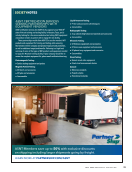
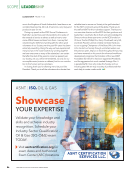
ASNT Members save up to 50% with exclusive discounts on shipping including larger shipments going by freight. LEARN MORE AT PARTNERSHIP.COM/ASNT ASNT CERTIFICATION SERVICES SEEKING PARTNERSHIPS WITH EQUIPMENT VENDORS ASNT Certification Services LLC (ASNT CS) has opened a new 9000 ft2 state-of-the-art training and testing facility in Houston, Texas, and is actively looking for a few more nondestructive testing (NDT) equipment and product vendors to partner with to equip the new facility. These partnerships would allow ASNT CS to use the vendor’s NDT products and equipment for training and testing while ensuring that vendors receive company and product exposure and promotion, as well as additional negotiated benefits. Following is a high-level overview of some of the types of NDT products and equipment needed to equip the Houston training facility. If your company would like to review the complete equipment list, please email certification@asnt.org. Electromagnetic Testing: ▶ Surface testing equipment and probes Magnetic Particle Testing: ▶ MT bench and accessories ▶ MT yoke and accessories ▶ Consumables Liquid Penetrant Testing: ▶ PT line and accessories (all techniques) ▶ Consumables Radiographic Testing: ▶ X-ray cabinet (fully locked and alarmed) and accessories ▶ Consumables Ultrasonic Testing: ▶ UT thickness equipment and accessories ▶ UT shear wave equipment and accessories ▶ UT phased array equipment and accessories ▶ Consumables Visual Testing: ▶ Remote visual video equipment ▶ Direct visual measurement devices General: ▶ Reference standards ▶ Flawed samples ▶ Promotional materials |SOCIETYNOTES J U L Y 2 0 2 3 • M A T E R I A L S E V A L U A T I O N 21 2307 ME July dup.indd 21 6/19/23 3:41 PM

SCANNER |STANDARDSUPDATE STANDARDIZATION IN ARTIFICIAL INTELLIGENCE: NEEDS, POSSIBILITIES, AND CHALLENGES Artificial intelligence (AI) and machine learning (ML) techniques and their appli- cations are flourishing in a variety of areas including health and medicine, engineering, manufacturing, and nonde- structive testing (NDT). Many industries, companies, and government agencies invest enormously in research on AI for example, €20 billion (US$21.5 billion) per year to the end of 2020 was invested by the European Union alone on AI research and development1. The US National Science Foundation announced US$140 million in funding in May 2023 to launch seven new National AI Research Institutes. This investment will bring the total number of institutes to 25 across the country and extend the network of orga- nizations involved into nearly every state2. Standardization of a technique or a method is the key step toward gener- alization of its application. In addition, standardization has a significant posi- tive impact on technology transfer and emerging technologies by forming common vocabularies and agreed defini- tions of terms. However, in the case of AI, and specif- ically in the field of NDT, the question is that if AI research has already produced mature technologies, and if AI-NDT is ready for standardization. There have been numerous articles published in AI for the NDT domain in the last few years, but practical assessment of the proposed AI methods is limited due to the lack of standardized practices that can be used to validate the performance of the developed tools. From a scientific point of view, there are many open research questions that make AI standardization appear to be premature. As an example, many existing standards in the field of inspection and safety, such as ISO 26262 on functional safety of road vehicles, are not compatible with typical AI methods despite the increasing efforts and interest in advancing technology in passenger cars and autonomous vehicles3. Currently, many standards develop- ment organizations worldwide work on norms for AI technologies and AI-related processes. The International Organization for Standardization (ISO) has run a stan- dardization project on AI since 2018. ISO, in collaboration with International Electrotechnical Commission (IEC), founded the subcommittee ISO/IEC JTC 1/SC 42 to work on an AI standard- ization project4. The scope of work of subcommittee 42 is standardization in the area of AI and consists of five working groups (WGs) and a joint working group with subcommittee 40 (IT Service Management and IT Governance). The WGs include foundational standards (WG 1) big data (WG 2), which used to be covered by a separate working group under JTC 1 trustworthiness (WG 3) use cases and applications (WG 4) and computational approaches and compu- tational characteristics of AI systems (WG 5). Societal concerns have become a subtopic of WG 3. A brief description of each WG follows: Ñ WG 1 attempts to find a workable definition by consensus. Although the concrete wording of the AI defi- nition may not be highly crucial for the quality of the future SC 42 stan- dards, there is a definite need for an AI definition in industry. Ñ WG 2 is assigned to work on big data. Ñ WG 3 works on trustworthiness, including the main tasks of (a) inves- tigating approaches to establish trust in AI systems through transpar- ency, verifiability, explainability, and controllability (b) investigating engi- neering pitfalls and assess typical associated threats and risks to AI systems with their mitigation tech- niques and methods and (c) inves- tigating approaches to achieve AI systems’ robustness, resiliency, reli- ability, accuracy, safety, security, and privacy. Ñ WG 4 works on use cases and applications with the main tasks of (a) identifying different AI application domains and the different context of their use (b) describing applications and use cases using the terminology and concepts defined in ISO/IEC 22989 and ISO/IEC 23053 and extending the terms as necessary and (c) collecting and identifying societal concerns related to the collected use cases. Ñ WG 5 works on computational approaches and computational characteristics of AI systems including (a) main computational characteristics of AI systems and (b) main algorithms and approaches used in AI systems. More updates on the progress of AI standardization will be discussed in future articles as they become available. STANDARDS EDITOR Hossein Taheri, PhD: Georgia Southern University, Statesboro, GA htaheri@georgiasouthern.edu REFERENCES 1 Duthon, P., F. Bernardin, F. Chausse, and M. Colomb. 2018. “Benchmark for the robustness of image features in rainy conditions.” Machine Vision and Applications 29 (5): 915–27. https://doi. org/10.1007/s00138-018-0945-8. 2 The White House. 2023. “Fact sheet: Biden-Harris administration announces new actions to promote responsible AI innovation that protects Amer- icans’ rights and safety.” https:// www.whitehouse.gov/briefing-room/ statements-releases/2023/05/04/ fact-sheet-biden-harris-administration -announces-new-actions-to-promote -responsible-ai-innovation-that-protects -americans-rights-and-safety/. 3 Rao, V. R., 2018. “How data becomes knowledge, part 1: from data to knowledge.” IBM Corp. 4 Zielke, T., 2020. “Is artificial intelligence ready for standardization?” EuroSPI 2020: Systems, Software and Services Process Improvement: 259–274. https://doi. org/10.1007/978-3-030-56441-4_19. 22 M A T E R I A L S E V A L U A T I O N • J U L Y 2 0 2 3 2307 ME July dup.indd 22 6/19/23 3:41 PM
ASNT grants non-exclusive, non-transferable license of this material to  .
All rights reserved. © ASNT 2026. To report unauthorized use, contact: customersupport@asnt.org