PATENTSROUNDUP
|
SCANNER
DETECTING DEFECTS IN RAILROADS
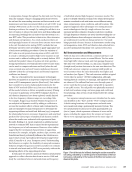
The rapid development of high-speed and heavy-haul railways motivates the
need for advanced railroad inspection techniques for real-time defect detection.
This month, we discuss nondestructive evaluation (NDE) technologies relevant for
detecting defects in railroads.
US9752993B1 NONDESTRUCTIVE
EVALUATION OF
RAILROAD RAILS,
WHEELS, AND AXLES
(Jeffrey G. Thompson, John R. Hull,
Morteza Safai, Barry A. Fetzer, Gary E.
Georgeson, and Steven K. Brady)
This patent describes NDE of railroads that
includes a carriage and plurality of wheels.
A source of vibration is connected to trans-
mitted vibrations at preselected frequen-
cies to inspect test regions of a wheel. An
infrared detector records temperature
changes due to the vibrations. A controller
is utilized to actuate the infrared detector
and record the thermal images of the
vibrations impacting the test regions, and
then store the thermal images recorded
by the infrared detector. The NDE system
may be mounted on a movable vehicle so
that the railroad rails may be tested on a
continuous basis, thus reducing the time
and expense for NDE of long railroad rails.
WO2004035368A1 TRANSVERSE CRACK
DETECTION IN
RAIL HEAD USING
LOW-FREQUENCY
EDDY CURRENTS
(Gopichand Katragadda, Douglas Earnest,
Gregory Anthony Garcia, and Richard Paul Reiff)
This patent describes a low-frequency
electromagnetic NDE approach to detect
transverse cracks in railroads. While
horizontal cracks can be detected by
conventional NDE approaches, transverse
cracks are difficult to detect below the
horizontal cracks. Here, the inventors utilize
a Hall element eddy current sensor to
distinguish low-frequency signatures from
nonrelevant indications such as thermite
welds, rail, and joints. The novel sensor
utilizes a toroidal-shaped DC magnet to
generate a saturated magnetic field into and
across the railhead, inductively coupling the
opposing pole ends of the magnet of the
sensor. The sensor follows the wear pattern
of the railroad and controls the liftoff of
the probe using a transporter that moves
along the track. A protective material on the
probe protects the probe from the defect
as it is moved along the railroad.
PATENTS EDITOR
Saptarshi Mukherjee, PhD: Lawrence
Livermore National Laboratory,
mukherjee5@llnl.gov
ASNT Members save up to 50% with exclusive discounts
on shipping including larger shipments going by freight.
LEARN MORE AT PARTNERSHIP.COM/ASNT
J A N U A R Y 2 0 2 4 • M A T E R I A L S E V A L U A T I O N 21
2401 ME January.indd 21 12/20/23 8:01 AM
|
SCANNER
DETECTING DEFECTS IN RAILROADS
The rapid development of high-speed and heavy-haul railways motivates the
need for advanced railroad inspection techniques for real-time defect detection.
This month, we discuss nondestructive evaluation (NDE) technologies relevant for
detecting defects in railroads.
US9752993B1 NONDESTRUCTIVE
EVALUATION OF
RAILROAD RAILS,
WHEELS, AND AXLES
(Jeffrey G. Thompson, John R. Hull,
Morteza Safai, Barry A. Fetzer, Gary E.
Georgeson, and Steven K. Brady)
This patent describes NDE of railroads that
includes a carriage and plurality of wheels.
A source of vibration is connected to trans-
mitted vibrations at preselected frequen-
cies to inspect test regions of a wheel. An
infrared detector records temperature
changes due to the vibrations. A controller
is utilized to actuate the infrared detector
and record the thermal images of the
vibrations impacting the test regions, and
then store the thermal images recorded
by the infrared detector. The NDE system
may be mounted on a movable vehicle so
that the railroad rails may be tested on a
continuous basis, thus reducing the time
and expense for NDE of long railroad rails.
WO2004035368A1 TRANSVERSE CRACK
DETECTION IN
RAIL HEAD USING
LOW-FREQUENCY
EDDY CURRENTS
(Gopichand Katragadda, Douglas Earnest,
Gregory Anthony Garcia, and Richard Paul Reiff)
This patent describes a low-frequency
electromagnetic NDE approach to detect
transverse cracks in railroads. While
horizontal cracks can be detected by
conventional NDE approaches, transverse
cracks are difficult to detect below the
horizontal cracks. Here, the inventors utilize
a Hall element eddy current sensor to
distinguish low-frequency signatures from
nonrelevant indications such as thermite
welds, rail, and joints. The novel sensor
utilizes a toroidal-shaped DC magnet to
generate a saturated magnetic field into and
across the railhead, inductively coupling the
opposing pole ends of the magnet of the
sensor. The sensor follows the wear pattern
of the railroad and controls the liftoff of
the probe using a transporter that moves
along the track. A protective material on the
probe protects the probe from the defect
as it is moved along the railroad.
PATENTS EDITOR
Saptarshi Mukherjee, PhD: Lawrence
Livermore National Laboratory,
mukherjee5@llnl.gov
ASNT Members save up to 50% with exclusive discounts
on shipping including larger shipments going by freight.
LEARN MORE AT PARTNERSHIP.COM/ASNT
J A N U A R Y 2 0 2 4 • M A T E R I A L S E V A L U A T I O N 21
2401 ME January.indd 21 12/20/23 8:01 AM