identification of fluids conveyed in piping and
their characteristics.
Ñ BSR/ASNT AI/ML-202x, Uses of AI/ML for
NDT Application. This is a new standard. This
standard establishes perquisites for applying
artificial intelligence/machine learning (AI/ML)
in digital NDT. It provides requirements for data
collection and management and defines criteria
for model selection and development in the
context of NDT applications. After the AI-enabled
system is developed, this standard stipulates
requirements to evaluate its performance, vali-
dation, deployment, and integration followed
by maintenance, feedback mechanisms,
training, risk assessment, and mitigation strat-
egies including the need for mandatory proce-
dures for these processes. This standard will
serve as a blueprint for formulating subsequent
standards specific to various modalities.
Ñ BSR/ALI ALCTV-202-202x, Standard for
Automotive Lifts – Safety Requirements for
Construction, Testing, and Validation. This is a
revision of ANSI/ALI ALCTV-2017. This standard
covers safety requirements for the design,
construction, testing, and validation of automo-
tive lifts used for vehicle service and parking.
These covered automotive lifts may be of the
following types: manually driven, power driven,
stationary, mobile, and lifts tilting the raised
vehicle in the pitch direction.
Ñ BSR/AWS D14.0/D14.0M-202x, Machinery
and Equipment Welding Specification. This is a
revision of ANSI/AWS D14.0/D14.0M-2023. This
specification establishes design, manufacture,
quality, inspection, and repair requirements
for carbon, low-alloy, and alloy steel welded
connections in machinery and equipment. It
addresses topics including weld joint design,
workmanship, quality acceptance criteria,
nondestructive examination methods (visual,
radiographic, ultrasonic, magnetic particle, and
liquid penetrant), repair of weld defects, and
post-weld heat treatment.
Ñ BSR/AWS D14.9/D14.9M-202x, Specification
for the Welding of Hydraulic Cylinders. This is
a revision of ANSI/AWS D14.9/D14.9M-2022.
This specification provides standards for the
design and manufacture of pressure-containing
welded joints and structural welded joints
used in the manufacture of hydraulic cylinders.
Manufacturer’s responsibilities are presented
as they relate to the welding practices that have
been proven successful within the industry in
the production of hydraulic cylinders. Included
are clauses defining procedure qualification,
performance qualification, workmanship, and
quality requirements as well as inspection
requirements and repair requirements.
Ñ BSR/AWS D8.11M-202x, Specification for
Automotive Weld Quality – Laser Beam Welding
of Aluminum. This is a new standard. This
document will standardize laser-beam-weld
inspection procedures and establish guidelines
for process control and quality acceptance of
aluminum laser beam welds in automotive
body applications. Aluminum use in automo-
tive body structures, now including battery
trays for electric vehicles, continues to expand.
Development of this specification is the natural
next step for the AWS D8E Subcommittee
following the recent release of AWS D8.10M:
2021, Specification for Automotive Weld Quality
– Laser Beam Welding of Steel.
CALL FOR COMMENT
ON PROPOSALS LISTED
The public comment period has passed for the
following draft American National Standards,
which are currently in review.
Ñ BSR/AWS D14.9/D14.9M-202x-AMD1,
Specification for the Welding of Hydraulic
Cylinders. This is a revision and redesignation
of ANSI/AWS D14.9/D14.9M-2022. This spec-
ification provides standards for the design
and manufacture of pressure containing
welded joints and structural welded joints
used in the manufacture of hydraulic cylinders.
Manufacturer’s responsibilities are presented
as they relate to the welding practices that have
been proven successful within the industry in
the production of hydraulic cylinders. Included
are clauses defining procedure qualification,
performance qualification, workmanship and
quality requirements, as well as inspection
requirements and repair requirements.
Ñ BSR/AWS D17.1/D17.1M-202x, Specification
for Fusion Welding for Aerospace Applications.
This is a revision of ANSI/AWS D17.1/
D17.1M-2017-AMD2. This specification
provides the general welding requirements
for welding aircraft and space hardware.
It includes but is not limited to the fusion
welding of aluminum-based, nickel-based,
iron-based, cobalt-based, magnesium-based,
and titanium-based alloys using electric arc
REGISTER FOR
RAILROAD
WEBINAR
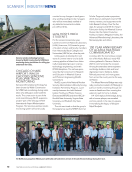
Join the upcoming ASNT Virtual
Section meeting on 18 January
2024 at 2:00 p.m. (ET) to learn
about the early development and
in-service assessment of locomo-
tive undercarriage thermal inspec-
tion systems, which are also known
as in-track thermal detectors. The
informative presentation will be
delivered by Anish Poudel, PhD,
who will discuss how MxV Rail
installed thermocouples and data
loggers on three different styles
of locomotives. This allowed them
to record the real-time tempera-
tures of the high-load mechanical
components while the locomotives
were running on the network.
By attending the webinar, you
will discover how the continuous
data obtained from the onboard
unit was useful for determining
warmup profiles and average
operating range temperatures for
the various components. Register
today at asnt.org/virtualsection.
ASNT WINS
CONTENT
STRATEGY AWARD
ASNT is a proud recipient of the
inaugural A100 CommImpact
Awards by OnWrd &UpWrd! These
awards recognize associations
redefining what it means to be
an effective communicator, from
advocacy efforts to groundbreaking
member engagement initiatives.
The ASNT Content Department
won the award for the Innovative
Content Strategy category, for
being true pioneers in content
creation and enhancing engage-
ment across diverse formats.
|
SOCIETYNOTES
J A N U A R Y 2 0 2 4 • M A T E R I A L S E V A L U A T I O N 19
2401 ME January.indd 19 12/20/23 8:01 AM
their characteristics.
Ñ BSR/ASNT AI/ML-202x, Uses of AI/ML for
NDT Application. This is a new standard. This
standard establishes perquisites for applying
artificial intelligence/machine learning (AI/ML)
in digital NDT. It provides requirements for data
collection and management and defines criteria
for model selection and development in the
context of NDT applications. After the AI-enabled
system is developed, this standard stipulates
requirements to evaluate its performance, vali-
dation, deployment, and integration followed
by maintenance, feedback mechanisms,
training, risk assessment, and mitigation strat-
egies including the need for mandatory proce-
dures for these processes. This standard will
serve as a blueprint for formulating subsequent
standards specific to various modalities.
Ñ BSR/ALI ALCTV-202-202x, Standard for
Automotive Lifts – Safety Requirements for
Construction, Testing, and Validation. This is a
revision of ANSI/ALI ALCTV-2017. This standard
covers safety requirements for the design,
construction, testing, and validation of automo-
tive lifts used for vehicle service and parking.
These covered automotive lifts may be of the
following types: manually driven, power driven,
stationary, mobile, and lifts tilting the raised
vehicle in the pitch direction.
Ñ BSR/AWS D14.0/D14.0M-202x, Machinery
and Equipment Welding Specification. This is a
revision of ANSI/AWS D14.0/D14.0M-2023. This
specification establishes design, manufacture,
quality, inspection, and repair requirements
for carbon, low-alloy, and alloy steel welded
connections in machinery and equipment. It
addresses topics including weld joint design,
workmanship, quality acceptance criteria,
nondestructive examination methods (visual,
radiographic, ultrasonic, magnetic particle, and
liquid penetrant), repair of weld defects, and
post-weld heat treatment.
Ñ BSR/AWS D14.9/D14.9M-202x, Specification
for the Welding of Hydraulic Cylinders. This is
a revision of ANSI/AWS D14.9/D14.9M-2022.
This specification provides standards for the
design and manufacture of pressure-containing
welded joints and structural welded joints
used in the manufacture of hydraulic cylinders.
Manufacturer’s responsibilities are presented
as they relate to the welding practices that have
been proven successful within the industry in
the production of hydraulic cylinders. Included
are clauses defining procedure qualification,
performance qualification, workmanship, and
quality requirements as well as inspection
requirements and repair requirements.
Ñ BSR/AWS D8.11M-202x, Specification for
Automotive Weld Quality – Laser Beam Welding
of Aluminum. This is a new standard. This
document will standardize laser-beam-weld
inspection procedures and establish guidelines
for process control and quality acceptance of
aluminum laser beam welds in automotive
body applications. Aluminum use in automo-
tive body structures, now including battery
trays for electric vehicles, continues to expand.
Development of this specification is the natural
next step for the AWS D8E Subcommittee
following the recent release of AWS D8.10M:
2021, Specification for Automotive Weld Quality
– Laser Beam Welding of Steel.
CALL FOR COMMENT
ON PROPOSALS LISTED
The public comment period has passed for the
following draft American National Standards,
which are currently in review.
Ñ BSR/AWS D14.9/D14.9M-202x-AMD1,
Specification for the Welding of Hydraulic
Cylinders. This is a revision and redesignation
of ANSI/AWS D14.9/D14.9M-2022. This spec-
ification provides standards for the design
and manufacture of pressure containing
welded joints and structural welded joints
used in the manufacture of hydraulic cylinders.
Manufacturer’s responsibilities are presented
as they relate to the welding practices that have
been proven successful within the industry in
the production of hydraulic cylinders. Included
are clauses defining procedure qualification,
performance qualification, workmanship and
quality requirements, as well as inspection
requirements and repair requirements.
Ñ BSR/AWS D17.1/D17.1M-202x, Specification
for Fusion Welding for Aerospace Applications.
This is a revision of ANSI/AWS D17.1/
D17.1M-2017-AMD2. This specification
provides the general welding requirements
for welding aircraft and space hardware.
It includes but is not limited to the fusion
welding of aluminum-based, nickel-based,
iron-based, cobalt-based, magnesium-based,
and titanium-based alloys using electric arc
REGISTER FOR
RAILROAD
WEBINAR
Join the upcoming ASNT Virtual
Section meeting on 18 January
2024 at 2:00 p.m. (ET) to learn
about the early development and
in-service assessment of locomo-
tive undercarriage thermal inspec-
tion systems, which are also known
as in-track thermal detectors. The
informative presentation will be
delivered by Anish Poudel, PhD,
who will discuss how MxV Rail
installed thermocouples and data
loggers on three different styles
of locomotives. This allowed them
to record the real-time tempera-
tures of the high-load mechanical
components while the locomotives
were running on the network.
By attending the webinar, you
will discover how the continuous
data obtained from the onboard
unit was useful for determining
warmup profiles and average
operating range temperatures for
the various components. Register
today at asnt.org/virtualsection.
ASNT WINS
CONTENT
STRATEGY AWARD
ASNT is a proud recipient of the
inaugural A100 CommImpact
Awards by OnWrd &UpWrd! These
awards recognize associations
redefining what it means to be
an effective communicator, from
advocacy efforts to groundbreaking
member engagement initiatives.
The ASNT Content Department
won the award for the Innovative
Content Strategy category, for
being true pioneers in content
creation and enhancing engage-
ment across diverse formats.
|
SOCIETYNOTES
J A N U A R Y 2 0 2 4 • M A T E R I A L S E V A L U A T I O N 19
2401 ME January.indd 19 12/20/23 8:01 AM