requirements of the rail industry. Internationally,
the rail industry follows specific guidelines and
regulations for axle inspections, and inspection fre-
quencies will depend on factors such as axle usage
and operating conditions. Qualified inspectors and
other nondestructive testing professionals regularly
conduct inspections to ensure compliance with
safety standards and to identify any issues that may
require maintenance or replacement. One example is
a full axle body inspection that requires the removal
of wheels, bearings, backing rings, and bearing caps
before the inspection. In North America, axle fatigue
cracks in the journal fillet radius are not detectable
during routine safety inspections because that part
of the axle is concealed by the roller-bearing backing
ring. Therefore, visual inspection in the journal
fillet radius is possible only during wheel and roller
bearing replacement or axle reconditioning.
The most common NDE methods currently used
for axle inspection include electromagnetic induction–
based techniques, such as magnetic particle testing
(MT) and alternating current field measurement
(ACFM), as well as a variety of ultrasonic testing (UT)
techniques. Researchers have also been exploring
other novel NDE approaches, which are described in
this paper. However, these novel approaches are not
yet commercially available and are currently in differ-
ent stages of research and development.
Magnetic Particle Testing
MT is a basic NDE method that uses magnetic fields
to detect surface and subsurface defects in ferromag-
netic materials. The underlying physics behind MT
involve the concept that a discontinuity in the test
piece will interrupt the flow of the magnetic lines of
force, thus forming opposite magnetic poles. When
fine magnetic particles are sprayed onto the surface
of the magnetized specimen, the particles will be
attracted by the new magnetic poles and provide a
visual representation of the surface discontinuity.
MT is generally more effective in detecting surface
defects compared to subsurface defects. For deeper
subsurface defects, UT may be more suitable.
In North America, when railcar axles undergo
inspection for surface cracks, the AAR standards
recommend using the MT NDE method during
wheel and roller bearing replacement or during axle
reconditioning. During the inspection, the surface
is cleaned, and the axle is placed on a fixture to be
rotated for testing. An encircling coil magnetizes
the axle to detect indications in the axial direction.
Similarly, indications along the radial direction are
detected by moving the motor-driven coil (with
the front side shower ring activated) along the part
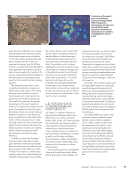
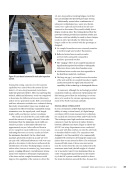
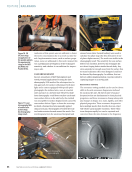
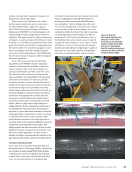
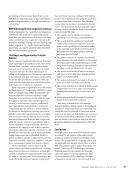
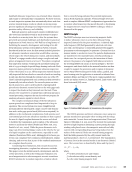
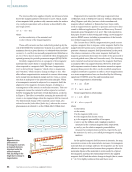
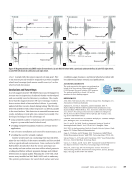
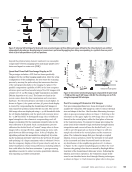
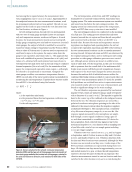
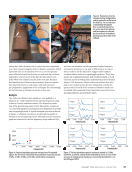
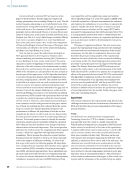
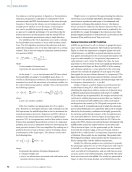
(Maass et al. 2014). Figure 3 shows wet fluorescent
MT systems used to detect longitudinal and trans-
verse cracks in axles and wheelsets.
Figure 3. Wet fluorescent
MT of railcar axle inspection:
(a) axle inspection system
(b) wheelset inspection system
(c) longitudinal crack in axle
body (d) fretting fatigue cracks
in journal fillet radius.
J A N U A R Y 2 0 2 4 • M A T E R I A L S E V A L U A T I O N 29
2401 ME January.indd 29 12/20/23 8:01 AM
the rail industry follows specific guidelines and
regulations for axle inspections, and inspection fre-
quencies will depend on factors such as axle usage
and operating conditions. Qualified inspectors and
other nondestructive testing professionals regularly
conduct inspections to ensure compliance with
safety standards and to identify any issues that may
require maintenance or replacement. One example is
a full axle body inspection that requires the removal
of wheels, bearings, backing rings, and bearing caps
before the inspection. In North America, axle fatigue
cracks in the journal fillet radius are not detectable
during routine safety inspections because that part
of the axle is concealed by the roller-bearing backing
ring. Therefore, visual inspection in the journal
fillet radius is possible only during wheel and roller
bearing replacement or axle reconditioning.
The most common NDE methods currently used
for axle inspection include electromagnetic induction–
based techniques, such as magnetic particle testing
(MT) and alternating current field measurement
(ACFM), as well as a variety of ultrasonic testing (UT)
techniques. Researchers have also been exploring
other novel NDE approaches, which are described in
this paper. However, these novel approaches are not
yet commercially available and are currently in differ-
ent stages of research and development.
Magnetic Particle Testing
MT is a basic NDE method that uses magnetic fields
to detect surface and subsurface defects in ferromag-
netic materials. The underlying physics behind MT
involve the concept that a discontinuity in the test
piece will interrupt the flow of the magnetic lines of
force, thus forming opposite magnetic poles. When
fine magnetic particles are sprayed onto the surface
of the magnetized specimen, the particles will be
attracted by the new magnetic poles and provide a
visual representation of the surface discontinuity.
MT is generally more effective in detecting surface
defects compared to subsurface defects. For deeper
subsurface defects, UT may be more suitable.
In North America, when railcar axles undergo
inspection for surface cracks, the AAR standards
recommend using the MT NDE method during
wheel and roller bearing replacement or during axle
reconditioning. During the inspection, the surface
is cleaned, and the axle is placed on a fixture to be
rotated for testing. An encircling coil magnetizes
the axle to detect indications in the axial direction.
Similarly, indications along the radial direction are
detected by moving the motor-driven coil (with
the front side shower ring activated) along the part
(Maass et al. 2014). Figure 3 shows wet fluorescent
MT systems used to detect longitudinal and trans-
verse cracks in axles and wheelsets.
Figure 3. Wet fluorescent
MT of railcar axle inspection:
(a) axle inspection system
(b) wheelset inspection system
(c) longitudinal crack in axle
body (d) fretting fatigue cracks
in journal fillet radius.
J A N U A R Y 2 0 2 4 • M A T E R I A L S E V A L U A T I O N 29
2401 ME January.indd 29 12/20/23 8:01 AM