handheld ultrasonic inspections, are extremely labor-intensive
and require a substantial time commitment. For these reasons,
in-track inspection systems that automatically detect and char-
acterize internal fatigue cracks in wheels on moving trains
present significant advantages and improvements for rail trans-
portation safety, efficiency, and reliability.
Railroad operators and research centers worldwide have
also tested and installed several in-track systems to inspect
the wheels on a moving train, but to date, the systems have
presented operational challenges and drawbacks for practical
deployment in North America. MxV Rail has a long history of
facilitating the research, development, and testing of two dif-
ferent ultrasonic systems at its facilities in Pueblo, Colorado.
Introduced in the late 1990s, the first system included piezoelec-
tric ultrasonic transducer sensors that would follow a moving
wheel, inspect the wheel during one rotation, and immediately
“fly back” to engage another wheel using a complex rack and
pinion arrangement (Garcia et al. 2007). The system comprised
four inspection stations, evenly spaced and situated along one
side of a 33.5 m length of special flange-bearing trackwork. Each
inspection station performed a dynamic ultrasonic inspection
of one wheel (rim) on a car. All four inspection stations dynami-
cally inspected the four wheels on one side of each car traveling
in only one direction through the system. Later, one of the US
Class I railroads implemented such a system in their network to
dynamically test railcar wheels. The second system was intro-
duced around 2013, and it used hundreds of spring-loaded
piezoelectric ultrasonic sensors laid out on the wide-gage track
to inspect the wheels as they traversed over the track. These
sensors were connected to a wayside data collection unit and a
central processing computer that ran the software program for
analyzing ultrasonic signals for wheel defects.
The complex mechanical design of the first ultrasonic
system proved too complicated and impractical to keep in
operation. The second system was more straightforward
mechanically but still required a large concrete slab founda-
tion and a wide-gage special track (FRA waiver required). In
addition to the mechanical complications, both systems used
conventional piezoelectric ultrasonic transducers that required
the use of a liquid couplant between the sensor and wheel
to facilitate the transmission and reception of the ultrasonic
waves to and from the wheel (Poudel and Witte 2018, 2021
Poudel et al. 2017, 2019a). While the piezo ultrasonics tech-
nique can detect internal fatigue cracks in the wheels, the use
of a liquid couplant can be cumbersome, especially in cold
climates (Poudel and Witte 2021). Adding glycol for freeze pro-
tection can complicate the continuous replenishment, regular
cleaning, and recovery that is part of the standard maintenance
on a couplant-based system.
Considering these limitations, this research focused on
investigating alternative, couplant-free ultrasonic methods.
This paper covers the initial research, development, and dis-
covery processes, as well as the testing and evaluation of a
novel magnetostrictive electromagnetic acoustic transducer
(EMAT) solution for in-motion inspection of railcar wheels
that is currently being evaluated for potential implementa-
tion in North American railroads. Several attempts were also
made to explore different EMAT configurations/approaches for
in-motion wheel inspection that paved the path to developing
the magnetostrictive strip-based EMAT technique, which is
discussed in this paper.
EMAT Principle
The EMAT technique uses two interacting magnetic fields
to induce ultrasonic waves in a test object (the part being
inspected) instead of in the piezo transducer. A relatively high
radio frequency (RF) field generated by electrical coils inter-
acts with a low frequency or static field generated by magnets
(permanent or electromagnetic) to generate a Lorentz force in a
manner similar to an electric motor. The particle displacements
are transferred to the material’s lattice, thereby producing an
elastic wave. In a reciprocal process, the interaction of elastic
waves in the presence of a magnetic field induces currents in
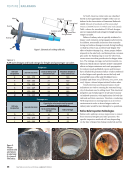
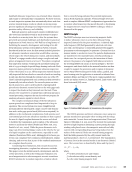
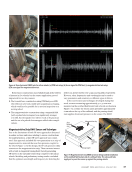
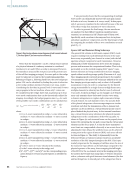
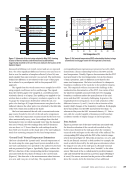
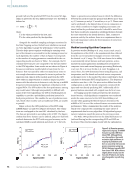
the receiving EMAT coil circuit, as shown in Figure 1. The elec-
tromagnetic and elastic fields in the material’s surface are then
coupled to support the generation and reception of ultrasonic
waves. Many EMAT techniques for bulk, surface, guided, and
wave focusing exist for application to materials at elevated tem-
peratures (Hirao and Ogi 2017). The most common guided wave
modes are surface waves (i.e., Rayleigh waves), Lamb waves, and
shear horizontal (SH) waves.
The EMATs generate and detect ultrasonic waves using two
primary transduction principles when working with ferromag-
netic materials: Lorentz force and magnetostriction (Hirao and
Ogi 2017 Ribichini et al. 2011, 2012). The Lorentz force principle
involves a high frequency alternating current passing through
winding coils placed near a ferromagnetic material and eddy
current with corresponding frequency being induced on the
surface of the material. Under an external biasing magnetic
field, the fields generated by the eddy current inside the
material produce a force (i.e., Lorentz force). The transmission
of Lorentz force in the material results in an ultrasonic (elastic)
wave. The Lorentz force is described by Hirao and Ogi (2017):
(1) f (L) = Je × BO
where
f (L) is the Lorentz force per unit volume,
Je is the electron eddy current density, and
BO is the static biasing magnetic field.
B
O
J
e
V
v
B
O
J
e
I
F
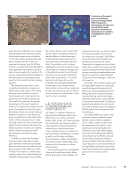
Figure 1. Primitive EMAT elements: (a) transmission (b) reception.
J A N U A R Y 2 0 2 4 • M A T E R I A L S E V A L U A T I O N 43
2401 ME January.indd 43 12/20/23 8:01 AM
and require a substantial time commitment. For these reasons,
in-track inspection systems that automatically detect and char-
acterize internal fatigue cracks in wheels on moving trains
present significant advantages and improvements for rail trans-
portation safety, efficiency, and reliability.
Railroad operators and research centers worldwide have
also tested and installed several in-track systems to inspect
the wheels on a moving train, but to date, the systems have
presented operational challenges and drawbacks for practical
deployment in North America. MxV Rail has a long history of
facilitating the research, development, and testing of two dif-
ferent ultrasonic systems at its facilities in Pueblo, Colorado.
Introduced in the late 1990s, the first system included piezoelec-
tric ultrasonic transducer sensors that would follow a moving
wheel, inspect the wheel during one rotation, and immediately
“fly back” to engage another wheel using a complex rack and
pinion arrangement (Garcia et al. 2007). The system comprised
four inspection stations, evenly spaced and situated along one
side of a 33.5 m length of special flange-bearing trackwork. Each
inspection station performed a dynamic ultrasonic inspection
of one wheel (rim) on a car. All four inspection stations dynami-
cally inspected the four wheels on one side of each car traveling
in only one direction through the system. Later, one of the US
Class I railroads implemented such a system in their network to
dynamically test railcar wheels. The second system was intro-
duced around 2013, and it used hundreds of spring-loaded
piezoelectric ultrasonic sensors laid out on the wide-gage track
to inspect the wheels as they traversed over the track. These
sensors were connected to a wayside data collection unit and a
central processing computer that ran the software program for
analyzing ultrasonic signals for wheel defects.
The complex mechanical design of the first ultrasonic
system proved too complicated and impractical to keep in
operation. The second system was more straightforward
mechanically but still required a large concrete slab founda-
tion and a wide-gage special track (FRA waiver required). In
addition to the mechanical complications, both systems used
conventional piezoelectric ultrasonic transducers that required
the use of a liquid couplant between the sensor and wheel
to facilitate the transmission and reception of the ultrasonic
waves to and from the wheel (Poudel and Witte 2018, 2021
Poudel et al. 2017, 2019a). While the piezo ultrasonics tech-
nique can detect internal fatigue cracks in the wheels, the use
of a liquid couplant can be cumbersome, especially in cold
climates (Poudel and Witte 2021). Adding glycol for freeze pro-
tection can complicate the continuous replenishment, regular
cleaning, and recovery that is part of the standard maintenance
on a couplant-based system.
Considering these limitations, this research focused on
investigating alternative, couplant-free ultrasonic methods.
This paper covers the initial research, development, and dis-
covery processes, as well as the testing and evaluation of a
novel magnetostrictive electromagnetic acoustic transducer
(EMAT) solution for in-motion inspection of railcar wheels
that is currently being evaluated for potential implementa-
tion in North American railroads. Several attempts were also
made to explore different EMAT configurations/approaches for
in-motion wheel inspection that paved the path to developing
the magnetostrictive strip-based EMAT technique, which is
discussed in this paper.
EMAT Principle
The EMAT technique uses two interacting magnetic fields
to induce ultrasonic waves in a test object (the part being
inspected) instead of in the piezo transducer. A relatively high
radio frequency (RF) field generated by electrical coils inter-
acts with a low frequency or static field generated by magnets
(permanent or electromagnetic) to generate a Lorentz force in a
manner similar to an electric motor. The particle displacements
are transferred to the material’s lattice, thereby producing an
elastic wave. In a reciprocal process, the interaction of elastic
waves in the presence of a magnetic field induces currents in
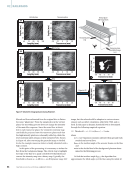
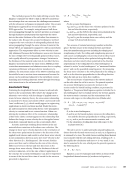
the receiving EMAT coil circuit, as shown in Figure 1. The elec-
tromagnetic and elastic fields in the material’s surface are then
coupled to support the generation and reception of ultrasonic
waves. Many EMAT techniques for bulk, surface, guided, and
wave focusing exist for application to materials at elevated tem-
peratures (Hirao and Ogi 2017). The most common guided wave
modes are surface waves (i.e., Rayleigh waves), Lamb waves, and
shear horizontal (SH) waves.
The EMATs generate and detect ultrasonic waves using two
primary transduction principles when working with ferromag-
netic materials: Lorentz force and magnetostriction (Hirao and
Ogi 2017 Ribichini et al. 2011, 2012). The Lorentz force principle
involves a high frequency alternating current passing through
winding coils placed near a ferromagnetic material and eddy
current with corresponding frequency being induced on the
surface of the material. Under an external biasing magnetic
field, the fields generated by the eddy current inside the
material produce a force (i.e., Lorentz force). The transmission
of Lorentz force in the material results in an ultrasonic (elastic)
wave. The Lorentz force is described by Hirao and Ogi (2017):
(1) f (L) = Je × BO
where
f (L) is the Lorentz force per unit volume,
Je is the electron eddy current density, and
BO is the static biasing magnetic field.
B
O
J
e
V
v
B
O
J
e
I
F
Figure 1. Primitive EMAT elements: (a) transmission (b) reception.
J A N U A R Y 2 0 2 4 • M A T E R I A L S E V A L U A T I O N 43
2401 ME January.indd 43 12/20/23 8:01 AM