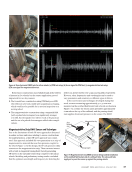
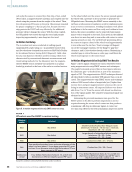
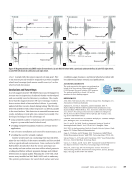
Initial Experimental Trials
There is a significant history of trying to use surface waves
for the inspection of railroad wheels dating back to the late
1980s (Schramm et al. 1988, 1989). The first known tests were
conducted using piezoelectric transducers under a rubber
boot filled with liquid, but this combination proved too fragile
for practical use. In the late 2000s, other researchers also tried
using surface waves generated with EMAT sensors with some
improvements (Fan and Jia 2008 Salzburger et al. 2009).
However, whether generated with piezoelectric transducers or
EMATs, surface waves have important limitations associated
with particle motion and wave penetration. Surface waves follow
an elliptical pattern with both horizontal and vertical out-of-
plane motions, which make the waves highly susceptible to the
surface conditions of the structure where the waves propagate.
Water, dirt, rust, or contaminants on the wheel’s surface can
scatter and attenuate the wave, thereby reducing the range and
ability of the EMAT sensor and technique to find defects.
The first EMAT technique researched and explored for the
in-motion inspection of railcar wheels involved using bulk waves
(0°). These tests were designed to determine whether EMATs
could replace the existing in-track ultrasonic system previously
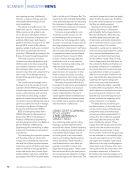
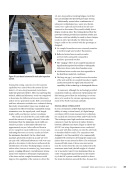
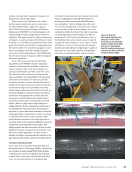
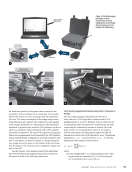
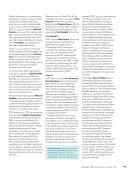
evaluated by MxV Rail. For these tests, the wheelset rotated on
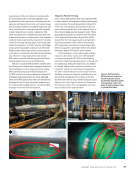
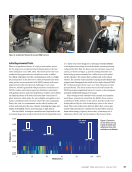
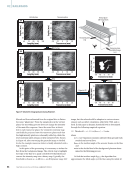
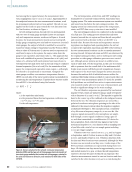
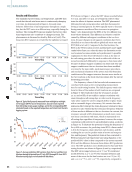
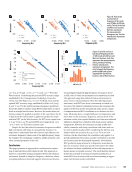
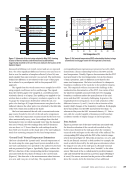
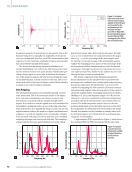
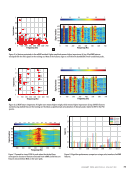
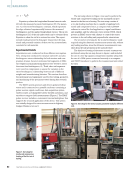
casters, as shown in Figure 3, and the rotating wheelset was
tested using a sensor mounted on a table next to each wheel
on the wheelset. The sensor fired continuously as the wheel
rotated. The custom sensor included a spring-loaded fixture that
engaged and disengaged the wheel and an eight-channel EMAT
RF coil that generates shear waves at 0° from the point of entry
(normal beam). The shear sensors were selected because the
EMAT generates longitudinal waves (L-waves) on ferromagnetic
materials inefficiently (Zhang et al. 2022).
After testing several wheelsets with natural and manufac-
tured flaws, researchers found that the EMAT shear sensors
could detect all the defects on the wheel, but the results were
heavily affected by the cold-worked layer close to the wheel
tread. This cold-worked area did not affect the L-waves gen-
erated with piezoelectric transducers but did reflect normal
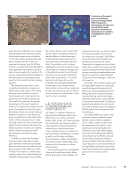
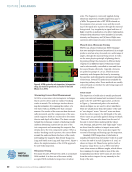
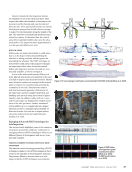
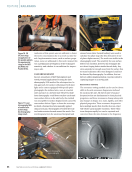
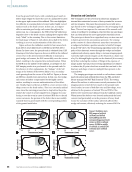
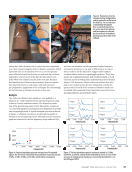
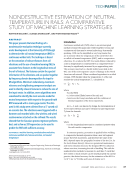
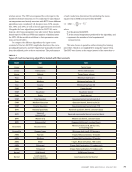
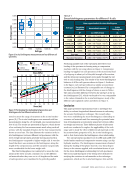
beam shear energy. Figure 4 shows the C-scan image for a
calibration wheel with various diameter flat-bottom holes
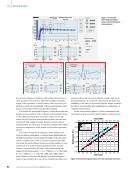
Figure 3. (a) wheelset fixture (b) custom EMAT sensors.
FBH–1/2 in. dia.
FBH–1/4 in. dia.
0
0.031
0.030
0.025
0.020
0.015
0.010
0.005
0.000
20 40 60
Distance (in.)
80 100 109.25
CAL–wheel
left side
FBH–1 in. dia.
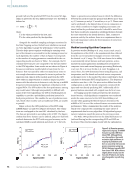
Figure 4. Detection
of real defects on top
(inside of wheel) and
reflections from cold-
worked area on bottom.
J A N U A R Y 2 0 2 4 • M A T E R I A L S E V A L U A T I O N 45
2401 ME January.indd 45 12/20/23 8:01 AM
Distance
(in.)
There is a significant history of trying to use surface waves
for the inspection of railroad wheels dating back to the late
1980s (Schramm et al. 1988, 1989). The first known tests were
conducted using piezoelectric transducers under a rubber
boot filled with liquid, but this combination proved too fragile
for practical use. In the late 2000s, other researchers also tried
using surface waves generated with EMAT sensors with some
improvements (Fan and Jia 2008 Salzburger et al. 2009).
However, whether generated with piezoelectric transducers or
EMATs, surface waves have important limitations associated
with particle motion and wave penetration. Surface waves follow
an elliptical pattern with both horizontal and vertical out-of-
plane motions, which make the waves highly susceptible to the
surface conditions of the structure where the waves propagate.
Water, dirt, rust, or contaminants on the wheel’s surface can
scatter and attenuate the wave, thereby reducing the range and
ability of the EMAT sensor and technique to find defects.
The first EMAT technique researched and explored for the
in-motion inspection of railcar wheels involved using bulk waves
(0°). These tests were designed to determine whether EMATs
could replace the existing in-track ultrasonic system previously
evaluated by MxV Rail. For these tests, the wheelset rotated on
casters, as shown in Figure 3, and the rotating wheelset was
tested using a sensor mounted on a table next to each wheel
on the wheelset. The sensor fired continuously as the wheel
rotated. The custom sensor included a spring-loaded fixture that
engaged and disengaged the wheel and an eight-channel EMAT
RF coil that generates shear waves at 0° from the point of entry
(normal beam). The shear sensors were selected because the
EMAT generates longitudinal waves (L-waves) on ferromagnetic
materials inefficiently (Zhang et al. 2022).
After testing several wheelsets with natural and manufac-
tured flaws, researchers found that the EMAT shear sensors
could detect all the defects on the wheel, but the results were
heavily affected by the cold-worked layer close to the wheel
tread. This cold-worked area did not affect the L-waves gen-
erated with piezoelectric transducers but did reflect normal
beam shear energy. Figure 4 shows the C-scan image for a
calibration wheel with various diameter flat-bottom holes
Figure 3. (a) wheelset fixture (b) custom EMAT sensors.
FBH–1/2 in. dia.
FBH–1/4 in. dia.
0
0.031
0.030
0.025
0.020
0.015
0.010
0.005
0.000
20 40 60
Distance (in.)
80 100 109.25
CAL–wheel
left side
FBH–1 in. dia.
Figure 4. Detection
of real defects on top
(inside of wheel) and
reflections from cold-
worked area on bottom.
J A N U A R Y 2 0 2 4 • M A T E R I A L S E V A L U A T I O N 45
2401 ME January.indd 45 12/20/23 8:01 AM
Distance
(in.)