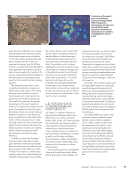
these cases, therefore, only a portion of the flaw could be suc-
cessfully scanned, resulting in an underestimation of flaw size.
Further work should be devoted to adapting the sensing
probe to enable scanning on curved surfaces, which could
be accomplished using either conformable wedges or fully
stretchable and flexible transducer arrays, as recently demon-
strated by one of the authors and collaborators (Hu et al. 2018).
This is an area of open research.
While the primary goal of the present research is to
improve current hand verification techniques for rail flaws,
the fast SAF technique introduced here could also be imple-
mented in motion. Possibilities for in-motion imaging could be
a walking-stick wheel or even an inspecting hi-railer vehicle,
although important issues such as fast image data interpreta-
tion and full rail coverage (probably requiring multiple arrays
simultaneously) would have to be addressed.
ACKNOWLEDGMENTS
This research was funded by the US Federal Railroad Administration under
contract no. 693JJ619C000008 (Dr. Robert Wilson, Program Manager).
The authors acknowledge the technical feedback provided by Dr. Wilson
throughout this project. The authors also acknowledge the support of
the former Transportation Technology Center (now MxV Rail) in Pueblo,
Colorado, and especially Dr. Anish Poudel, for providing the rail test
sections utilized in the validation tests and the ground truth information,
as well as assisting with the evaluation of the results. Finally, the authors
would like to acknowledge Mr. Gavin Dao of Advanced OEM Solutions
(West Chester, OH) for providing technical advice on SAF hardware
solutions and valuable insights over the use of the multiplexer currently
adopted in the prototype.
REFERENCES
Drinkwater, B. W., and P. D. Wilcox. 2006. “Ultrasonic arrays for
non-destructive evaluation: A review.” NDT &E International 39 (7):
525–41. https://doi.org/10.1016/j.ndteint.2006.03.006.
Flaherty, J. J., K. R. Erikson, and V. M. Lund. 1967. Synthetic aperture
ultrasonic imaging systems. U.S. Patent 3,548,642, filed 2 March 1967, and
issued 22 December 1970.
Frazier, C. H., and W. D. O’Brien. 1998. “Synthetic aperture tech-
niques with a virtual source element.” IEEE Transactions on Ultra-
sonics, Ferroelectrics, and Frequency Control 45 (1): 196–207. https://doi.
org/10.1109/58.646925.
Hu, H., X. Zhu, C. Wang, L. Zhang, X. Li, S. Lee, Z. Huang, et al. 2018.
“Stretchable ultrasonic transducer arrays for three-dimensional imaging
on complex surfaces.” Science Advances 4 (3): eaar3979. https://doi.
org/10.1126/sciadv.aar3979.
Huang, C., and F. Lanza di Scalea. 2022. “High Resolution Real Time
Synthetic Aperture Imaging in Solids Using Virtual Elements,” Proceed-
ings of the ASME 2022 International Mechanical Engineering Congress
and Exposition. Volume 9: Mechanics of Solids, Structures, and Fluids
Micro- and Nano-Systems Engineering and Packaging Safety Engineering,
Risk, and Reliability Analysis Research Posters. https://doi.org/10.1115/
IMECE2022-94445.
Jensen, J. A., S. I. Nikolov, K. L. Gammelmark, and M. H. Pedersen. 2006.
“Synthetic aperture ultrasound imaging.” Ultrasonics 44 (Suppl. 1): e5–15.
https://doi.org/10.1016/j.ultras.2006.07.017.
Karaman, M., P. -C. Li, and M. O’Donnell. 1995. “Synthetic aperture
imaging for small scale systems.” IEEE Transactions on Ultrasonics,
Ferroelectrics, and Frequency Control 42 (3): 429–42. https://doi.
org/10.1109/58.384453.
Lockwood, G. R., J. R. Talman, and S. S. Brunke. 1998. “Real-time 3-D
ultrasound imaging using sparse synthetic aperture beamforming.” IEEE
Transactions on Ultrasonics, Ferroelectrics, and Frequency Control 45 (4):
980–88. https://doi.org/10.1109/58.710573.
Lanza di Scalea, F., 2007, “Ultrasonic testing applications in the railroad
industry,” Chapter 15: Special Applications of Ultrasonic Testing, in
Non-destructive Testing Handbook, 3rd edition, P.O. Moore, ed., American
Society for Nondestructive Testing, pp. 535-552.
Lanza di Scalea, F., S. Sternini, and T. V. Nguyen. 2017. “Ultrasonic imaging
in solids using wave mode beamforming.” IEEE Transactions on Ultra-
sonics, Ferroelectrics, and Frequency Control 64 (3): 602–16. https://doi.
org/10.1109/TUFFC.2016.2637299.
Martin-Arguedas, C. J., D. Romero-Laorden, O. Martinez-Graullera, M.
Perez-Lopez, and L. Gomez-Ullate. 2012. “An ultrasonic imaging system
based on a new SAFT approach and a GPU beamformer.” IEEE Transac-
tions on Ultrasonics, Ferroelectrics, and Frequency Control 59 (7): 1402–12.
https://doi.org/10.1109/TUFFC.2012.2341.
Sternini, S., A. Y. Liang, and F. Lanza di Scalea. 2019a. “Ultrasonic
synthetic aperture imaging with interposed transducer–medium coupling
path.” Structural Health Monitoring 18 (5-6): 1543–56. https://doi.
org/10.1177/1475921718805514.
Sternini, S., A. Y. Liang, and F. Lanza di Scalea. 2019b. “Rail Defect Imaging
by Improved Ultrasonic Synthetic Aperture Focus Techniques.” Materials
Evaluation 77 (7): 931–40.
Witte, M., and A. Poudel. 2016. “High-speed rail flaw detection using
phased array ultrasonics.” Technology Digest TD16-030.
J A N U A R Y 2 0 2 4 • M A T E R I A L S E V A L U A T I O N 59
2401 ME January.indd 59 12/20/23 8:01 AM
cessfully scanned, resulting in an underestimation of flaw size.
Further work should be devoted to adapting the sensing
probe to enable scanning on curved surfaces, which could
be accomplished using either conformable wedges or fully
stretchable and flexible transducer arrays, as recently demon-
strated by one of the authors and collaborators (Hu et al. 2018).
This is an area of open research.
While the primary goal of the present research is to
improve current hand verification techniques for rail flaws,
the fast SAF technique introduced here could also be imple-
mented in motion. Possibilities for in-motion imaging could be
a walking-stick wheel or even an inspecting hi-railer vehicle,
although important issues such as fast image data interpreta-
tion and full rail coverage (probably requiring multiple arrays
simultaneously) would have to be addressed.
ACKNOWLEDGMENTS
This research was funded by the US Federal Railroad Administration under
contract no. 693JJ619C000008 (Dr. Robert Wilson, Program Manager).
The authors acknowledge the technical feedback provided by Dr. Wilson
throughout this project. The authors also acknowledge the support of
the former Transportation Technology Center (now MxV Rail) in Pueblo,
Colorado, and especially Dr. Anish Poudel, for providing the rail test
sections utilized in the validation tests and the ground truth information,
as well as assisting with the evaluation of the results. Finally, the authors
would like to acknowledge Mr. Gavin Dao of Advanced OEM Solutions
(West Chester, OH) for providing technical advice on SAF hardware
solutions and valuable insights over the use of the multiplexer currently
adopted in the prototype.
REFERENCES
Drinkwater, B. W., and P. D. Wilcox. 2006. “Ultrasonic arrays for
non-destructive evaluation: A review.” NDT &E International 39 (7):
525–41. https://doi.org/10.1016/j.ndteint.2006.03.006.
Flaherty, J. J., K. R. Erikson, and V. M. Lund. 1967. Synthetic aperture
ultrasonic imaging systems. U.S. Patent 3,548,642, filed 2 March 1967, and
issued 22 December 1970.
Frazier, C. H., and W. D. O’Brien. 1998. “Synthetic aperture tech-
niques with a virtual source element.” IEEE Transactions on Ultra-
sonics, Ferroelectrics, and Frequency Control 45 (1): 196–207. https://doi.
org/10.1109/58.646925.
Hu, H., X. Zhu, C. Wang, L. Zhang, X. Li, S. Lee, Z. Huang, et al. 2018.
“Stretchable ultrasonic transducer arrays for three-dimensional imaging
on complex surfaces.” Science Advances 4 (3): eaar3979. https://doi.
org/10.1126/sciadv.aar3979.
Huang, C., and F. Lanza di Scalea. 2022. “High Resolution Real Time
Synthetic Aperture Imaging in Solids Using Virtual Elements,” Proceed-
ings of the ASME 2022 International Mechanical Engineering Congress
and Exposition. Volume 9: Mechanics of Solids, Structures, and Fluids
Micro- and Nano-Systems Engineering and Packaging Safety Engineering,
Risk, and Reliability Analysis Research Posters. https://doi.org/10.1115/
IMECE2022-94445.
Jensen, J. A., S. I. Nikolov, K. L. Gammelmark, and M. H. Pedersen. 2006.
“Synthetic aperture ultrasound imaging.” Ultrasonics 44 (Suppl. 1): e5–15.
https://doi.org/10.1016/j.ultras.2006.07.017.
Karaman, M., P. -C. Li, and M. O’Donnell. 1995. “Synthetic aperture
imaging for small scale systems.” IEEE Transactions on Ultrasonics,
Ferroelectrics, and Frequency Control 42 (3): 429–42. https://doi.
org/10.1109/58.384453.
Lockwood, G. R., J. R. Talman, and S. S. Brunke. 1998. “Real-time 3-D
ultrasound imaging using sparse synthetic aperture beamforming.” IEEE
Transactions on Ultrasonics, Ferroelectrics, and Frequency Control 45 (4):
980–88. https://doi.org/10.1109/58.710573.
Lanza di Scalea, F., 2007, “Ultrasonic testing applications in the railroad
industry,” Chapter 15: Special Applications of Ultrasonic Testing, in
Non-destructive Testing Handbook, 3rd edition, P.O. Moore, ed., American
Society for Nondestructive Testing, pp. 535-552.
Lanza di Scalea, F., S. Sternini, and T. V. Nguyen. 2017. “Ultrasonic imaging
in solids using wave mode beamforming.” IEEE Transactions on Ultra-
sonics, Ferroelectrics, and Frequency Control 64 (3): 602–16. https://doi.
org/10.1109/TUFFC.2016.2637299.
Martin-Arguedas, C. J., D. Romero-Laorden, O. Martinez-Graullera, M.
Perez-Lopez, and L. Gomez-Ullate. 2012. “An ultrasonic imaging system
based on a new SAFT approach and a GPU beamformer.” IEEE Transac-
tions on Ultrasonics, Ferroelectrics, and Frequency Control 59 (7): 1402–12.
https://doi.org/10.1109/TUFFC.2012.2341.
Sternini, S., A. Y. Liang, and F. Lanza di Scalea. 2019a. “Ultrasonic
synthetic aperture imaging with interposed transducer–medium coupling
path.” Structural Health Monitoring 18 (5-6): 1543–56. https://doi.
org/10.1177/1475921718805514.
Sternini, S., A. Y. Liang, and F. Lanza di Scalea. 2019b. “Rail Defect Imaging
by Improved Ultrasonic Synthetic Aperture Focus Techniques.” Materials
Evaluation 77 (7): 931–40.
Witte, M., and A. Poudel. 2016. “High-speed rail flaw detection using
phased array ultrasonics.” Technology Digest TD16-030.
J A N U A R Y 2 0 2 4 • M A T E R I A L S E V A L U A T I O N 59
2401 ME January.indd 59 12/20/23 8:01 AM