to temperature changes throughout the day) and over the long
term (for example, owing to changing interactions between
the rail and the surrounding structure and factors such as rail
maintenance and train movement) (Kish et al. 1987). RNT in an
existing CWR system can be reset by conducting stress modi-
fication procedures for example, by cutting the rail that is in a
state of tension to release the axial stress and then pulling and
reconnecting (welding) the rail ends so that the system is at a
new RNT value. This procedure is destructive, labor-intensive,
and disrupts rail operation. As a result, such procedures are
used sparingly because of concerns about extreme stress states
in the rail. Nondestructive testing (NDT) methods that can
determine rail stress state are helpful to guide appropriate use
of such stress modifying procedures. Given the variation of
RNT value in a rail system, knowing stress or RNT with NDT
is critical to identify potential for high-stress situations in rail
sections and to address buckling risk in a timely fashion. NDT
methods that predict values of in-place rail strain provide a
strong representation of overall rail stress state because strain
can be used to compute rail stress and load (when the rail
cross-sectional area and steel Young’s modulus are known),
and RNT (when the rail temperature and thermal expansion
coefficient are known).
The use of nondestructive measurement technologies
has been recognized as an important component of good rail
stress or RNT management practice (Read 2005). Past studies
have considered a variety of physical phenomena for the
basis of NDT methods (Elliot 1979), but none of them satisfy
all the needed criteria or deliver acceptable accuracy (Huang
et al. 2023). In particular, several NDT techniques based on
rail vibration frequency have been explored, usually limited
to the low-frequency vibration range not exceeding 1 kHz.
For example, Boggs (1994) studied vibration frequencies of
an analytical rail dynamic model by adding a coefficient to
account for moderate effects of shear and rotational inertia,
and used multiple resonance frequencies to determine the
supporting stiffness and axial load. Béliveau (1997) compared
the relationship between resonance frequencies and axial load
predicted by various types of analytical rail dynamic models
where the results were evaluated with experimental data.
Recently, Belding et al. (2023) employed an artificial neural
network to estimate RNT that is trained by the experimental
low-frequency set of rail resonances. However, other studies
suggest that the mechanical characteristics of supporting
structures (for example, rail pads, anchors, clips, crossties, and
foundational bases) profoundly influence the vibration reso-
nance values of rail, especially in the frequency range below
5 kHz (Connolly et al. 2015 Thompson 2009). Understanding
this behavior, we explore the feasibility of using rail resonance
behavior at higher frequencies (20 kHz and above) to estimate
in situ rail axial strain and/or RNT more precisely, without the
disrupting effects of the supporting structure.
In this paper we present a practical vibration measurement
approach to collect vibration data from in-service CWR and
study the correlation between rail axial strain and frequency
of individual selected high-frequency resonance modes. The
goal is to identify vibration resonances for which the frequency
remains correlated to rail axial strain across different testing
times, temperatures, stress conditions, and rail locations. This
proposed approach offers advantages over existing measure-
ment technologies in that (a) a single reference-free mea-
surement provides estimates of in-place rail stress condition
(b) high-frequency vibrations are used, thereby avoiding the cor-
rupting influences from rail support structures and (c) the tests
are nondestructive and do not disrupt rail service. Our study
brings practical relevance because it demonstrates results using
rail temperature, strain, RNT, and vibration data collected from
an active instrumented track line over a period of two years.
Rail Instrumentation and Measurement
Field test data were collected from a commercial Class 1 rail
freight line in active service in central Illinois. The line main-
tains high traffic volume, loads, and train passage frequency.
The data were collected within a 3.2 km (2 mi.) tangent track
(straight track) section that runs in the east-west direction. The
CWR track structure comprises a nominal 136RE profile on
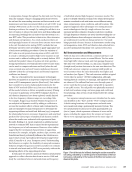
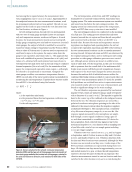
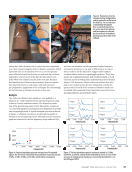
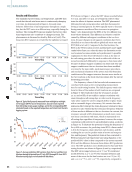
wood crossties where the rail is fastened by steel spikes and
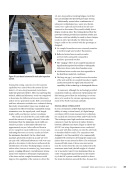
rail anchors (see Figure 1). The track structure exhibits a typical
“every other tie anchor” (EOTA) configuration, although
varying physical condition, tie spacings, and tightness of spikes
are observed. The railhead has been worn through years of
service such that the actual in-place rail profile is equivalent
to an 132RE section. The rail profile was physically measured
at both test locations using a rail wear gauge and confirmed
by measuring a thin section of rail obtained after the cutting
procedure.
Two separate testing locations were identified on the same
rail, identified as the “East” and the “West” testing locations.
At both testing locations, rail temperature and axial strain
were monitored using a permanently mounted system. The
two measurement locations are located approximately 4 m
(160 in.) apart, which represents a distance of seven rail tie
spans, excluding the spans where the sensors are located.
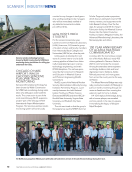
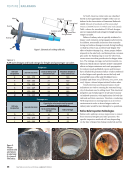
The tie-to-tie spacings (spacing between the inner edges of
1 2
Figure 1. Part of the test site in Illinois showing the section reserved for
rail cutting, indicated by 1, and the span for instrumentation at the East
test location, indicated by 2. The location of the West test location is not
shown in this photo.
J A N U A R Y 2 0 2 4 • M A T E R I A L S E V A L U A T I O N 61
2401 ME January.indd 61 12/20/23 8:01 AM
term (for example, owing to changing interactions between
the rail and the surrounding structure and factors such as rail
maintenance and train movement) (Kish et al. 1987). RNT in an
existing CWR system can be reset by conducting stress modi-
fication procedures for example, by cutting the rail that is in a
state of tension to release the axial stress and then pulling and
reconnecting (welding) the rail ends so that the system is at a
new RNT value. This procedure is destructive, labor-intensive,
and disrupts rail operation. As a result, such procedures are
used sparingly because of concerns about extreme stress states
in the rail. Nondestructive testing (NDT) methods that can
determine rail stress state are helpful to guide appropriate use
of such stress modifying procedures. Given the variation of
RNT value in a rail system, knowing stress or RNT with NDT
is critical to identify potential for high-stress situations in rail
sections and to address buckling risk in a timely fashion. NDT
methods that predict values of in-place rail strain provide a
strong representation of overall rail stress state because strain
can be used to compute rail stress and load (when the rail
cross-sectional area and steel Young’s modulus are known),
and RNT (when the rail temperature and thermal expansion
coefficient are known).
The use of nondestructive measurement technologies
has been recognized as an important component of good rail
stress or RNT management practice (Read 2005). Past studies
have considered a variety of physical phenomena for the
basis of NDT methods (Elliot 1979), but none of them satisfy
all the needed criteria or deliver acceptable accuracy (Huang
et al. 2023). In particular, several NDT techniques based on
rail vibration frequency have been explored, usually limited
to the low-frequency vibration range not exceeding 1 kHz.
For example, Boggs (1994) studied vibration frequencies of
an analytical rail dynamic model by adding a coefficient to
account for moderate effects of shear and rotational inertia,
and used multiple resonance frequencies to determine the
supporting stiffness and axial load. Béliveau (1997) compared
the relationship between resonance frequencies and axial load
predicted by various types of analytical rail dynamic models
where the results were evaluated with experimental data.
Recently, Belding et al. (2023) employed an artificial neural
network to estimate RNT that is trained by the experimental
low-frequency set of rail resonances. However, other studies
suggest that the mechanical characteristics of supporting
structures (for example, rail pads, anchors, clips, crossties, and
foundational bases) profoundly influence the vibration reso-
nance values of rail, especially in the frequency range below
5 kHz (Connolly et al. 2015 Thompson 2009). Understanding
this behavior, we explore the feasibility of using rail resonance
behavior at higher frequencies (20 kHz and above) to estimate
in situ rail axial strain and/or RNT more precisely, without the
disrupting effects of the supporting structure.
In this paper we present a practical vibration measurement
approach to collect vibration data from in-service CWR and
study the correlation between rail axial strain and frequency
of individual selected high-frequency resonance modes. The
goal is to identify vibration resonances for which the frequency
remains correlated to rail axial strain across different testing
times, temperatures, stress conditions, and rail locations. This
proposed approach offers advantages over existing measure-
ment technologies in that (a) a single reference-free mea-
surement provides estimates of in-place rail stress condition
(b) high-frequency vibrations are used, thereby avoiding the cor-
rupting influences from rail support structures and (c) the tests
are nondestructive and do not disrupt rail service. Our study
brings practical relevance because it demonstrates results using
rail temperature, strain, RNT, and vibration data collected from
an active instrumented track line over a period of two years.
Rail Instrumentation and Measurement
Field test data were collected from a commercial Class 1 rail
freight line in active service in central Illinois. The line main-
tains high traffic volume, loads, and train passage frequency.
The data were collected within a 3.2 km (2 mi.) tangent track
(straight track) section that runs in the east-west direction. The
CWR track structure comprises a nominal 136RE profile on
wood crossties where the rail is fastened by steel spikes and
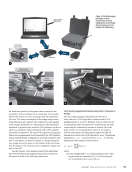
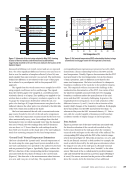
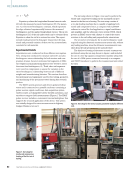
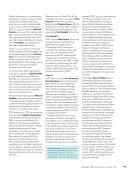
rail anchors (see Figure 1). The track structure exhibits a typical
“every other tie anchor” (EOTA) configuration, although
varying physical condition, tie spacings, and tightness of spikes
are observed. The railhead has been worn through years of
service such that the actual in-place rail profile is equivalent
to an 132RE section. The rail profile was physically measured
at both test locations using a rail wear gauge and confirmed
by measuring a thin section of rail obtained after the cutting
procedure.
Two separate testing locations were identified on the same
rail, identified as the “East” and the “West” testing locations.
At both testing locations, rail temperature and axial strain
were monitored using a permanently mounted system. The
two measurement locations are located approximately 4 m
(160 in.) apart, which represents a distance of seven rail tie
spans, excluding the spans where the sensors are located.
The tie-to-tie spacings (spacing between the inner edges of
1 2
Figure 1. Part of the test site in Illinois showing the section reserved for
rail cutting, indicated by 1, and the span for instrumentation at the East
test location, indicated by 2. The location of the West test location is not
shown in this photo.
J A N U A R Y 2 0 2 4 • M A T E R I A L S E V A L U A T I O N 61
2401 ME January.indd 61 12/20/23 8:01 AM