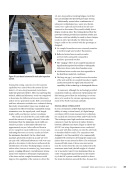
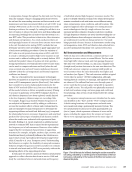
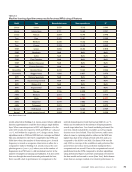
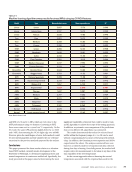
testing day. Each vibration test at a given location comprised
10 or more repeated impulse-driven vibration responses, which
represents one set of responses. Five to 13 sets of responses
were collected at each test location on each test day, and con-
sequently a total of 73 sets at the East location and 65 sets
at the West were collected across all the test days. Because
this impulse-based vibration measurement does not require
any mounted sensors or rail surface and track structure
pre-preparation, application of the technique does not damage
the rail structure or disrupt rail service in any way.
Analysis
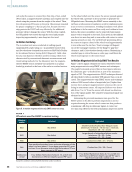
The collected vibration time signals are zero-padded to a
duration of 1 s and transformed into spectral responses using
a discrete Fourier transform routine. The frequency resolu-
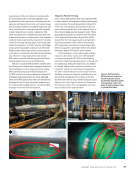
tion of the spectral responses is 1 Hz. The spectra of each set
(~10 repeated signals) are averaged across frequency to provide
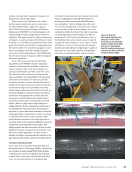
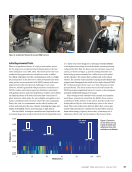
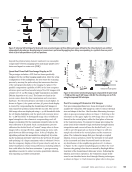
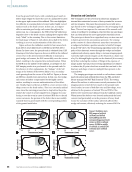
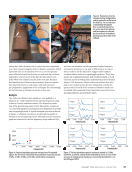
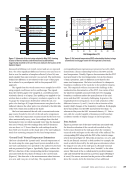
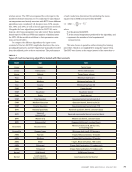
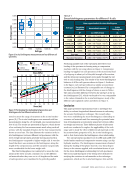
one averaged spectrum. A typical averaged spectrum is shown
in Figure 4. Vibration resonances are identified as peaks or
maxima in the averaged spectrum. Although several resonance
peaks are observed in the low frequency range under 20 kHz,
we focus our attention on four prominent higher frequency
resonances around 31, 37, 39, and 76 kHz because we expect
these modes to not be affected by support and boundary
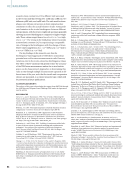
condition effects such as tie span length variation. These four
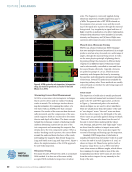
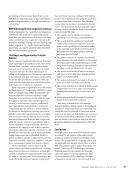
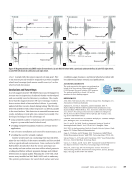
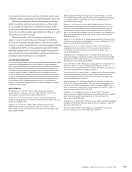
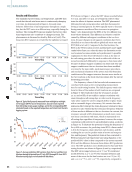
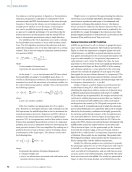
modes are consistently present and visually trackable at both
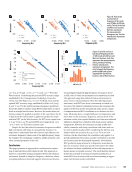
locations across all testing days, as illustrated in more detail in
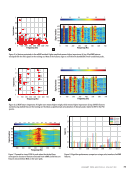
Figure 5. The frequency values at the peak of these four reso-
nances are tracked across the nine testing days, and the fre-
quency values of each of the monitored vibration modes are
correlated with measured strain values that occur at the corre-
sponding vibration measurement times.
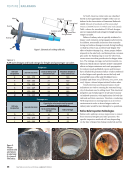
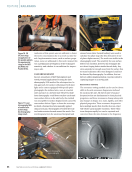
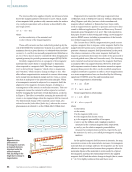
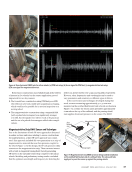
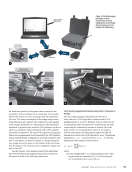
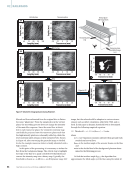
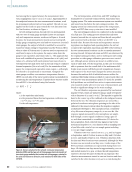
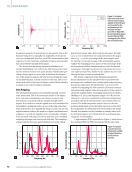
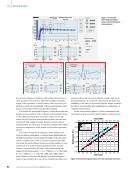
Condenser microphone
Steel impactor
Figure 3. Illustration of (a) the
vibration testing configuration
and (b) application of the test at
the field site. The rail vibration
is initiated by the impulse
from a steel ball impactor at
the center-top of the railhead,
and the response is collected
by the condenser microphone
pointing toward the side of the
railhead.
20 000 0
0.0000
0.0002
0.0004
0.0006
40 000 60 000
Frequency (Hz)
80 000 100 000 120 000
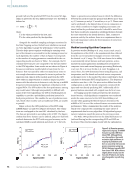
Figure 4. A typical amplitude spectrum averaged over 10 repeated
signals. The red arrows indicate the four prominent resonances around
31 kHz, 37 kHz, 39 kHz, and 76 kHz, which will be investigated.
5 August
15 August
29 August
5 August
15 August
29 August
5 Augustu
15 Augustu
29 Augustu
5
15
29
30 800 31 000 31 200 31 400 31 600
Frequency (Hz)
36 800 37 000 37 200 37 400
Frequency (Hz)
39 000 39 200 39 400 39 600 39 800
Frequency (Hz)
76 200 76 400 76 600 76 800
Frequency (Hz)
77 000
s
s
s
AAugust
AAugust
AAugust
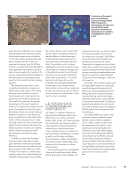
Figure 5. The four prominent spectral resonances around (a) 31 kHz
(b) 39 kHz (c) 37 kHz and (d) 76 kHz (indicated by arrows in cases of the
presence of multiple peaks nearby) are consistently identified on 5, 15,
and 29 August 2019.
J A N U A R Y 2 0 2 4 • M A T E R I A L S E V A L U A T I O N 63
2401 ME January.indd 63 12/20/23 8:01 AM
Amplitude
10 or more repeated impulse-driven vibration responses, which
represents one set of responses. Five to 13 sets of responses
were collected at each test location on each test day, and con-
sequently a total of 73 sets at the East location and 65 sets
at the West were collected across all the test days. Because
this impulse-based vibration measurement does not require
any mounted sensors or rail surface and track structure
pre-preparation, application of the technique does not damage
the rail structure or disrupt rail service in any way.
Analysis
The collected vibration time signals are zero-padded to a
duration of 1 s and transformed into spectral responses using
a discrete Fourier transform routine. The frequency resolu-
tion of the spectral responses is 1 Hz. The spectra of each set
(~10 repeated signals) are averaged across frequency to provide
one averaged spectrum. A typical averaged spectrum is shown
in Figure 4. Vibration resonances are identified as peaks or
maxima in the averaged spectrum. Although several resonance
peaks are observed in the low frequency range under 20 kHz,
we focus our attention on four prominent higher frequency
resonances around 31, 37, 39, and 76 kHz because we expect
these modes to not be affected by support and boundary
condition effects such as tie span length variation. These four
modes are consistently present and visually trackable at both
locations across all testing days, as illustrated in more detail in
Figure 5. The frequency values at the peak of these four reso-
nances are tracked across the nine testing days, and the fre-
quency values of each of the monitored vibration modes are
correlated with measured strain values that occur at the corre-
sponding vibration measurement times.
Condenser microphone
Steel impactor
Figure 3. Illustration of (a) the
vibration testing configuration
and (b) application of the test at
the field site. The rail vibration
is initiated by the impulse
from a steel ball impactor at
the center-top of the railhead,
and the response is collected
by the condenser microphone
pointing toward the side of the
railhead.
20 000 0
0.0000
0.0002
0.0004
0.0006
40 000 60 000
Frequency (Hz)
80 000 100 000 120 000
Figure 4. A typical amplitude spectrum averaged over 10 repeated
signals. The red arrows indicate the four prominent resonances around
31 kHz, 37 kHz, 39 kHz, and 76 kHz, which will be investigated.
5 August
15 August
29 August
5 August
15 August
29 August
5 Augustu
15 Augustu
29 Augustu
5
15
29
30 800 31 000 31 200 31 400 31 600
Frequency (Hz)
36 800 37 000 37 200 37 400
Frequency (Hz)
39 000 39 200 39 400 39 600 39 800
Frequency (Hz)
76 200 76 400 76 600 76 800
Frequency (Hz)
77 000
s
s
s
AAugust
AAugust
AAugust
Figure 5. The four prominent spectral resonances around (a) 31 kHz
(b) 39 kHz (c) 37 kHz and (d) 76 kHz (indicated by arrows in cases of the
presence of multiple peaks nearby) are consistently identified on 5, 15,
and 29 August 2019.
J A N U A R Y 2 0 2 4 • M A T E R I A L S E V A L U A T I O N 63
2401 ME January.indd 63 12/20/23 8:01 AM
Amplitude