LEADERSHIP
|
SCOPE
NDT AS A PROFESSION:
IN CONCLUSION
This is the last of a three-part series that examines whether nondestruc-
tive testing (NDT) is a profession or just an occupation. In the first article,
I outlined the differences between occupations and professions, and last
month I assessed the NDT field specifically to determine whether it’s a
profession or occupation. I summarized that NDT meets some, but not
all, of the tests defining a profession. While the presence of specialized
knowledge and education, ethical standards and codes of conduct, and
regulation support the notion that NDT is a profession, questions remain
related to independent certification and continuing education require-
ments, inconsistent pathways for entry and progression in the field, and
lack of public trust and recognition.
This month, I’ll explain why this discussion is important and relevant for
ASNT but also for the education and training institutions that support the
field, for the organizations who employ NDT professionals, and for the
clients who rely on NDT to produce and maintain safe and high-quality
goods and services.
Let’s start by exploring why this discussion is so important. Many
readers who have made a career of NDT may be asking, “What’s the big
deal? Why is it important to categorize NDT as a profession or occupa-
tion?” I would start by going back to my first day on the job here at ASNT
on 8 July 2019. The Chair of the Board Scott Cargill and President Michael
McGloin were kind enough to come to Columbus to welcome me and to
outline what they saw as ASNT’s priorities. We discussed many things, but
the challenge they highlighted, which underscored everything else we
discussed, was the fact that NDT was little known (outside the field itself,
of course). They lamented that there was no clear pathway to enter and
progress through the field. People just made their way.
In countless discussions since then with members, educators, clients,
and the like, this problem has been repeated. How can we be consid-
ered a profession without being recognized by the general public for
the important work we do and the role we play in creating a safer world?
ASNT has engaged extensively in advocating for NDT through public
relations and advertising, but just being aware of the field won’t be
enough. There must also be a clear pathway to find and enter the field.
Traditional professions such as law and medicine require completion of
specific educational requirements followed by independent licensing.
Newer professions such as information technology (IT) once started out
very much like NDT, with no recognized pathway for entry, but over the
past 40 years, this has been addressed as the people who employ IT
professionals demanded a minimum level of higher education and in
some cases certification. You may still find the self-taught IT professional
in the workforce with a high school education, but generally people need
a minimum of a four-year degree to be employable today.
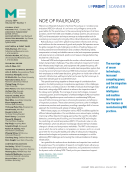
NEAL J. COUTURE, CAE
ASNT CEO
NCOUTURE@ASNT.ORG
How can we be
considered a
profession
without being
recognized by the
general public
for the important
work we do and
the role we play
in creating a safer
world?
J A N U A R Y 2 0 2 4 • M A T E R I A L S E V A L U A T I O N 89
2401 ME January.indd 89 12/20/23 8:01 AM
|
SCOPE
NDT AS A PROFESSION:
IN CONCLUSION
This is the last of a three-part series that examines whether nondestruc-
tive testing (NDT) is a profession or just an occupation. In the first article,
I outlined the differences between occupations and professions, and last
month I assessed the NDT field specifically to determine whether it’s a
profession or occupation. I summarized that NDT meets some, but not
all, of the tests defining a profession. While the presence of specialized
knowledge and education, ethical standards and codes of conduct, and
regulation support the notion that NDT is a profession, questions remain
related to independent certification and continuing education require-
ments, inconsistent pathways for entry and progression in the field, and
lack of public trust and recognition.
This month, I’ll explain why this discussion is important and relevant for
ASNT but also for the education and training institutions that support the
field, for the organizations who employ NDT professionals, and for the
clients who rely on NDT to produce and maintain safe and high-quality
goods and services.
Let’s start by exploring why this discussion is so important. Many
readers who have made a career of NDT may be asking, “What’s the big
deal? Why is it important to categorize NDT as a profession or occupa-
tion?” I would start by going back to my first day on the job here at ASNT
on 8 July 2019. The Chair of the Board Scott Cargill and President Michael
McGloin were kind enough to come to Columbus to welcome me and to
outline what they saw as ASNT’s priorities. We discussed many things, but
the challenge they highlighted, which underscored everything else we
discussed, was the fact that NDT was little known (outside the field itself,
of course). They lamented that there was no clear pathway to enter and
progress through the field. People just made their way.
In countless discussions since then with members, educators, clients,
and the like, this problem has been repeated. How can we be consid-
ered a profession without being recognized by the general public for
the important work we do and the role we play in creating a safer world?
ASNT has engaged extensively in advocating for NDT through public
relations and advertising, but just being aware of the field won’t be
enough. There must also be a clear pathway to find and enter the field.
Traditional professions such as law and medicine require completion of
specific educational requirements followed by independent licensing.
Newer professions such as information technology (IT) once started out
very much like NDT, with no recognized pathway for entry, but over the
past 40 years, this has been addressed as the people who employ IT
professionals demanded a minimum level of higher education and in
some cases certification. You may still find the self-taught IT professional
in the workforce with a high school education, but generally people need
a minimum of a four-year degree to be employable today.
NEAL J. COUTURE, CAE
ASNT CEO
NCOUTURE@ASNT.ORG
How can we be
considered a
profession
without being
recognized by the
general public
for the important
work we do and
the role we play
in creating a safer
world?
J A N U A R Y 2 0 2 4 • M A T E R I A L S E V A L U A T I O N 89
2401 ME January.indd 89 12/20/23 8:01 AM