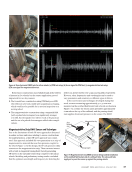
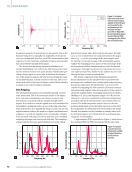
domain, showing which resonance frequency (or
frequencies) exist for that object.
From 2005 to 2007 (Verhelst 2008), under
the European Commission and its consortium,
the WOLAXIM program, supported a project
titled “Wheelset Integrated Design and Effective
Maintenance (WIDEM)” for the development of a
compensated resonance inspection prototype for
wheelsets. This project aimed to improve inspection
techniques on axles and expand the lifetime of axles
in Europe. A set of fully decommissioned axles, both
good and cracked, were tested in a suspended static
test rig. The axles were excited by an impact source
from a tap hammer, and the resonance frequen-
cies were recorded and analyzed. The WIDEM data
showed that resonance frequency shifts on fatigued
axles were significant.
In 2017 and 2018, researchers at MxV Rail
expanded on the WIDEM work by conducting
research to determine the feasibility of using res-
onance testing to detect axle discontinuities on
moving trains (Poudel and Witte 2018 FRA 2020).
The objective of this work was to determine the
range, sensitivity, and repeatability of the measure-
ment that will be required to detect an axle dis-
continuity and also to assess whether the result is
feasible for in-motion detection. In the first step, the
measurement range and repeatability were deter-
mined using accelerometers mounted to the axle on
a wheelset rolling in a laboratory rig. It was demon-
strated that, with appropriate excitation, the axle
resonance exceeded rolling noise at high frequen-
cies (above 20 kHz) and was repeatedly measured
within 3 dB for a single impact (tap testing) on a
rolling wheelset. The measurements were shown to
be repeatable for each axle tested. The resonance
response of a given axle/wheel assembly is more like
a fingerprint than a characteristic, in that it is unique
to each assembly. However, the resonance differ-
ences between new axles of the same type were in
the same order as the resonance differences between
nondefective and artificially notched axles. This
finding implies that axle anomalies will only be iden-
tifiable if a baseline resonance test is stored for every
axle in the sample population. In other words, a
baseline resonance response must be taken for every
axle/wheelset that will be monitored by this method.
INFRARED THERMOGRAPHY
In 2017 and 2018, researchers from MxV Rail and
Boeing Research &Technology (BR&T) explored the
use of infrared thermography (IR) NDE methods
to develop an in-motion technology for detecting
cracked axles on moving trains (Poudel and Witte
2020). Several experiments were designed and
conducted to eliminate the most relevant unknowns
related to applying the flash IR NDE method to
moving axles and demonstrating flash IR inspec-
tion capabilities. The key findings from this work
were that the IR approach could detect fine surface
or near-surface cracks of varied shapes, sizes, and
orientations within the body of the axle in a moving
car using high frame rate IR cameras. In order to
measure 20% to 25% of the circumference, four or
five flash infrared camera systems must be spaced
to image the axle at angles 72° to 90° apart. A stand-
off distance of 1.5 m or more between the camera
and the axle, with off-line-of-sight surface angles of
more than 30°, are easily achieved, with minimal
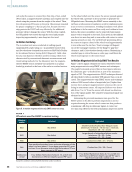
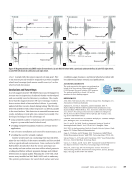
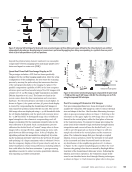
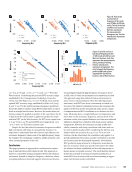
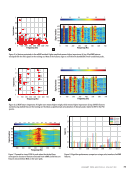
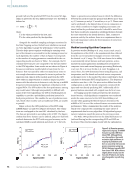
reduction of crack detectability. Figure 12 shows
Magnetic sensor for triggering
Ramp for rolling the test sample
IR camera head
Giraffe system
Saturation of detectors
Figure 12. Flash IRT:
(a) in-motion laboratory test
setup (b) in-motion flash
IRT results on axle with EDM
notches (c) high speed (1000
frames/s) long-wavelength
flash IRT results for the test axle
rotated on the lathe at 200 rpm
(Poudel and Witte 2020).
J A N U A R Y 2 0 2 4 • M A T E R I A L S E V A L U A T I O N 35
2401 ME January.indd 35 12/20/23 8:01 AM
frequencies) exist for that object.
From 2005 to 2007 (Verhelst 2008), under
the European Commission and its consortium,
the WOLAXIM program, supported a project
titled “Wheelset Integrated Design and Effective
Maintenance (WIDEM)” for the development of a
compensated resonance inspection prototype for
wheelsets. This project aimed to improve inspection
techniques on axles and expand the lifetime of axles
in Europe. A set of fully decommissioned axles, both
good and cracked, were tested in a suspended static
test rig. The axles were excited by an impact source
from a tap hammer, and the resonance frequen-
cies were recorded and analyzed. The WIDEM data
showed that resonance frequency shifts on fatigued
axles were significant.
In 2017 and 2018, researchers at MxV Rail
expanded on the WIDEM work by conducting
research to determine the feasibility of using res-
onance testing to detect axle discontinuities on
moving trains (Poudel and Witte 2018 FRA 2020).
The objective of this work was to determine the
range, sensitivity, and repeatability of the measure-
ment that will be required to detect an axle dis-
continuity and also to assess whether the result is
feasible for in-motion detection. In the first step, the
measurement range and repeatability were deter-
mined using accelerometers mounted to the axle on
a wheelset rolling in a laboratory rig. It was demon-
strated that, with appropriate excitation, the axle
resonance exceeded rolling noise at high frequen-
cies (above 20 kHz) and was repeatedly measured
within 3 dB for a single impact (tap testing) on a
rolling wheelset. The measurements were shown to
be repeatable for each axle tested. The resonance
response of a given axle/wheel assembly is more like
a fingerprint than a characteristic, in that it is unique
to each assembly. However, the resonance differ-
ences between new axles of the same type were in
the same order as the resonance differences between
nondefective and artificially notched axles. This
finding implies that axle anomalies will only be iden-
tifiable if a baseline resonance test is stored for every
axle in the sample population. In other words, a
baseline resonance response must be taken for every
axle/wheelset that will be monitored by this method.
INFRARED THERMOGRAPHY
In 2017 and 2018, researchers from MxV Rail and
Boeing Research &Technology (BR&T) explored the
use of infrared thermography (IR) NDE methods
to develop an in-motion technology for detecting
cracked axles on moving trains (Poudel and Witte
2020). Several experiments were designed and
conducted to eliminate the most relevant unknowns
related to applying the flash IR NDE method to
moving axles and demonstrating flash IR inspec-
tion capabilities. The key findings from this work
were that the IR approach could detect fine surface
or near-surface cracks of varied shapes, sizes, and
orientations within the body of the axle in a moving
car using high frame rate IR cameras. In order to
measure 20% to 25% of the circumference, four or
five flash infrared camera systems must be spaced
to image the axle at angles 72° to 90° apart. A stand-
off distance of 1.5 m or more between the camera
and the axle, with off-line-of-sight surface angles of
more than 30°, are easily achieved, with minimal
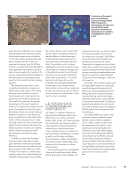
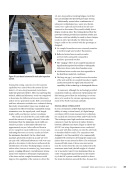
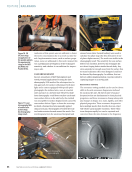
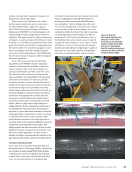
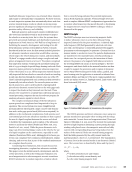
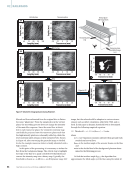
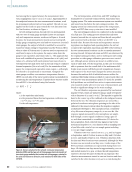
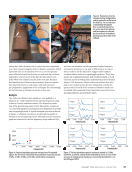
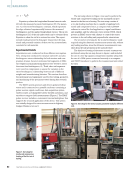
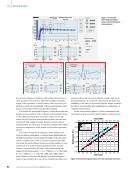
reduction of crack detectability. Figure 12 shows
Magnetic sensor for triggering
Ramp for rolling the test sample
IR camera head
Giraffe system
Saturation of detectors
Figure 12. Flash IRT:
(a) in-motion laboratory test
setup (b) in-motion flash
IRT results on axle with EDM
notches (c) high speed (1000
frames/s) long-wavelength
flash IRT results for the test axle
rotated on the lathe at 200 rpm
(Poudel and Witte 2020).
J A N U A R Y 2 0 2 4 • M A T E R I A L S E V A L U A T I O N 35
2401 ME January.indd 35 12/20/23 8:01 AM