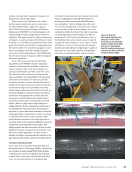
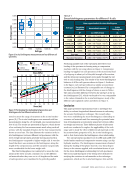
of 54.7–61.2 kph with the sensors spaced 508 mm apart. Five
to six sensors per rail would be required to provide complete
wheel tread coverage (each sensor would cover ±90° on the
wheel in both directions).
Conclusions and Future Steps
A novel magnetostrictive SH EMAT sensor and technique for
revenue service inspection of railroad wheels was developed
and successfully tested in laboratory conditions. The results
show that the magnetostrictive SH wave technique works to
detect various kinds of internal wheel defects. A previously
undetected flaw was also found during testing. The SH wave
detected all defects with robust responses on defects parallel
to the tread surface. This detection is essential because most
cracks, including vertical split rims, initiate horizontally. The
developed technique has the advantages of:
Ñ using a limited number of stationary rail-mounted probes to
inspect a 50 mm wide band of wheel tread,
Ñ avoiding extensive foundation work for a revenue service
application,
Ñ ease of sensor installation and removal for maintenance, and
Ñ avoiding the need for a liquid couplant.
Current work focuses on conducting tests that will deter-
mine the survivability of the sensor assembly and the notched
rail in a typical railroad environment. Tests conducted at MxV
Rail facilities already show that the sensor prototypes are
very sturdy and can endure over two million wheel passes in
a rolling load fixture without apparent damage and without
deterioration in signal quality. Planning for a test with a full
sensor array installed on MxV Rail’s FAST track is underway.
The system’s performance for varied wheel surface and wear
conditions, gage clearance, and lateral wheelset position will
be addressed in future research and publications.
ACKNOWLEDGMENTS
The work reported in this paper was performed on
behalf of the Association of American Railroads’
(AAR) Strategic Research Initiative (SRI) program.
The authors would like to thank AAR and its
members for their funding support.
REFERENCES
AAR. 2023. Field Manual of the AAR Interchange Rules. Washington: D.C.
Association of American Railroads.
Asplund, M., M. Palo, S. Famurewa, and M. Rantatalo. 2016. “A
Study of Railway Wheel Profile Parameters Used as Indicators of an
Increased Risk of Wheel Defects. Proc. Institution of Mechanical Engi-
neers, Part F.” Proceedings of the Institution of Mechanical Engineers.
Part F, Journal of Rail and Rapid Transit 230 (2): 323–34. https://doi.
org/10.1177/0954409714541953.
COMSOL. 2023 Introduction to COMSOL Multiphysics. COMSOL Multiph-
ysics, Burlington, MA. Accessed May 2023.
Fan, H., and H. Jia. 2008. “Study on Automatic Testing of Treads of
Running Railroad Wheels.” Proc.17th WCNDT. Shanghai, China.
FRA. 2019. An Implementation Guide for Wayside Detector Systems. Wash-
ington, DC: Federal Railroad Administration.
Gage, S., J. Robeda, and R. Morgan. 2001. “Evaluation of AEAT Wheel
Profile Measurement System.” AAR/TTCI. Technology Digest: TD 01-026.
Galvan-Nunez, S., A. Poudel, and B. Lindeman. 2022. “Laser Broken Rim
Detector – Part II. MxV Rail. Technology Digest.
Garcia, G., S. Kalay, and D. Carter. 2007. “Automated Cracked Wheel Detec-
tion System Overview.” AAR/TTCI. Technology Digest: TD-07-028.
Hirao, M., and H. Ogi. 2017. Electromagnetic Acoustic Transducers -
Noncontacting Ultrasonic Measurements using EMATs. 2nd ed., Springer.
https://doi.org/10.1007/978-4-431-56036-4.
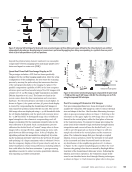
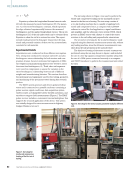
Defect
Cracked Cracked
AX-863 Left
POS-1
AX-965 Left
POS-1
AX-935 Right
POS-4
CAL Right
POS-4
FBH-0.5 in. dia. FBH-0.25 in. dia. FBH-1.0 in. dia.
Input signal
OD notch
Wraparound signal
Wraparound signal
Input signal
Wraparound signal
Wraparound signal
Input
signal Input signal
FBH signals
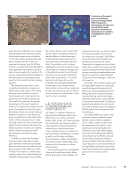
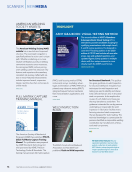
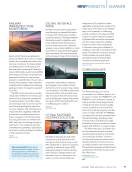
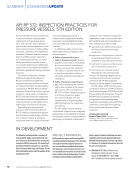
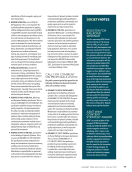
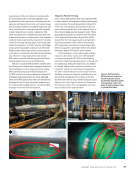
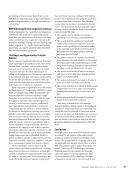
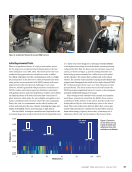
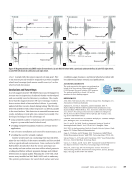
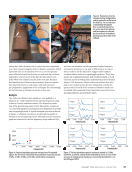
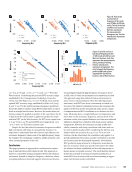
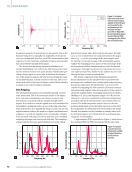
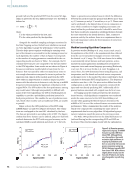
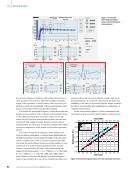
Figure 9. Magnetostrictive strip EMAT results for test wheels: (a) axle 863 left wheel with a previously unknown defect (b) axle 935 right wheel
(c) axle 965 left wheel (d) calibration axle right wheel.
WATCH
THE VIDEO
J A N U A R Y 2 0 2 4 • M A T E R I A L S E V A L U A T I O N 49
2401 ME January.indd 49 12/20/23 8:01 AM
to six sensors per rail would be required to provide complete
wheel tread coverage (each sensor would cover ±90° on the
wheel in both directions).
Conclusions and Future Steps
A novel magnetostrictive SH EMAT sensor and technique for
revenue service inspection of railroad wheels was developed
and successfully tested in laboratory conditions. The results
show that the magnetostrictive SH wave technique works to
detect various kinds of internal wheel defects. A previously
undetected flaw was also found during testing. The SH wave
detected all defects with robust responses on defects parallel
to the tread surface. This detection is essential because most
cracks, including vertical split rims, initiate horizontally. The
developed technique has the advantages of:
Ñ using a limited number of stationary rail-mounted probes to
inspect a 50 mm wide band of wheel tread,
Ñ avoiding extensive foundation work for a revenue service
application,
Ñ ease of sensor installation and removal for maintenance, and
Ñ avoiding the need for a liquid couplant.
Current work focuses on conducting tests that will deter-
mine the survivability of the sensor assembly and the notched
rail in a typical railroad environment. Tests conducted at MxV
Rail facilities already show that the sensor prototypes are
very sturdy and can endure over two million wheel passes in
a rolling load fixture without apparent damage and without
deterioration in signal quality. Planning for a test with a full
sensor array installed on MxV Rail’s FAST track is underway.
The system’s performance for varied wheel surface and wear
conditions, gage clearance, and lateral wheelset position will
be addressed in future research and publications.
ACKNOWLEDGMENTS
The work reported in this paper was performed on
behalf of the Association of American Railroads’
(AAR) Strategic Research Initiative (SRI) program.
The authors would like to thank AAR and its
members for their funding support.
REFERENCES
AAR. 2023. Field Manual of the AAR Interchange Rules. Washington: D.C.
Association of American Railroads.
Asplund, M., M. Palo, S. Famurewa, and M. Rantatalo. 2016. “A
Study of Railway Wheel Profile Parameters Used as Indicators of an
Increased Risk of Wheel Defects. Proc. Institution of Mechanical Engi-
neers, Part F.” Proceedings of the Institution of Mechanical Engineers.
Part F, Journal of Rail and Rapid Transit 230 (2): 323–34. https://doi.
org/10.1177/0954409714541953.
COMSOL. 2023 Introduction to COMSOL Multiphysics. COMSOL Multiph-
ysics, Burlington, MA. Accessed May 2023.
Fan, H., and H. Jia. 2008. “Study on Automatic Testing of Treads of
Running Railroad Wheels.” Proc.17th WCNDT. Shanghai, China.
FRA. 2019. An Implementation Guide for Wayside Detector Systems. Wash-
ington, DC: Federal Railroad Administration.
Gage, S., J. Robeda, and R. Morgan. 2001. “Evaluation of AEAT Wheel
Profile Measurement System.” AAR/TTCI. Technology Digest: TD 01-026.
Galvan-Nunez, S., A. Poudel, and B. Lindeman. 2022. “Laser Broken Rim
Detector – Part II. MxV Rail. Technology Digest.
Garcia, G., S. Kalay, and D. Carter. 2007. “Automated Cracked Wheel Detec-
tion System Overview.” AAR/TTCI. Technology Digest: TD-07-028.
Hirao, M., and H. Ogi. 2017. Electromagnetic Acoustic Transducers -
Noncontacting Ultrasonic Measurements using EMATs. 2nd ed., Springer.
https://doi.org/10.1007/978-4-431-56036-4.
Defect
Cracked Cracked
AX-863 Left
POS-1
AX-965 Left
POS-1
AX-935 Right
POS-4
CAL Right
POS-4
FBH-0.5 in. dia. FBH-0.25 in. dia. FBH-1.0 in. dia.
Input signal
OD notch
Wraparound signal
Wraparound signal
Input signal
Wraparound signal
Wraparound signal
Input
signal Input signal
FBH signals
Figure 9. Magnetostrictive strip EMAT results for test wheels: (a) axle 863 left wheel with a previously unknown defect (b) axle 935 right wheel
(c) axle 965 left wheel (d) calibration axle right wheel.
WATCH
THE VIDEO
J A N U A R Y 2 0 2 4 • M A T E R I A L S E V A L U A T I O N 49
2401 ME January.indd 49 12/20/23 8:01 AM