ABSTR ACT
This paper presents an experimental prototype
developed for rail flaw imaging. This capability
can help obtain quantitative information on
detected flaws during manual flaw verification.
Ultrasonic synthetic aperture focus (SAF) imaging
has advantages over phased-array imaging for both
speed and accuracy. The prototype developed is
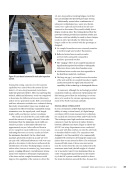
hosted in a portable and battery-powered carry-on
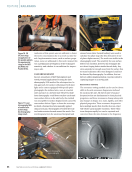
size case. The probe is a linear ultrasonic array
mounted on a wedge and with a position encoder to
build 3D point clouds from 2D beamformed images.
The prototype includes several advances over the
basic SAF technique, including sparse subarray
firing that allows fast imaging speeds (e.g., 25 Hz)
without sacrificing image accuracy. Validation results
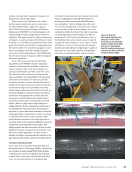
are presented from scans performed on rail sections
from the FRA rail defect library, which contains
natural transverse defects and artificial end-drilled
hole defects. The tests showed good accuracy in
defect size and shape, as compared to the available
ground truth information, for defects located away
from the railhead corners. Additional developments
are required to properly cover the head corners, and
especially in the case of heavily worn rails.
KEYWORDS: nondestructive testing, ultrasonic imaging,
synthetic aperture focus, SAF, phased arrays, rail flaws
Introduction
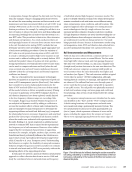
Internal rail flaws are a significant cause of train accidents.
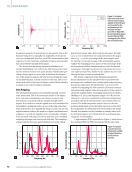
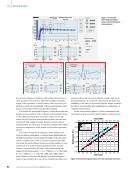
According to FRA’s Safety Statistics data shown in Figure 1, in
the past five years (2018–2022) detail fractures were responsi-
ble for as many as 222 derailments and damage cost of US$79
million (the highest cost of any other cause within the category
of Track, Roadbed, and Structures). Transverse/compound
fissures (TF) were responsible for 77 derailments and US$21
million in damage, and vertical split head (VSH) defects
caused 83 derailments and ~US$20 million in damage. These
three defects combined, therefore, caused as many as ~80
derailments per year and ~US$25 million in damage per year.
The detection and quantification of these flaws is clearly of
importance to railroad safety and efficiency.
The current manual verification of detected flaws consists
of a simple ultrasonic pulse-echo test conducted using a
handheld ultrasonic transducer with a wedge that is manually
moved around the flaw in attempt to estimate the flaw size
through a –6 dB threshold technique (Lanza di Scalea 2007).
This process yields rail flaw sizing results that are highly sub-
jective to the operator’s judgement. An improved flaw verifi-
cation would allow the generation of 3D ultrasound images of
the internal flaw for an objective determination of flaw size and
orientation. Knowledge of the correct flaw size can inform the
most appropriate remedial actions, which can largely reduce
the cost of rail maintenance and improve safety.
Current OEM portable systems exist for manual flaw
imaging in structural components using ultrasonic techniques.
These systems are based on phased array (PA) technology
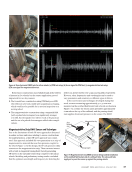
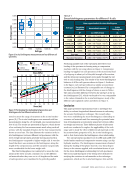
(Witte and Poudel 2016). As schematized in Figure 2, in PAs
the transmission is sent to all channels that are appropri-
ately delayed for physical focusing and steering at various
depths. This means that (a) the PA hardware is fairly compli-
cated because of the multiple digital-to-analog (D/A) output
channels required (b) the PA imaging speed is limited by the
need to physically focus at different locations in the medium
and (c) the classical PA beamforming is only achieved in trans-
mission through focused beams, which limits the lateral reso-
lution. Conversely, synthetic aperture focus (SAF) techniques
have been considered for defect imaging for various benefits
over the PA methods (Drinkwater and Wilcox 2006). In a tradi-
tional SAF scheme, the transmission is sent to a single channel
NDTTECHPAPER
|
ME
RAIL FLAW IMAGING PROTOTYPE BASED
ON IMPROVED ULTRASONIC SYNTHETIC
APERTURE FOCUS METHOD
BY CHENGYANG HUANG* AND FRANCESCO LANZA DI SCALEA*†
*Experimental Mechanics &NDE Laboratory, Department of Structural
Engineering, University of California at San Diego, La Jolla, CA 92093
† flanza@ucsd.edu
Materials Evaluation 82 (1): 51–59
https://doi.org/10.32548/2024.me-04371
©2024 American Society for Nondestructive Testing
J A N U A R Y 2 0 2 4 • M A T E R I A L S E V A L U A T I O N 51
2401 ME January.indd 51 12/20/23 8:01 AM
This paper presents an experimental prototype
developed for rail flaw imaging. This capability
can help obtain quantitative information on
detected flaws during manual flaw verification.
Ultrasonic synthetic aperture focus (SAF) imaging
has advantages over phased-array imaging for both
speed and accuracy. The prototype developed is
hosted in a portable and battery-powered carry-on
size case. The probe is a linear ultrasonic array
mounted on a wedge and with a position encoder to
build 3D point clouds from 2D beamformed images.
The prototype includes several advances over the
basic SAF technique, including sparse subarray
firing that allows fast imaging speeds (e.g., 25 Hz)
without sacrificing image accuracy. Validation results
are presented from scans performed on rail sections
from the FRA rail defect library, which contains
natural transverse defects and artificial end-drilled
hole defects. The tests showed good accuracy in
defect size and shape, as compared to the available
ground truth information, for defects located away
from the railhead corners. Additional developments
are required to properly cover the head corners, and
especially in the case of heavily worn rails.
KEYWORDS: nondestructive testing, ultrasonic imaging,
synthetic aperture focus, SAF, phased arrays, rail flaws
Introduction
Internal rail flaws are a significant cause of train accidents.
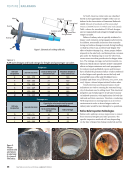
According to FRA’s Safety Statistics data shown in Figure 1, in
the past five years (2018–2022) detail fractures were responsi-
ble for as many as 222 derailments and damage cost of US$79
million (the highest cost of any other cause within the category
of Track, Roadbed, and Structures). Transverse/compound
fissures (TF) were responsible for 77 derailments and US$21
million in damage, and vertical split head (VSH) defects
caused 83 derailments and ~US$20 million in damage. These
three defects combined, therefore, caused as many as ~80
derailments per year and ~US$25 million in damage per year.
The detection and quantification of these flaws is clearly of
importance to railroad safety and efficiency.
The current manual verification of detected flaws consists
of a simple ultrasonic pulse-echo test conducted using a
handheld ultrasonic transducer with a wedge that is manually
moved around the flaw in attempt to estimate the flaw size
through a –6 dB threshold technique (Lanza di Scalea 2007).
This process yields rail flaw sizing results that are highly sub-
jective to the operator’s judgement. An improved flaw verifi-
cation would allow the generation of 3D ultrasound images of
the internal flaw for an objective determination of flaw size and
orientation. Knowledge of the correct flaw size can inform the
most appropriate remedial actions, which can largely reduce
the cost of rail maintenance and improve safety.
Current OEM portable systems exist for manual flaw
imaging in structural components using ultrasonic techniques.
These systems are based on phased array (PA) technology
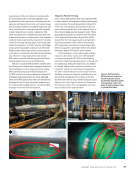
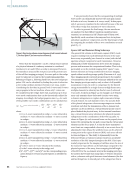
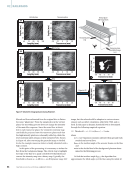
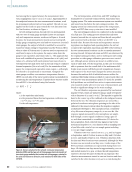
(Witte and Poudel 2016). As schematized in Figure 2, in PAs
the transmission is sent to all channels that are appropri-
ately delayed for physical focusing and steering at various
depths. This means that (a) the PA hardware is fairly compli-
cated because of the multiple digital-to-analog (D/A) output
channels required (b) the PA imaging speed is limited by the
need to physically focus at different locations in the medium
and (c) the classical PA beamforming is only achieved in trans-
mission through focused beams, which limits the lateral reso-
lution. Conversely, synthetic aperture focus (SAF) techniques
have been considered for defect imaging for various benefits
over the PA methods (Drinkwater and Wilcox 2006). In a tradi-
tional SAF scheme, the transmission is sent to a single channel
NDTTECHPAPER
|
ME
RAIL FLAW IMAGING PROTOTYPE BASED
ON IMPROVED ULTRASONIC SYNTHETIC
APERTURE FOCUS METHOD
BY CHENGYANG HUANG* AND FRANCESCO LANZA DI SCALEA*†
*Experimental Mechanics &NDE Laboratory, Department of Structural
Engineering, University of California at San Diego, La Jolla, CA 92093
† flanza@ucsd.edu
Materials Evaluation 82 (1): 51–59
https://doi.org/10.32548/2024.me-04371
©2024 American Society for Nondestructive Testing
J A N U A R Y 2 0 2 4 • M A T E R I A L S E V A L U A T I O N 51
2401 ME January.indd 51 12/20/23 8:01 AM