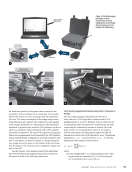
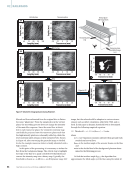
the transverse position of the probe when scanned on the
rail surface, with a resolution of 16 counts/mm. The encoder
allowed the system to create 3D images from the individual
2D scans. The array was coupled to the wedge using conven-
tional ultrasonic gel couplant. The couplant was also applied
at the wedge/rail interface to compensate for the impedance
mismatch. A graphical user interface (GUI) platform was devel-
oped on a standard commercial laptop with a GPU available
for parallel computation. All steps of the signal processing algo-
rithms were programmed and automated in the GUI platform,
which enabled flexible configuration and result analysis for the
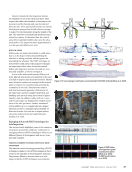
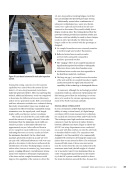
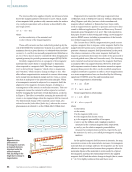
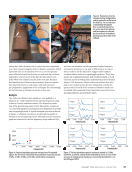
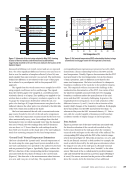
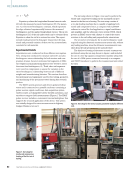
user’s convenience. As shown in Figure 3c, during testing the
user simply moves the probe on the surface of the rail section,
and 3D images of the scanned area are displayed in quasi real
time in the GUI.
Specific features of the image reconstruction algorithms
that were developed and implemented in the prototype are
discussed in detail in the following subsections.
Time Backpropagation Beamforming with a Transducer
Wedge
The time backpropagation algorithm (also known as
delay-and-sum or DAS algorithm) is widely used in SAF
imaging (Jensen et al. 2006). Dynamic focus is achieved both
in transmission and in reception by considering the ray path
connecting the transmitting transducer element, the focus
point, and the receiving transducer element. An image is
built by summing the backpropagated signals through all
transmitter-receiver pairs of the transducer array. Considering
transmitters i =1, 2,…, M and receivers j =1, 2,…, N, the DAS
beamformed SAF image is constructed as:
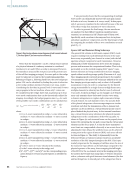
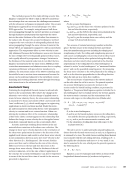
(1) I(y, z) = ∑
i=1
M ∑
j=1
N Aij(τij,yz)
where
the time of flight (TOF) ij,yz is the propagation time of the
ray path from the transmitter Ti(yi, zi) to the focus pixel
P(y, z) and back to the receiver Rj(yj, zj).
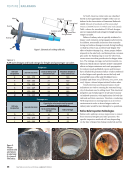
Ultrasonic array
(2.25 MHz, 64 elements)
Wedge
(55° shear wave)
Encoder
(16 counts/mm)
Case
Case
Battery
Multiplexer
Probe holder
(array+encoder)
Laptop computer
(MATLAB GUI)
Data
Data
Power
Laptop GUI
Handheld probe
Scan
direction
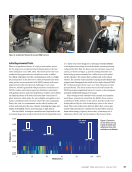
Figure 3. Portable imaging
prototype: (a) main
components (b) array-
wedge probe (c) prototype
during scanning of a rail
section in the laboratory.
J A N U A R Y 2 0 2 4 • M A T E R I A L S E V A L U A T I O N 53
2401 ME January.indd 53 12/20/23 8:01 AM
rail surface, with a resolution of 16 counts/mm. The encoder
allowed the system to create 3D images from the individual
2D scans. The array was coupled to the wedge using conven-
tional ultrasonic gel couplant. The couplant was also applied
at the wedge/rail interface to compensate for the impedance
mismatch. A graphical user interface (GUI) platform was devel-
oped on a standard commercial laptop with a GPU available
for parallel computation. All steps of the signal processing algo-
rithms were programmed and automated in the GUI platform,
which enabled flexible configuration and result analysis for the
user’s convenience. As shown in Figure 3c, during testing the
user simply moves the probe on the surface of the rail section,
and 3D images of the scanned area are displayed in quasi real
time in the GUI.
Specific features of the image reconstruction algorithms
that were developed and implemented in the prototype are
discussed in detail in the following subsections.
Time Backpropagation Beamforming with a Transducer
Wedge
The time backpropagation algorithm (also known as
delay-and-sum or DAS algorithm) is widely used in SAF
imaging (Jensen et al. 2006). Dynamic focus is achieved both
in transmission and in reception by considering the ray path
connecting the transmitting transducer element, the focus
point, and the receiving transducer element. An image is
built by summing the backpropagated signals through all
transmitter-receiver pairs of the transducer array. Considering
transmitters i =1, 2,…, M and receivers j =1, 2,…, N, the DAS
beamformed SAF image is constructed as:
(1) I(y, z) = ∑
i=1
M ∑
j=1
N Aij(τij,yz)
where
the time of flight (TOF) ij,yz is the propagation time of the
ray path from the transmitter Ti(yi, zi) to the focus pixel
P(y, z) and back to the receiver Rj(yj, zj).
Ultrasonic array
(2.25 MHz, 64 elements)
Wedge
(55° shear wave)
Encoder
(16 counts/mm)
Case
Case
Battery
Multiplexer
Probe holder
(array+encoder)
Laptop computer
(MATLAB GUI)
Data
Data
Power
Laptop GUI
Handheld probe
Scan
direction
Figure 3. Portable imaging
prototype: (a) main
components (b) array-
wedge probe (c) prototype
during scanning of a rail
section in the laboratory.
J A N U A R Y 2 0 2 4 • M A T E R I A L S E V A L U A T I O N 53
2401 ME January.indd 53 12/20/23 8:01 AM