Materials
The first testing set used two rail specimens to investigate the
stress-acoustic birefringence behavior. One specimen used for
this phase was a plate measuring 4 × 24 × 0.59 in. (102 × 610 ×
15 mm) machined from 136RE rail, and the second was a plate
measuring 2 × 24 × 0.59 in. (51 × 610 × 15 mm) machined from
141RE rail. The full-sized rail section was reduced to a plate
consisting of the rail’s web to be loaded using a 220-kip load
frame and achieve the desired stress range in both tensile and
compressive stages. Because these specimens were reduced
from a full rail cross section, the surface conditions were
uniform, machined-smooth surfaces.
The second testing set used 4-ft-long full cross-section
rails with as-received surface conditions to assess acoustic
properties. Five specimens from different rail weights/sources
were used: a 115RE rail specimen, a 119RE rail specimen, two
136RE rail specimens from different sources, and a 141RE
rail specimen. The specimens were tested with as-received
surface conditions that consisted of mill scale and light cor-
rosion products typical of in situ rail sections. The surface
conditions were kept the same to verify the EMAT’s capability
to launch and receive waves on realistic rail sections and to
provide test results for full cross-section specimens. The third
testing set involved cutting a 1 ft rail section to assess different
rails’ stress-acoustic relationship (m1). A compression testing
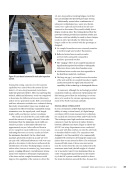
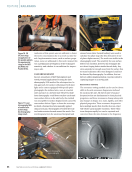
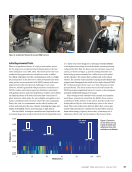
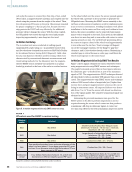
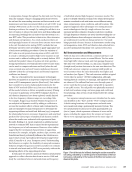
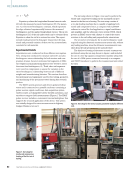
machine was used to load compression, as shown in Figure 2.
Data Collection and Analysis
For each testing phase and measurement point, ultrasonic
shear waves were collected at different polarization directions
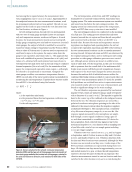
to gather the data needed for birefringence measurement (refer
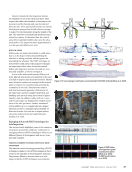
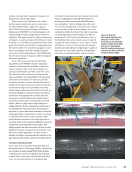
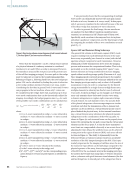
to Figure 3). The EMAT was placed at the web of the rails and
the pulser/receiver was set to launch and receive ultrasonic
shear waves through the thickness of the rail, polarized once in
the rail rolling direction and another set in the direction per-
pendicular to the rolling direction.
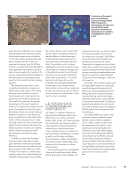
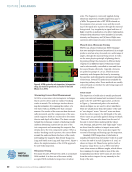
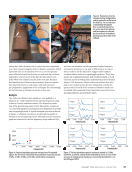
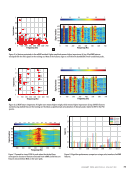
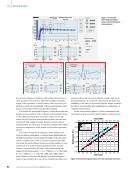
Figure 4 shows the user interface of the software and the
signal obtained from operating the EMAT on the stress-free
rails as an example to demonstrate how the shear wave data
was processed and the ToF was calculated. As can be seen in
the figure, multiple reflections from the back wall of the web
of the rails are captured in a single scan. A start gate and an
end gate are selected from these echoes, and the software cal-
culates the ToF automatically based on the zero crossing of
the waveform. The timing measurements typically included
multiple round-trip signals to mitigate potential timing delays
and other error sources. The custom software was designed to
capture multiple waveforms and batch process-time measure-
ments for different transducer orientations (i.e., polarization
directions).
The birefringence values used in this research were calcu-
lated from Equation 2 based on the ToF of the waves in each
polarization direction: the rolling direction and orthogonal
to the rolling direction. The ToF, rather than the velocity, was
chosen to calculate the birefringence in order to be able to
calculate the birefringence independently from material thick-
ness. In this way, if the rail section changes or is unknown
in the field, the birefringence can still be calculated. To illus-
trate the typical wave velocities, two orthogonally polarized
shear waves propagating through a 136RE unmachined rail
specimen showed a fast wave velocity in the rolling direction of
3235.5 m/s, whereas the velocity of slow waves polarized in the
orthogonal direction was 3230.7 m/s. Therefore, the resulting
unstressed birefringence was 0.0015 or 0.15%.
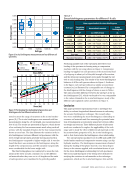
Results and Discussion
This section presents the results of the experimental tests con-
ducted for the three phases of the study. The first testing set
used two 24-in.-long rail specimens machined from 136RE and
141RE rails and explored the relationship between the applied
longitudinal stress in both tensile and stress regions and the
measured acoustic birefringence in rail materials. For this set
of testing, the test setup shown previously in Figure 1 was used
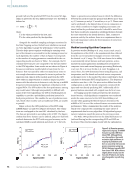
to apply incremental loading on the specimens up to about
60% of the yield capacity of the specimens in both tension
and compression to ensure that the loading remained in the
elastic regions. The two specimens were not machined simul-
taneously and the cross-sectional areas differed hence, the
stress ranges differed. At each incremental loading, the pulser/
receiver was set to launch and receive ultrasonic shear waves
once in the rolling direction and another time in the transverse
direction, and those data were saved for later analysis to obtain
Figure 3. Rail cross
section showing (a) the
path of ultrasonic waves
and (b) illustrating
orthogonal polarization
angles.
J A N U A R Y 2 0 2 4 • M A T E R I A L S E V A L U A T I O N 83
2401 ME January.indd 83 12/20/23 8:01 AM
The first testing set used two rail specimens to investigate the
stress-acoustic birefringence behavior. One specimen used for
this phase was a plate measuring 4 × 24 × 0.59 in. (102 × 610 ×
15 mm) machined from 136RE rail, and the second was a plate
measuring 2 × 24 × 0.59 in. (51 × 610 × 15 mm) machined from
141RE rail. The full-sized rail section was reduced to a plate
consisting of the rail’s web to be loaded using a 220-kip load
frame and achieve the desired stress range in both tensile and
compressive stages. Because these specimens were reduced
from a full rail cross section, the surface conditions were
uniform, machined-smooth surfaces.
The second testing set used 4-ft-long full cross-section
rails with as-received surface conditions to assess acoustic
properties. Five specimens from different rail weights/sources
were used: a 115RE rail specimen, a 119RE rail specimen, two
136RE rail specimens from different sources, and a 141RE
rail specimen. The specimens were tested with as-received
surface conditions that consisted of mill scale and light cor-
rosion products typical of in situ rail sections. The surface
conditions were kept the same to verify the EMAT’s capability
to launch and receive waves on realistic rail sections and to
provide test results for full cross-section specimens. The third
testing set involved cutting a 1 ft rail section to assess different
rails’ stress-acoustic relationship (m1). A compression testing
machine was used to load compression, as shown in Figure 2.
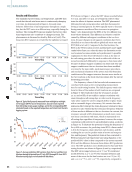
Data Collection and Analysis
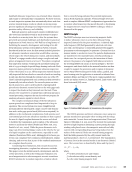
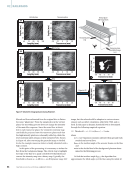
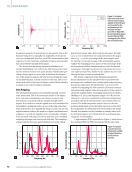
For each testing phase and measurement point, ultrasonic
shear waves were collected at different polarization directions
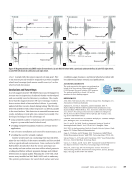
to gather the data needed for birefringence measurement (refer
to Figure 3). The EMAT was placed at the web of the rails and
the pulser/receiver was set to launch and receive ultrasonic
shear waves through the thickness of the rail, polarized once in
the rail rolling direction and another set in the direction per-
pendicular to the rolling direction.
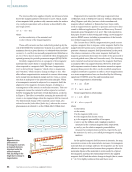
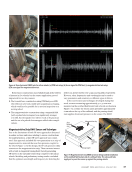
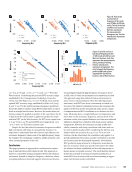
Figure 4 shows the user interface of the software and the
signal obtained from operating the EMAT on the stress-free
rails as an example to demonstrate how the shear wave data
was processed and the ToF was calculated. As can be seen in
the figure, multiple reflections from the back wall of the web
of the rails are captured in a single scan. A start gate and an
end gate are selected from these echoes, and the software cal-
culates the ToF automatically based on the zero crossing of
the waveform. The timing measurements typically included
multiple round-trip signals to mitigate potential timing delays
and other error sources. The custom software was designed to
capture multiple waveforms and batch process-time measure-
ments for different transducer orientations (i.e., polarization
directions).
The birefringence values used in this research were calcu-
lated from Equation 2 based on the ToF of the waves in each
polarization direction: the rolling direction and orthogonal
to the rolling direction. The ToF, rather than the velocity, was
chosen to calculate the birefringence in order to be able to
calculate the birefringence independently from material thick-
ness. In this way, if the rail section changes or is unknown
in the field, the birefringence can still be calculated. To illus-
trate the typical wave velocities, two orthogonally polarized
shear waves propagating through a 136RE unmachined rail
specimen showed a fast wave velocity in the rolling direction of
3235.5 m/s, whereas the velocity of slow waves polarized in the
orthogonal direction was 3230.7 m/s. Therefore, the resulting
unstressed birefringence was 0.0015 or 0.15%.
Results and Discussion
This section presents the results of the experimental tests con-
ducted for the three phases of the study. The first testing set
used two 24-in.-long rail specimens machined from 136RE and
141RE rails and explored the relationship between the applied
longitudinal stress in both tensile and stress regions and the
measured acoustic birefringence in rail materials. For this set
of testing, the test setup shown previously in Figure 1 was used
to apply incremental loading on the specimens up to about
60% of the yield capacity of the specimens in both tension
and compression to ensure that the loading remained in the
elastic regions. The two specimens were not machined simul-
taneously and the cross-sectional areas differed hence, the
stress ranges differed. At each incremental loading, the pulser/
receiver was set to launch and receive ultrasonic shear waves
once in the rolling direction and another time in the transverse
direction, and those data were saved for later analysis to obtain
Figure 3. Rail cross
section showing (a) the
path of ultrasonic waves
and (b) illustrating
orthogonal polarization
angles.
J A N U A R Y 2 0 2 4 • M A T E R I A L S E V A L U A T I O N 83
2401 ME January.indd 83 12/20/23 8:01 AM