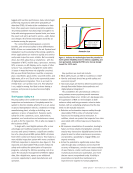
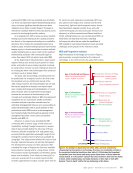
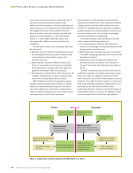
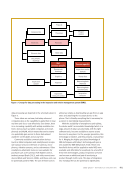
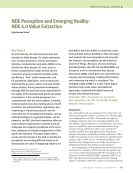
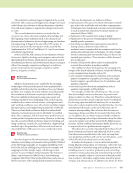
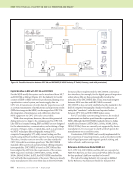
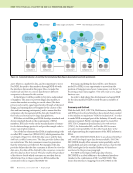
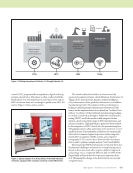
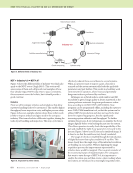
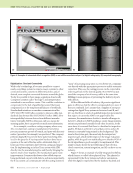
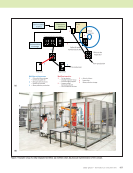
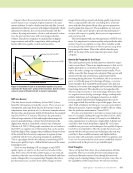
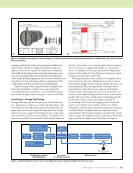
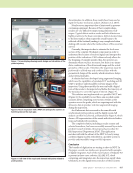
858 M A T E R I A L S E V A L U A T I O N • J U L Y 2 0 2 0 offline evaluation. This allows users to decouple inspection from evaluation and thereby parallelize it. This yields huge productivity gains. By introducing a single part flow and trace- ability based on serial numbers, the overall process safety is fully given at any time. By using the cloud, it is even possible to connect systems and sites into a world-spanning NDT network. This ensures that interpretation results and archived data are available to all employees of a global company every- where at any time. End customers can be easily integrated into the cloud and given access to the data from their parts. Figure 8 shows an example of such a setup. How Does This Affect Me? The world has never been more complex. As supply chains are expanding to cover every corner of the world, we see the rise of large-scale automation on the shop floor and beyond. Espe- cially Western economies face a growing competition from lower-wage countries that are quickly catching up in terms of technology. Many internal company departments have already been transformed by the digital disruption, and robots have become valued contributors in many areas. In every sector, from automotive to aerospace, the impact of automa- tion is undeniable. Companies understand that they are in a global competition these days, and that just continuing to do things the way they’ve always done them will most likely have severe consequences. NDT has traditionally been cautious when regarding change, and there are good reasons for it. In the end, all of us are responsible for the quality of the product that is delivered by our companies. Our work is far too important for thought- less experiments with technology. As the guardians of quality, the NDT industry has created a strong network of rigid stan- dards and regulations. The upside is an unprecedented quality system that protects our products, but on the downside these rigidities can often slow us down significantly. As a recent example, a supplier in the aerospace industry discovered substantial cost savings (roughly by a factor of 10) if they would switch from X-ray film to digital radiography, robotics, and computer numerical controls. The return of interest was amazing, and it would help the company to stay in business against its new competitors from Far East. Unfortunately, the project had to be abandoned as it was discovered that the parts were governed under a standard established in the 1970s, which could not be altered. Such situations are quite frequent in our industry and effectively destroy a huge amount of value that could be captured for our companies and countries. Even though such stories are common, our industry is already witnessing a fundamental transformation. New tech- nologies and approaches have been embraced in several industries like the automotive industry, which has less-rigid quality requirements than, for example, aerospace. To give a recent example, one of Germany’s leading automotive manu- facturers has just adopted an in-line CT system to inspect rotors for electric motors (VisiConsult 2019). The system uses an industrial robot for part handling and AI for the inter- pretation of the images. At the same time, the system is fully hooked up to the company’s cloud system and processes all the data in real time. The skill sets required for the operators of this system are completely different than what was required for the manual process of the past. It is important to realize the ongoing transformation and to invest in the new skills early. ME TECHNICAL PAPER w ndt 4.0: opportunity or threat? Figure 8. Example of a globally connected NDT operation. Each site has a number of X-ray systems that are linked to a central server. The servers are connected to the company-wide “NDT cloud,” which is also used as the central image archive. It is also possible to connect portable devices that can be used outside of specific sites. The interpretation can be done from anywhere in the world using a review software that is connected to the cloud.

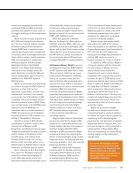
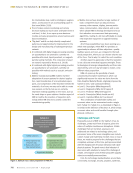
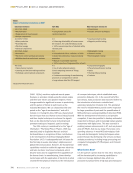
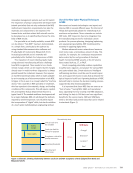
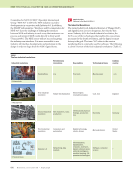
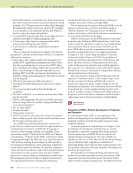
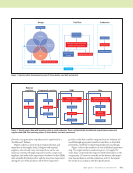
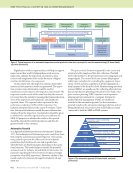
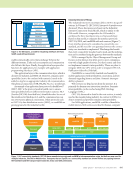
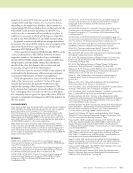
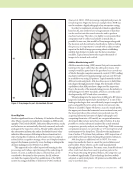
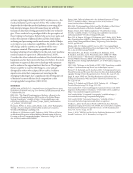
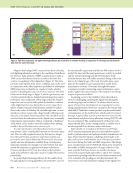
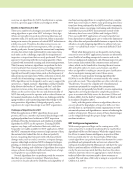
J U L Y 2 0 2 0 • M A T E R I A L S E V A L U A T I O N 859 Figure 9 shows the economies of scale of an automated system based on an exemplary implementation in the auto- motive industry. It can be clearly seen that with film (second industrial revolution) and even with digital radiography (third industrial revolution), the cost increases linearly with the volume. By using automation, robotics, and automatic evalua- tion, the unit cost decreases with increasing production volume. This allows companies to manufacture in higher- wage countries and still be competitive, while putting all human effort into quality control and innovation. NDT as a Sensor The data-driven trends of Industry 4.0 and NDT 4.0 are fueled by information provided by sensors. These sensors are omnipresent and range from discrete data points (such as temperature, time, position, etc.) to the most complex sensors that provide a much greater depth of information. An example found in NDT is CT systems, which have the potential to delivery large amounts of data and insight about inspected parts. In manufacturing, a current trend of interest is the digital twin, which is considered a virtual copy of the part (Madni et al. 2019). What people sometimes do not realize is that NDT can supply a lot of information that can be used to build this digital twin. Imagine the possibilities when you have all the as-built data for every component in a given system combined with the ever-advancing simulation capabilities. This is a paradigm shift for the industry, transforming NDT from a pure quality step to a full industrial sensor in the manu- facturing process. Once we stop thinking of X-ray images as only NDT quality inputs, we start to see the next level of value in this data. This is true of both 2D and 3D images, so we must ask ourselves, what else can we learn from the hundreds and thou- sands of images that we are generating? Imagine what else a production process can learn from subtle changes in these images that mostly go unnoticed during quality inspections. Then, compound this effect by correlating these small vari- ances with the data gleaned from other process parameters used to make that same part. The possibilities are vast, and the NDT world can be proud to provide that information— not just with respect to quality, but to process improvement and control as well. This development will raise the importance of NDT even more. It is important to evaluate quality and provide the infor- mation if a part is acceptable or scrap. More valuable would be to also provide information on how to prevent scrap from happening in the future. This is the added value that puts NDT on the map of the most important processes of any company. How to Be Prepared for the Future The initial question posed in this paper was related to oppor- tunity versus threat. There is no singular answer to this, as it is highly dependent on context, but this movement will, one way or the other, change our industry fundamentally. There will be a need for this change to be adopted. This process will stretch over the next several years, and pressure will be increasing during that time. Nevertheless, this is no reason to panic or to blindly grasp at technology offerings—everyone must remember that each NDT professional’s job, first and foremost, is to ensure part integrity and to prevent faulty parts from being delivered. This should never be jeopardized by efficiency improvements or new technology therefore, there is a requirement to develop a strategic change roadmap with realistic milestones and contingency measures. A careful process analysis will reveal low-hanging fruits that can be easily approached. Beyond the scope of this paper, there are other fields of Industry 4.0 that pose even more potential for efficiency increases. A great example would be the use of big data for predictive maintenance (Vrana 2019). It is also very important to not take too many steps at one time. For example, making the leap from film (2.0) to a fully automated ADR robot system (4.0) may be too difficult for some organizations to achieve in a single effort. A better way could be to first switch from film to digital RT (3.0), then establish new processes and techniques, then qualify all opera- tors before moving further. After the people have been accli- mated with the new processes and techniques, the next step could be to then carefully automate and digitize further process steps with automatic/assisted defect recognition, and so on. It is recommended to reach out to established solution providers early in the process to get valuable input. Final Thoughts There is a big fear that robots, AI, and automation will take away jobs. This fear is mainly driven by misleading media articles and futuristic movies. Even though the new tech- nology can do amazing things, it does not even come close to the capabilities of the human brain. We will not see these No investment Investment in DR Automatic evaluation (ADR) Production volume A Investment in ADR Digital X-ray system (DR) Inspection by film (RT) B C Figure 9. Economies of scale of an automated system: A, B, and C represent the “break even” points of the investment. From A it makes sense to invest in DR and from B/C to invest in automation. Costs per part
ASNT grants non-exclusive, non-transferable license of this material to  .
All rights reserved. © ASNT 2026. To report unauthorized use, contact: customersupport@asnt.org