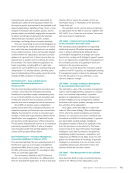
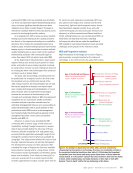
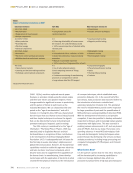
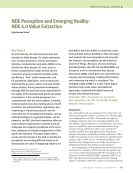
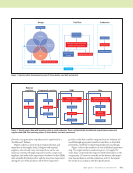
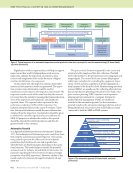
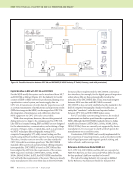
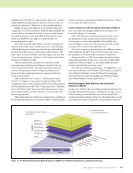
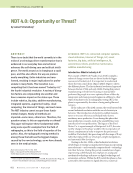
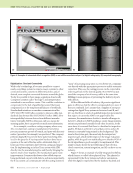
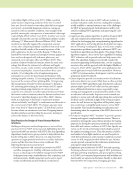
836 M A T E R I A L S E V A L U A T I O N • J U L Y 2 0 2 0 ME TECHNICAL PAPER w nde 4.0: perception and reality Committee for NDT (ICNDT) Specialist International Group “NDE 4.0” in 2019, the NDE industry reacted to developments in connection with Industry 4.0. In addition, the DGZfP subcommittee “Interfaces and Documentation for NDE 4.0” faces the challenge of defining the interfaces between NDE and industry in such a way that customers can process and interpret NDE results directly in their world (Vrana 2019b). The NDE sector will not succeed in giving the industry new interfaces. It is more reasonable to use Industry 4.0 interface developments and participate in the design in order to shape them for NDE requirements. The Industrial Revolutions The terms Industry 4.0, Industrial Internet of Things (IIoT), and digital factory are now ubiquitous, but what do they mean? Industry 4.0 is the fourth industrial revolution, the IIoT is one of the technologies that enables the connections necessary for the fourth revolution, and the digital or smart factory is the goal. The term “4.0” refers to the version numbering that is commonly used for software. The following is a brief overview of the four industrial revolutions (Table 1). Watch the video Welcome to the World of NDE 4.0 TABLE 1 The four industrial revolutions Industrial revolutions Revolutionary innovations Key enablers Technological basis Leading country © Johann Jaritz Handcrafting n/a Fire, tools Muscle power n/a © Wassily Frese First industrial revolution Simple mechanization Steam engine, renewable energies Coal, iron England Second industrial revolution New industries, mass production Chemical and physical findings, production line Electricity Germany Third industrial revolution Computers and automation Digital technology, robots, drones Microelectronics United States © Franziska Vrana Industry 4.0 Networking, data markets Informatization, digitalization, networks, interfaces, digital communication, artificial intelligence, machine learning, 5G, quantum technologies Software, computer science ?

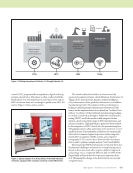
J U L Y 2 0 2 0 • M A T E R I A L S E V A L U A T I O N 837 The industrial revolution began in England in the second half of the 18th century and brought about change from hand- crafted forms of production to the mechanization of produc- tion with steam engines or regenerative energy sources such as water. The second industrial revolution was marked by the economic use of new chemical and physical knowledge and the beginning of new industries such as the chemical and pharmaceutical industries, electrical engineering, and mechan- ical engineering. It began at the end of the 19th century in Germany and led to the introduction of the assembly line (implemented in 1913 at Ford Motor Co.) and to new forms of industrial organization. At the end of the 20th century, the development of micro- electronics, digital technology, and computers ushered in the third industrial revolution, which allowed automated control of industrial production and revolutionized data processing in offices (for example, computers and laptops) as well as in private environments (for example, computers, mobile phones, and game consoles). All these developments were enabled by the emerging technologies of the particular period, were implemented to simplify industrial production, and allowed new and cheaper products. For example, the textile industry started during the first revolution and allowed everybody to afford clothing. However, multiple professions became unnecessary and working conditions were challenging. This, in the long run, resulted in the creation of trade unions, creating better and safer working conditions, more jobs, shorter workdays, longer life expectancies, and a higher living standard for everybody. The second and third revolutions helped to further build industries and made more products affordable (or enabled them, like a computer), but also made more professions and certain product categories unnecessary. However, in the long run, the second and third revolutions improved working and living conditions, created jobs, and resulted in a higher living standard, up to the point that a 40-hour work week and an expected lifetime of 80 years were now considered normal. New developments like informatization, digitization, digi- talization, networking, and semantic interoperability (defined in the following paragraph) are changing/simplifying every- body’s life and are enabling new products for example, web mapping tools (like Google maps), self-driving vacuum cleaners or cars, intelligent virtual assistants (like Amazon’s Alexa), cryptocurrencies (like bitcoin), and ridesharing companies (like Uber). New products like these can be seen as the first outcomes of the starting fourth industrial revolution. The new developments are defined as follows: l Informatization is the process by which information technolo- gies, such as the world wide web and other communication technologies, have transformed economic and social relations to such an extent that cultural and economic barriers are minimized (Kluver 2000). l Digitization is the transition from analog to digital. l Digitalization is the process of using digitized information to simplify specific operations. l Networking uses digital telecommunication networks for sharing resources between nodes, which are machines/assets/computers that use common wire-based or wireless telecommunication technologies. To allow straight- forward communication between the nodes, it is best to use standard open interfaces. These interfaces will be discussed later in this paper. l Semantic interoperability allows nodes to understand the received data and makes it machine readable. The enablers for these developments, the emerging tech- nologies of the fourth industrial revolution, include the following: l new communication channels, such as 5G l new computer technologies for evaluation, such as general- purpose computation on graphics processing units, single- board computers, special hardware for AI calculations, and quantum computers l new ways to protect data from manipulation, such as quantum cryptography and blockchains For example, consider the self-driving car. The car uses data from multiple sensors to determine its position and distance relative to other cars. Therefore, networks between all the sensors and the central computer must be established. By choosing open standardized interfaces, the car manufac- turer only needs to implement the standard interface one time and afterward all sensors can be used. Moreover, due to semantic interoperability, the car knows that the sensor is measuring a distance and that it is located at the front of the car. In addition, the car obtains maps and traffic conditions from web mapping tools and gets information from the other cars in the vicinity, even if they were built by different manu- facturers. All this combined information finally allows the car to map and travel to a predetermined waypoint. This shows the necessity of standardized interfaces for all kinds of systems and sensors and ultimately leads to a situa- tion where sensor manufacturers who insist on using their own proprietary interfaces will soon be out of business—even if they offer the best-suited sensor on the market. A similar development occurs in industrial manufac- turing. Manufacturing shops are starting to collect the data from all kinds of manufacturing and handling machines by installing sensors to monitor production and connecting enterprise resource planning and manufacturing execution systems to simplify, enhance, and secure industrial produc- tion in order to streamline supply chains and allow newer, cheaper, and safer products. In addition, the desire for these Watch the video The Four Industrial Revolutions Watch the video The Why of Industrie and NDE 4.0
ASNT grants non-exclusive, non-transferable license of this material to  .
All rights reserved. © ASNT 2026. To report unauthorized use, contact: customersupport@asnt.org