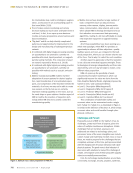
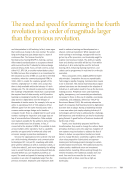
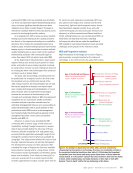
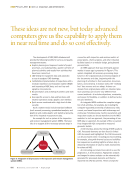
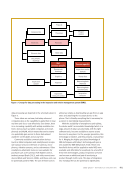
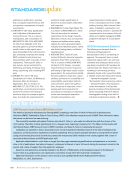
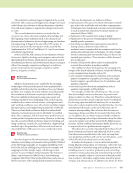
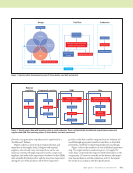
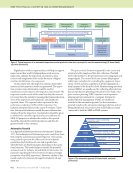
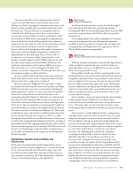
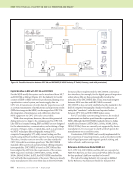
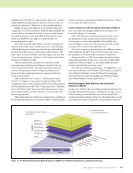
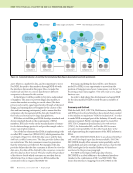
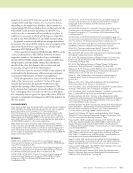
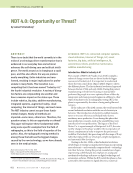
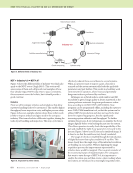
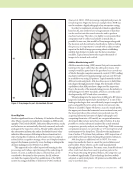
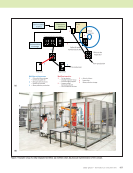
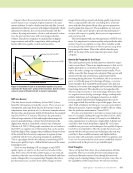
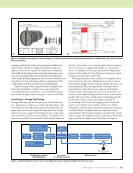
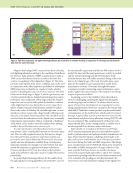
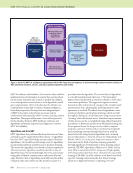
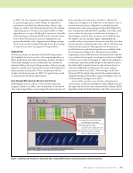
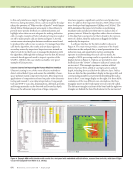
842 M A T E R I A L S E V A L U A T I O N • J U L Y 2 0 2 0 Digitalization of these input interfaces will help to support inspectors in their work by helping them avoid errors in inspection, optimize the inspection, and ensure a clear, revision-safe assignment of the results by means of digital machine identification of a component. On the output side, the inspection system’s status infor- mation and the inspection results are generated. The inspec- tion system’s status information could be used for maintenance and to improve the inspection system itself. The inspection results consist of the actual test data, the raw and processed data, the metadata (meaning the framework param- eters of the inspection and evaluation), and, finally, the reported values. The reported values represent the key performance indicators (KPIs) of the inspection. For industry, interpreted data are the easiest to evaluate. There- fore, the reported values are usually the most relevant data obtained from the inspection. Consideration should be given to whether the currently reported values are sufficient for NDE 4.0 purposes or whether the results to be reported should be extended for statistical purposes and thus for greater benefit to the customer. Automation Pyramid In a digitized industrial production environment (“Industry 3.0”), the techniques and systems in process control are classi- fied using the automation pyramid (Figure 4). The automa- tion pyramid represents the different levels in industrial production. Each level has its own task in production, whereby there are fluid boundaries depending on the opera- tional situation. This model helps to identify the potential systems/levels for Industry 4.0 and NDE 4.0 interaction (in particular regarding the beforementioned input and output parameters of an NDE inspection). However, validity of this model needs to be discussed in regard to Industry 4.0 and NDE 4.0. The process level (bottom of pyramid) is the sensor and actuator level for simple and fast data collection. The field level is the interface to the production process using input and output signals. The control level uses systems like program- mable logic controllers for controlling the equipment. Super- visory control and data acquisition of all the equipment in a shop happens at the shop floor level. Manufacturing execution systems (MESs) are usually used for collecting all production data and production planning at the plant level. Finally, enter- prise resource planning (ERP) systems control operation planning and procurement for a company. Systems for product lifecycle management (PLM) are usually not included in the automation pyramid (as the automation pyramid visualizes the automation during production and not during the lifecycle of a product), but such PLMs are clearly connected to both the MES and ERP systems. ME TECHNICAL PAPER w nde 4.0: perception and reality Existing documentation Inspection system status information Reports with indications, sensitivities, OK/not OK, and deviations Inspection Data processing Raw data Processed data Equipment, inspection, mechanical, and processing settings Metadata Interpretation Documentation of results Component information Inspection equipment Environmental parameters Inspector certification Procedures and specifications Figure 3. Typical sequence of an automated inspection in serial production (can also in principle be used for manual testing) (© Vrana GmbH, used with permission). Process level Production PLC SCADA MES ERP Input/output signals Field level Programmable logic controller: control level Supervisory control and data acquisition: shop floor level Manufacturing execution system: plant level Enterprise resource planning: enterprise level Figure 4. The automation pyramid (© Vrana GmbH, used with permission).

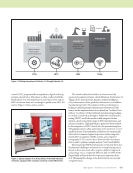
J U L Y 2 0 2 0 • M A T E R I A L S E V A L U A T I O N 843 The information flow for the planning of production comes from the ERP system and is broken down to the field/process level (meaning the communication starts at the top level of the pyramid and is communicated down to the bottom level). Once production is running, the data are collected at the field/process level, then condensed into several steps (into the different levels), and finally the KPIs are stored in the ERP system (meaning the communication starts at the bottom levels of the pyramid and is communi- cated up to the top level). In order for this information to flow in both directions, interfaces need to be implemented between the levels. Depending on the number of systems or devices in a level, the number of interfaces needing to be implemented can be exhausting. This is why in a lot of production environments, analog (paper-based) or not- machine-readable digital (email or PDF) solutions are still used for certain interfaces between levels. However, such solutions require human action and are highly error prone (like errors that occur when entering the 10-digit serial number of a certain component). This already shows the need for standard, machine-readable interfaces. In such an environment, the main interaction system for NDE is the MES system, as this is the point where all of the data from all of the equipment is combined. However, the idea of Industry 4.0 is not only to collect and analyze the data from all devices and systems (including PLM), but also that every device and system (including all NDE equipment) is able to communicate with one another. All of this is independent from the levels shown in the automation pyramid (Figure 4). Therefore, not only do inter- faces between two adjacent levels become necessary, but so do interfaces between all devices and systems throughout all of the levels. This would lead to an unmanageable number of necessary interfaces, and hence the implementation effort for all of these interfaces would prevent Industry 4.0. This is why standardized, open, and machine-readable interfaces become key for Industry 4.0 and why companies will have to shift from proprietary interfaces to standard interfaces if they want to survive the ongoing fourth industrial revolution. Looking at the member lists of the ongoing standardization efforts shows that most of the big players (for example, SAP, Microsoft, and Siemens) are beginning to understand this. Unfortunately, a lot of small- and medium-sized companies are still ignoring this development. Digital Twins, Semantic Interoperability, and Data Security Every asset (meaning every manufacturing device, sensor, product, software, operator, engineer, etc.), can be described in the virtual world with information like shape, type, func- tionality, material composition, operational data, financial data, interfaces, and more. All of this information combined creates a virtual representation—the digital twin. As discussed in the previous section, data for the digital twin comes from all levels of the automation pyramid including the MES for all manufacturing-related data, the ERP system for corporate data, and PLM for data from product development. For creating digital twins and for all Industry 4.0 commu- nication, it is important that the information is machine readable. It must be possible to interpret the meaning of the exchanged data unambiguously in the appropriate context. This is called semantic interoperability. With the semantic information stored in the digital twin, it will be possible to simulate the asset, predict its behavior, apply algorithms, and so on. A digital twin can also include services to interact with the asset. User profiles and all user activities maintained by social media platforms or data stored about individuals by insurance companies, other businesses, or government can be seen as a part of a digital twin of a person. Already, the data stored by just one of those entities has quite some value. All the infor- mation combined in one digital twin would hold incredible value for certain entities but is a great threat for society, as it leads to transparent humans. This shows the need for data security and sovereignty. Data security is a means for protecting data (for example, in files, emails, clouds, databases, or on servers) from unwanted actions of unauthorized users or from destructive forces. Therefore, data security is the basis for data-centric developments like the Industry 4.0 landscape discussed in this paper. Data security is usually implemented by creating decen- tralized backups (to protect from destructive forces) and by using data encryption (to protect from unwanted actions). Data encryption is based on mathematical algorithms that encrypt and decrypt data using encryption keys. If the correct key is known, encryption and decryption can be accomplished in a short time, but if the key is not known, decryption becomes very challenging for current-day computers (requiring several months or years of calculation time). Therefore, the data is secured from unwanted access. However, with computers becoming increasingly more powerful over time, encryption keys and algorithms need to become more challenging. As well, data encrypted with old algorithms or keys that are too short need to be re-encrypted after some time to keep it safe. The only measure ensuring data encryption over time is to use keys that have the same length as the data to be encrypted and are purely random. One of the few methods to creating such keys is quantum cryptography, which is still quite expensive in installation. Watch the video The Idea of the Digital Twin Watch the video Semantic Interoperability using Ontologies and Information Models
ASNT grants non-exclusive, non-transferable license of this material to  .
All rights reserved. © ASNT 2026. To report unauthorized use, contact: customersupport@asnt.org