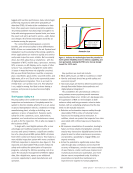
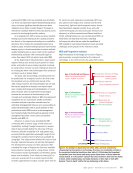
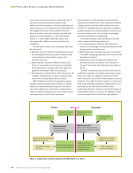
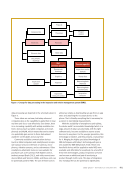
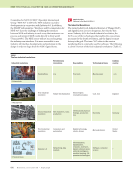
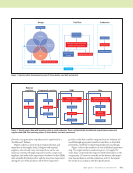
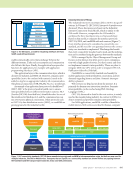
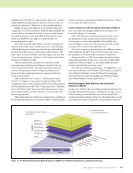
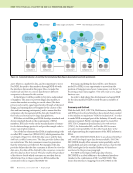
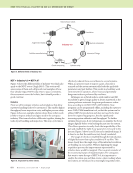
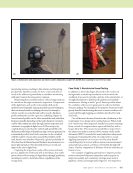
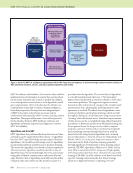
788 M A T E R I A L S E V A L U A T I O N • J U L Y 2 0 2 0 An intermediate step could be intelligence augmen- tation, as discussed in an accompanying paper in this issue (Aldrin 2020). l The IoT makes remote monitoring and remote decision making so much easier and faster (even in real time). In fact, it can open up new business models and value propositions around services and data monetization. l “Big data” and AI can help identify complicated patterns and opportunities for improvement in the design and manufacturing of subsequent product variants. l AI combined with digital image processing provides an opportunity to see anomalies currently not possible with visual, liquid penetrant, or magnetic particle testing methods. This conjecture is based on research reported by Hosny et al. (2018). l AI combined with digital signal processing provides an opportunity to see anomalies currently not possible with methods such as acoustic emission testing. l Additive manufacturing (AM) enables real-time adaptation of sensor systems for desired applica- tion, rapid manufacture of scarce/obsolete spare parts, and compression of the lead time needed for materials. As of now, we may not be able to create new sensors on the fly, but we can certainly improvise existing capability on the move, such as for naval ships or space stations. Another aspect of NDE 4.0 will be the insertion of inspection tech- nology within AM devices to actively control the manufacturing quality. l Mobile devices have absorbed a large number of basic components (such as data processor, memory, video camera, display, two-way audio- video communication, data network, and so on), which allows NDE technology developers to focus their attention on sensors and data processing algorithms, making it a lot more affordable to create new inspection equipment or upgrade existing systems. All of these possibilities have been opening up a whole new paradigm, where NDE 4.0 provides an opportunity to advance all three objectives—quality (safety), speed, and cost—as compared to the tradi- tional perspective, where you can choose only two out of the three. That is why it is called the next revolution. Another aspect to appreciate is that the revolution is not a discrete event that happens overnight. These technologies all emerge independently and then inter- dependently, until one day we begin to realize a very different value proposition. NDE 4.0 opens up the possibility of asset- customized prescriptive maintenance, which can significantly improve the value we derive from the Data Analytics Maturity Model, originally proposed by Gartner in 2012 and summarized below: l Level 1: Descriptive (What happened?) l Level 2: Diagnostics (Why did it happen?) l Level 3: Predictive (What will happen?) l Level 4: Prescriptive (What should we do?) l Level 5: Cognitive (What don’t we know?) This combination of stakeholder safety and economic value can be summarized under a single term: Safety 5.0. Safety 5.0, as illustrated in Figure 2, is similar to the definition of Society 5.0, which brings economic value and social benefits through cyber- physical confluence. Challenges and Pursuit Purposeful pursuit of NDE 4.0 for Safety 5.0 has its challenges, pretty much from all aspects, given the nature of multiple simultaneous disruptions. Visible challenges that can be listed, assessed, and addressed are related to technology, talent, and processes. Some of the more intangible ones include culture change and leadership mindset. And, on top of these, we need to prepare for the challenges that are completely unknown at this time, perhaps associated with the changing role of human interaction with cyber- physical systems. The good news is that Industry 4.0 also comes with solutions to many of the challenges it creates. Let’s explore some of these along with opportu- nities to successfully overcome them. First, the technology standardization around data connectivity, exchange, security, analytics, synthesis, ME BACK TO BASICS w purpose and pursuit of nde 4.0 Digital twin for both Safety solutions Economic value ● Keep inspector out of harm’s way ● Reduce the risk of fatal system failure ● Optimize life-cycle sustainment costs ● Use data to drive design improvements NDE 4.0 can purposefully blend human safety and business needs to create a safer system Safety 5.0 Figure 2. Safety 5.0 as a value proposition for NDE 4.0.

J U L Y 2 0 2 0 • M A T E R I A L S E V A L U A T I O N 789 and interpretation is still evolving. In fact, some argue that continuous change is the new normal. The under- lying technology may just always stay in a state of continuous flux. The German Society for Nondestructive Testing (DGZfP) is making a serious effort toward standardization or acceptance thereof with sources from the IT industry for data exchange protocol (Vrana 2020). Soon, we will come to accept either HL7, OPC UA, or another variant better suited for NDE, because this acceptance is a cornerstone for the industrial success of NDE 4.0, just like in the third revolution, when the community adapted HTML in 1990–1991 to enable the explosive growth of the Internet, originally born in 1969. Let’s accept that there is help available within the Industry 4.0 tech- nology suite. The 5G network is expected to address the challenge of bandwidth. Blockchain could provide the required level of data security, and AI/machine learning is emerging to handle the vast amounts of data stored in digital twins over the lifespan of thousands of similar assets. For example, let’s say an airline is operating a fleet of 520 airplanes of four different types from the same manufacturer, with a common undercarriage design and a baseline computer model. There is a digital twin for each serial number, tracking the inspection and usage data on top of as-manufactured information. Data analysis now makes it possible for the airline to derive informa- tion and trends based on all assets. In fact, if connected to the airplane’s OEM, it is possible to look across multiple airline operators. Such a capability provides an opportunity for enhanced safety and economic savings in proactive maintenance. Second, the organizations need a whole new skill set—skills involving information and communication technologies (ICT, not just IT), coworking with intelli- gent systems (desktop as well as industrial cobots, or “collective robots”), and more importantly, the willing- ness to accept that what you know today will likely be obsolete before you can establish yourself as an expert. The need and speed for learning in the fourth revolution is an order of magnitude larger than the previous revolution. Employers and employees both need to embrace learning and development as a shared, continual investment. While operators will need training on technology, managers will need to get on top of the processes, and leadership ought to explore new business models. The ability to rapidly learn and develop new skills will be key. From within Industry 4.0, AI is reducing the need for technical training, AR is enhancing training experience, and cobots can be programmed in real time for on-the-job execution. Third, companies need a slightly different leader- ship mindset. Competitive forces are unpredictable. Technology is rapidly changing. Communication needs to be in real time. This means that hierarchical organi- zational structures are detrimental to the adaption of Industry 4.0, and leaders need to free up the decision- making process. Peripheral vision and leadership agility, transparency, and connectivity are absolutely necessary to thrive in this era of volatility, uncertainty, complexity, and ambiguity, defined as “VUCA” by Bennis and Nanus (1985). We routinely witness the death of companies that flourished prior to digitization but were slow to adapt. Having a leadership mindset is one area where just simply adopting Industry 4.0 technologies will not help in addressing the challenge. Self-awareness and mindfulness are key for leadership going forward. A good fraction of business leaders will fail the test of time. Fourth, once leadership prepares itself for the transformation, they need to change the culture. Basic principles of physics come into play here. Adaption of new systems requires leaders to address the fear of failure to deliver on expectation (inertia) and resist- ance to change (friction). Leadership ought to define a clear value proposition (lubrication) and sponsor learning and technology projects (energy) to sustain transformation (momentum). The traditional business culture seeks a traditional return on investment analysis before investing. When working through the newest revolution, the traditional analysis does not work. You need to account for the cost of not investing, which at times could be as high as bankruptcy. The need and speed for learning in the fourth revolution is an order of magnitude larger than the previous revolution.
ASNT grants non-exclusive, non-transferable license of this material to  .
All rights reserved. © ASNT 2026. To report unauthorized use, contact: customersupport@asnt.org