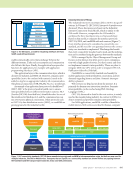
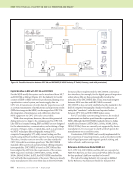
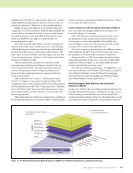
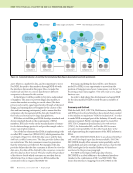
790 M A T E R I A L S E V A L U A T I O N • J U L Y 2 0 2 0 At the time of finalizing this special issue, the world was in the grip of the COVID-19 pandemic, which forced millions to work remotely from home or other locations that permitted social distancing (at least 1.8 m [6 ft] apart) and engage in contactless operations. All trainings and meetings had gone virtual. Anything that could be done remotely was done that way. As of June 2020, it was still too early to analyze how many businesses and jobs were saved by the cyber-physical technologies that constitute Industry 4.0. But there is certainly an enhanced appre- ciation of the role of digitalization in a robust and resilient workplace. AM, AI, AR, and remote operations have all proven their value in the health care sector. In the coming years, I expect management will use lessons from the COVID-19 pandemic to build business cases in pursuit of Industry 4.0 and NDE 4.0. NDE thought leaders are coming together to create knowledge platforms for guidance on this topic. There is a range of activities being pursued jointly by DGZfP and ASNT for general awareness and early acceptance of the topic. These include the formation of commit- tees, technical publications, and conferences. However, individual companies need to manage their risk of adaption and investment through some dependable process (Singh 2018, 2019). The best practices in innovation management are now emerging through a series of ISO standards (ISO 2019) that captures global expertise on the subject. My service on ISO/TC 279, as one of the US delegates to the ISO 56000 series, gives me the confidence that these will enable the evolution of purposeful NDE 4.0. Role of ISO in Support of NDE 4.0 The ISO 56000 series of standards brings best practices in innovation management to the public and can be used for the conception, development, valida- tion, and pursuit of purposeful NDE 4.0 applications. The intended benefits of these standards in the context of NDE 4.0 development process, include the following: Market Benefits: l Provide guidance on how an organization can fulfill unmet inspection and safety needs. l Enhance the competitiveness of organizations, NDE products, and inspection services. l Lead to the easier acceptance of global inspection products. l Reduce time to market for new inspection equipment. Cultural Benefits: l Open the mind to accept new NDE equipment, tech- niques, and business models. l Promote the growth of an NDE 4.0 culture with a global safety objective. l Facilitate necessary partnerships across NDE and IT expertise. l Implement social responsibility while developing new NDE tools and methods. Organizational Benefits: l Save costs and reduce risk in developing NDE 4.0 through standard processes. l Increase the ability to make decisions (test and try, fail fast) and the capability to take reasonable risks, while facing the challenges and uncertainty associ- ated with NDE 4.0. l Evaluate the progress of the organization and identify and share good practices in innovation management. l Share a globally accepted “common language” for innovation management and perhaps develop a common language for NDE 4.0. The following provides a quick overview of what is in store with the new series of ISO 56000 standards and their relevance to NDE 4.0. ISO 56000:2020 – Fundamentals and Vocabulary (published in February 2020) This document describes the fundamental concepts, principles, and vocabulary of innovation management and its systematic implementation. Innovation is defined as “new or changed entity, realizing or redis- tributing value.” The eight innovation management principles behind the ISO 56000 series are: (1) realization of value (2) future-focused leaders (3) strategic direction (4) culture (5) exploiting insights (6) managing uncertainty (7) adaptable structures and (8) systems approach. The four principles of NDE 4.0, defined earlier, already conform with these innovation management principles. The task of terminology specific to NDE 4.0 has been taken on by the ASNT committee, and the committee will adapt whatever definitions have been published in this document. ISO 56002:2019 – Innovation Management System – Guidance (published in July 2019) This document provides guidance for the establish- ment, implementation, maintenance, and continual improvement of an innovation management system for use in all established organizations. It is applicable to NDT equipment manufacturers, service providers, ME BACK TO BASICS w purpose and pursuit of nde 4.0

J U L Y 2 0 2 0 • M A T E R I A L S E V A L U A T I O N 791 training houses, and asset owners responsible for infrastructure safety. All of the guidance within this document is generic and intended to be applicable to all types of organizations, regardless of type, sector, or size all types of innovations (for example, product, service, process, model, and method), ranging from incremental to radical and all types of approaches (for example, internal and open innovation and user-, market-, technology-, and design-driven innovation activities). This is an overarching document that integrates all of the remaining ISO 56003-08 documents on innova- tion, which refer and eventually feed into one another for successful execution. It does not describe detailed activities within the organization, but rather provides guidance at a general level. It does not prescribe any requirements or specific tools or methods for innova- tion activities. This intent makes the application as broad as possible, including NDE 4.0, which also subjects the user to differences in understanding and interpretation. It is directly relevant, providing some level of understanding of the overlap across the funda- mentals of NDE and basics of innovation. ISO 56003:2019 – Tools and Methods for Innovation Partnership (published in February 2019) This document provides guidance for innovation part- nerships. It describes the innovation partnership framework and provides sample corresponding tools to use to decide whether to enter an innovation part- nership and describes how to evaluate and select partners and how to manage the partner interactions. Since NDE 4.0 requires serious collaborative activity across those who understand the physics of inspection systems and those who can connect them digitally, this standard is of value to innovation part- nerships. It starts with a gap analysis, followed by the identification, and engagement, of potential innova- tion partners and the governance of their interaction. The document addresses the essence of an innovation partnership required for NDE 4.0, where all parties must mutually benefit from working together in the context of the purpose defined above. ISO/TR 56004:2019 – Innovation Management Assessment (published in February 2019) This document will help the user understand why it is beneficial to carry out an innovation management assessment (IMA), what to assess, how to carry out the IMA, and how to maximize the resulting benefits, which are universally applicable. This document is labeled as ISO/TR (Technical Report), and contains information of a different kind from the standard ISO publication. It may include data obtained from a survey, for example, or from an informative report, or information of the perceived “state of the art.” This standard can be used to assess and prepare an organization for the NDE 4.0 journey. Together with ISO 56002, it is a “must use and conform” document with some level of interpretation. ISO 56005 – Intellectual Property Management (to be published by November 2020) This standard proposes guidelines for supporting intellectual property (IP) within innovation manage- ment. It aims at addressing the following topics concerning IP management at strategic and opera- tional levels: creating an IP strategy to support innova- tion in an organization establishing IP management in the innovation process and applying IP tools and methods in the innovation process. NDE 4.0 is a fertile ground for innovation and the creation of new IP. In general, any dependable existing IP management system is likely to be adequate. If not, then this document is of use otherwise, a cross reference might be enough. ISO 56006 – Strategic Intelligence Management (to be published by November 2020) This standard is a part of the innovation management system and through planning, deployment, measure- ment, and continual improvement, it provides guidance to organizations on how to develop and provide intelligence to top management, enabling decisions on the vision, mission, strategy, and innova- tion activities of the organization. Once again, at this time NDE 4.0 is still in the realm of “blue ocean strategy” (Kim and Mauborgne 2015), where the market boundaries and industry structure are not a given and can be constructed by the actions and beliefs of industry players. In general, any dependable existing strategic intelligence management system is likely to be adequate. If not, then this document can be referred to. The funda- mental model is the data–information–knowledge– intelligence cycle. And this needs to be applied to marketplace insight (consumers, competitors, and regulators) and PESTEL trends (Albu 2014). The inte- gration and interpretation of knowledge to generate intelligence is somewhat of an art, and you cannot completely depend upon ISO 56006. Hence, this standard should be used with caution. ISO 56007 – Idea Management (to be published in 2022) Ideas have the ability to make incremental improve- ments in the efficiency of an organization, up to
ASNT grants non-exclusive, non-transferable license of this material to  .
All rights reserved. © ASNT 2026. To report unauthorized use, contact: customersupport@asnt.org