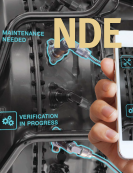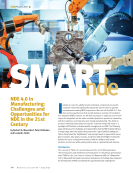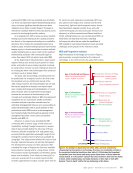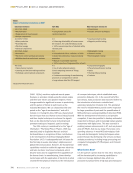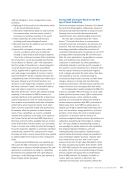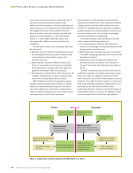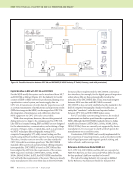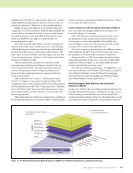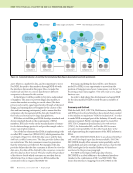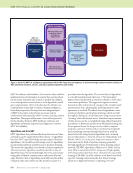

J U L Y 2 0 2 0 • M A T E R I A L S E V A L U A T I O N 835 ME TECHNICAL PAPER w A B S T R A C T Up until recently, the industrial revolution was divided into three phases: (1) simple mechaniza- tion (2) mass production and (3) automation. Similarly, nondestructive evaluation (NDE) can be divided into three phases: (1) tools, such as lenses, sharpened the human senses (2) the conversion of waves made the invisible visible by offering a “look” inside components and (3) automation, digitization, and reconstruction enhanced the accuracy, speed, and ease of infor- mation sharing. During industrial development, although NDE has been decisively responsible for the quality of the manufactured goods and safety of operations, it has carried perceptions not commensurate with the value realized. Currently, industry leaders have been talking about a fourth revolution: the informatization, digitization, and networking of industrial production and the concurrent use of emerging technologies, such as artificial intelligence, augmented reality, and 5G networks. For NDE, this fourth revolution offers an unprecedented opportunity to address technical challenges and negative perceptions at the same time, leading to an enhanced appreciation of this significant discipline. The paper begins with a survey of professionals in the field to identify the perceptions surrounding NDE and moves on to demonstrate the value of integrating Industry 4.0 with NDE in the form of NDE 4.0 driven by connec- tivity and data mining. Building on that, this paper next presents the necessary basics and concepts, like semantic interoperability and the Industrial Internet of Things. Moreover, the key interfaces and data formats, like OPC UA and DIOCONDE, are discussed, and the International Data Spaces Association (IDSA), which goes one step further by ensuring data sovereignty, enabling data markets, and connecting the world, is introduced. The emerging reality of NDE 4.0 is that robust digital interfaces help create value, and statistical approaches combined with digital twins and threads help extract that value. KEYWORDS: NDE 4.0, Industry 4.0, perception, AAS, digital twin, IIoT, OPC UA, DICOM, DICONDE, semantic interoperability Introduction The term Industry 4.0 was created in 2011 and has led to an almost unmanageable number of activities over the past eight years (Kagermann et al. 2011). Thousands of people are working to make the dream of a networked industry come true, thanks to data transparency. As detailed later, data trans- parency is enabled by open standardized interfaces using semantic interoperability that allows easy, unhindered machine-readable data exchange between all machines, systems, and assets in industrial production and service. This enables, for example, users to reuse the data, to perform trend analyses, and to enable the use of artificial intelligence (AI). Therefore, data transparency is one of the cornerstones of Industry 4.0, both for data formats and for interfaces. As an integral part of industrial production and operation, nondestructive evaluation (NDE) provides the quality assur- ance means required by industry. With the foundation of the German Society for NDE (DGZfP) committee “ZfP 4.0” in 2017, the American Society for Nondestructive Testing (ASNT) committee “NDE 4.0” in 2019, and the International NDE Perception and Emerging Reality: NDE 4.0 Value Extraction by Johannes Vrana* Materials Evaluation 78 (7): 835–851 https://doi.org/10.32548/2020.me-04131 ©2020 American Society for Nondestructive Testing * Vrana GmbH, Rimsting, Germany contact@vrana.net DGZfP Subcommittee Interfaces and Documentation for NDE 4.0, Berlin, Germany
ASNT grants non-exclusive, non-transferable license of this material to  .
All rights reserved. © ASNT 2026. To report unauthorized use, contact: customersupport@asnt.org