J U L Y 2 0 2 0 • M A T E R I A L S E V A L U A T I O N 797 artificial intelligence. These changes will be repre- sented by: l Digitizing of all (or much) of our information, which can be stored effectively forever. l Information networks that allow not only real-time telecommunication, but also remote control of processes and activities anywhere in the world. l Smart robots that can interact with humans, including much beyond keyboard control. l Machines that have the ability to learn and make decisions on their own. l Exponential convergence of atoms, bits, qubits, neurons, and genes, which also includes the merging of cyber-physical and biological systems. Due to the continuous increase of the miniaturiza- tion of electronic circuits (successfully described by Gordon Moore as “Moore’s Law”—the observation that the number of transistors in a dense integrated circuit will double about every two years [Moore 1965]), together with a significant decrease in the price and energy consumption of circuits, it can be expected that there will be computers that have the computational power of the human brain within just a few years. Already, a lot of human functions and decisions can be replaced by computers however, in the future, advanced “smart” devices will be able to learn and adapt or respond to new situations. Machines will become “smart” with decision-making capability, if not sentient. In NDE this means, for example, that there is the potential (for at least some routine inspections) to have the initial characteriza- tions of parts and potentially initial data evaluations performed by smart inspection robots. Such smart robots can then potentially enable new applications for example, allow for operation in harsh environ- ments. These capabilities can even be controlled remotely from anywhere in the world. Such advances don’t mean that we will not need NDE inspectors in the future, but tools will be available that can remove some of the tedium of routine tasks, such as viewing X-rays or C-scans, and enable the smart technology to focus the inspector’s attention to anomalies identified automatically, improve POD, and give senior inspec- tors (who are often a scarce resource) the time needed to address higher-level review and even reinspection tasks. Introducing smart NDE to the new industrial age will require the NDE community to make techniques ready for use in advanced manufacturing and the new approaches in production, by using the capabilities that will become available with new cyber-physical techniques. In the following sections, two aspects of these changes will be discussed. Develop NDE Techniques Ready for the New Age of Smart Production The fourth industrial revolution (Industry 4.0) is driven by trends that bring together collaborative advanced manufacturing networks (networks of advanced manu- facturing devices controlled by computers) and combining them into a physical-digital environment. This new age is characterized by the “smart factory.” This means that there is communication among the machines and between the products and machines. This new manufacturing philosophy and technology potentially enables the production of customized individual parts for example, by use of 3D printing/additive manufacturing. We can then poten- tially, for some applications, say goodbye to conveyor belts and traditional mass production. Each component or small batch can then potentially be individually tailored to meet the specific requests of the customer and be manufactured on demand, which will also impact inventory and production logistics. Such a change will impact the entire value chain from raw materials to end use, including through to recovery/recycling (circular economy), and with these changes, advances in design and manufacturing, including customization, will also impact business and support functions (such as supply chain and sales). For next-generation quality management (QM), this requires a paradigm shift. Until today, we used estab- lished optimized process chains. QM is characterized by statistical process control, statistical quality planning, and commonly the destructive testing of random samples combined with NDE, particularly for higher-value items. Such NDE has always been an integral part of QM in specific high-technology indus- tries, such as aviation, energy production, and trans- portation. In the future, the trend is moving toward production “on demand” with the delivery of customer-configured objects produced by additive and subtractive manufacturing technologies in combina- tion. This step change in manufacturing requires a new paradigm for quality assurance with capabilities that employ integrated intelligence and self- learning/teaching smart systems. Statistics-based random destructive testing is simply not possible for many small-batch additive products. “Sample sets” may consist of just one item, and it can be both unique and an item of high value (Wunderlich 2016). As smart manufacturing evolves, there will be a need for 100% NDE inspection for many cases where parts are safety critical. Such new manufacturing techniques will also require new approaches and implementa- tions of NDE methods. For example, if metallic or ceramic parts are created in a 3D printer, the material’s microstructure and volumetric defects like

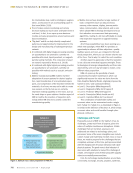
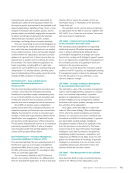
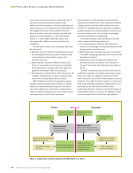
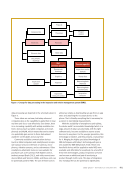
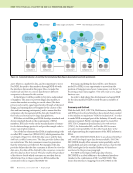
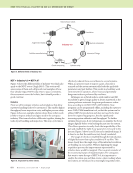
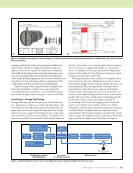
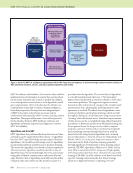
798 M A T E R I A L S E V A L U A T I O N • J U L Y 2 0 2 0 microcracks or microporosity are mostly unknown. It becomes necessary to provide material state awareness/characterization, including obtaining such data in process, as microfeatures can potentially harm the integrity of the part. This is different from the present situation, where the starting materials and products and end products can be characterized before or to some degree after fabrication, and then again after different process steps like heat treatments. To meet these needs, some challenges that must be solved are: l Real-time monitoring of the manufacturing process, by detecting thermal and acoustic emissions that can be related to the position of where the emission occurred. l High-resolution volumetric NDE techniques, like X-ray, CT, or acoustic microscopy. For nonmetallic and transparent or opaque parts, both optical or gigahertz techniques might be considered. l 3D volumetric characterization of the whole part for example, taking density or elastic modulus meas- urements and mapping the grain structure. NDE strategies are based on experience gained through making repeated measurements on similar objects and understanding the types of discontinu- ities, their significance and impact on performance, and the responses they produce when using sensors and instruments to look for the anomalies. Determination of a POD strategy is most useful for assessing the performance of an inspection involving a larger number of similar objects (Meyendorf et al. 2017b). The challenge becomes the need to address quality assurance and maintainability for unique struc- tures and components, such as those increasingly produced by additive manufacturing. In a Frost & Sullivan report (Kimbara 2015), the author made the following predictions: l The current business model for NDT inspection services is increasingly coming under threat and will change over the next few years. l While historically innovation has been incremental in the NDT industry, going forward the model will be disruptive innovation. l Organizations need to adapt and embrace the disruptive business ecosystem to be relevant in 10 years’ time (note: this statement was written in 2015!). The NDE community needs to look at how best to enable the inspection of complex and unique compo- nents, and make the ability and experience of the senior inspectors (Level IIIs) locally available at remote locations. This might be able to happen in conjunction with using modeling capabilities (“digital twins”) and providing remote viewing for example, when performing ultrasonic inspection and interpretation of results (Meyendorf et al. 2017a). The ability to enable and move toward this future will be supported by ME FEATURE w nde 4.0: challenges and opportunities Medical doctor Selects medical diagnostics methods “Machine doctor” Knows about NDE, material, and service conditions selects NDT methods Doctor makes diagnosis and chooses treatments Patient’s behavior and symptoms SHM and condition monitoring Diagnosis about continuation of use (prognostics) or required repair Technicians perform NDE measurements Nurses perform noninvasive diagnostic methods Specialists analyze this data Medical record Component life record file Level III engineers analyze this data Mirroring Component Patient Figure 2. Learning from medicine (adapted from Meyendorf et al. 2017).
ASNT grants non-exclusive, non-transferable license of this material to  .
All rights reserved. © ASNT 2026. To report unauthorized use, contact: customersupport@asnt.org