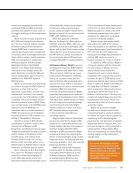
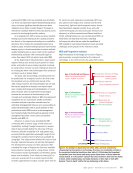
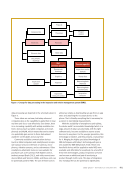
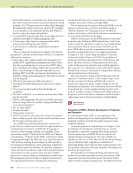
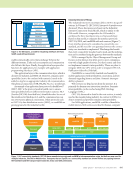
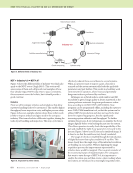
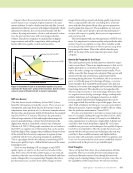
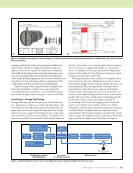
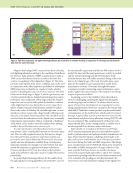
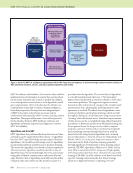
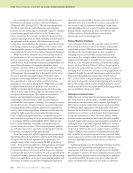
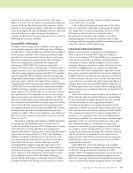
J U L Y 2 0 2 0 • M A T E R I A L S E V A L U A T I O N 801 data processing are depicted in the schematic given in Figure 5. These ideas are not new, but today advanced computers give us the capability to apply them in near real time and do so cost effectively. Even better, there is an increasing capability with widely available elec- tronic devices (such as tablet computers and smart- phones) and WLAN, which means that service teams can potentially gain access to these data almost anywhere on the globe and at any time. Commonly available communication devices (such as tablet computers and smartphones) incorpo- rate various sensors in the form of cameras, micro- phones, vibration sensors, and accelerometers. Other smartphone-attachable tools are now available for purchase such as IR cameras (FLIR Systems 2017), terahertz arrays (Boyle 2012), and eddy current trans- ducers (Mook and Simonin 2008), and these units can be potentially used for NDE. The use of these tools is almost as simple as downloading an app from an app store and attaching the necessary device to the phone. That is literally everything that is necessary for a person to start taking measurements. With the availability of smartphones and tablets, the whole world’s accumulated knowledge (which is a large amount of data) can potentially, with the right software tools, become available to anyone at any time and in any place. For the younger generation, this technology is intuitive, and they possess a natural flair for it. Merging the highly specialized knowledge of NDE techniques with today’s technology will open a new market for NDE (Meyendorf 2018). These new handheld devices will be applied to make NDE more available and affordable for everybody. As a benefit of these new technologies, product inspection at home can become an additional part of monitoring a product through its life cycle. This type of integration into everyday life has the potential to significantly Components Elements Element data Documents, drawings Documents, drawings Inspection control Inspector Base data Protocols Processes Projects Project control Inspection results (verbal) Process-specific Not process-specific Setup data Measuring data (manual) Measuring data (mechanized) Inspection measure Inspection measure control Graphics Figure 5. Concept for data processing in the inspection and revision management system (IRMS).

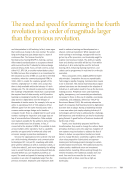
802 M A T E R I A L S E V A L U A T I O N • J U L Y 2 0 2 0 increase the rate of acceptance of NDE 4.0 within the wider NDE and engineering communities by solving new inspection problems, which can then become part of everyday service activities. Conclusions Industry 4.0 and the ability to tailor the assessment of individual components to meet customer needs will significantly impact the way we ensure quality, safety, and reliability and provide NDT inspections. NDE has the capability to be integrated into the new smart production process by networking with the machines and materials used during manufacturing. This will result in a paradigm shift between industrial QM and NDE. Classical concepts applied to quality assurance, which are statistics-based and employ the comparison of multiple similar components, will not be applicable in a world of unique products and additive manufac- turing, which utilize limited production runs and indi- vidual product designs. The resulting changes required for the delivery of quality will raise the importance and needed skill sets for those engaged in NDE delivery. It will be critical to address workforce needs, but it can be expected that such changes will be a major challenge. To be successful in this new world, it will be necessary to have specialists available to make the best possible decisions based on the available NDE results along with prior knowledge of the materials/ components and the service/loading conditions. This will require the incorporation of “digital” and also the addition of multidisciplinary engineering skills. The following bullets summarize what, in the authors’ opinion, will characterize NDE for the mid- 21st century: l The internet will enable remote real-time monitoring of structure integrity. l Tele-NDE will enhance the reliable inspection of unique components. l Fast 3D imaging techniques (X-ray, CT, and PAUT) will create big data that has to be handled and analyzed. l Creating NDE databases, managing a component’s lifetime files, and handling big data will create value and present significant benefits for quality management. l Smart robots and drones will assist inspectors in performing NDE in harsh and hard-to-access environments by automated or remote NDE. l NDE modeling will support inspection, planning, and interpretation of results. l Digital twins will include NDE in design/planning and in the interpretation of data based on modeling. l 3D printing will require new NDE techniques and concepts for the reliable inspection of unique components. Smartphones and tablets make NDE available to anybody. By making low-cost sensing available, this can create new markets for NDE and enable inspection at home. This can become an additional component of monitoring throughout the life cycle of some products (Meyendorf 2018). We perceive two supplementing trajectories of evolution for the field, which may be perceived as moving in opposite directions: (1) the increased sophistication and specialization of NDE technologies and equipment, including the develop- ment of multipurpose, multimethod devices (for example, ET/UT in a single unit) and (2) the “democ- ratization” of NDE to the general public with devices that may be attached to smartphones. Example appli- cations could include thermal imaging of failing electric/electronic equipment or a low-cost “sniffer” that can detect leaks in air-conditioning equipment. w ME FEATURE w nde 4.0: challenges and opportunities NDE has the capability to be integrated into the new smart production process by networking with machines and materials...
ASNT grants non-exclusive, non-transferable license of this material to  .
All rights reserved. © ASNT 2026. To report unauthorized use, contact: customersupport@asnt.org