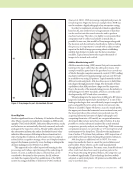
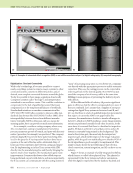
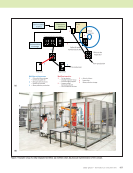
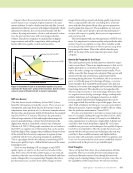
J U L Y 2 0 2 0 • M A T E R I A L S E V A L U A T I O N 817 NEW patents ROBERT E. SHANNON Associate Technical Editor US 10488371 Nondestructive inspection using thermoacoustic imagery system (A.M. Finn, A. Surana, M.O. Williams, E.A. Bernal, and O. Erdinc) This patent relates to a nondestructive thermoacoustic imagery system for prog- nostics and health management, preventa- tive maintenance, and repair of gas turbine engine parts. Manufactured components may incur defects or imperfections during manufacturing or suffer wear and incur defects during operation and thus are peri- odically inspected. Some defects are caused by delaminations or the improper bonding of composite structures, which may be detected by thermoacoustic tech- niques (also known as vibroacoustic, vibrothermography, thermosonic, or sonic infrared techniques) wherein vibration of the component induces localized heating at defect locations. The heating is detected by an infrared camera. Typically, the imagery is reviewed manually for the detection of defects. These reviews are tedious, time consuming, imprecise, and may be prone to errors. More recently, automated statistical analysis has been performed for crack detection using rapid exterior heating of a component and infrared imaging. For instance, pulsed ther- mography, in which a very short intense flash of light heats a component, has been used to show thermal conductivity of a coating. These techniques, however, require external heating of the component, which may not be applicable to composite material components. This technique uses an ultrasonic exci- tation source to induce elastic waves in the component such that each single frequency of excitation is converted into a broad band of frequencies that are partic- ular to resonant frequencies of the component. This vibrational energy is dissipated through conversion into heat due to friction or plastic deformation at defects in the component. A thermal signature is then observed with the ther- mography system. The amount of heat generated depends on the frequency and position of the excitation source and the size, shape, orientation, and depth of the dissipation site, as well as the excitation power level. Particular to this patent, a model of the component is stored in the component database to be registered to the thermal signature to provide structural information for location-dependent analysis. The model stored in the component database may be an as- designed model, an as-built model, a previous condition model, a model derived from the current thermal signature, and variations thereof for each component. In one example, the model may be a statis- tical distribution of pixel values from the thermal signature as constrained by the internal structure. Pixel values that fall outside of +/– 3s of the mean are consid- ered anomalous. If the anomalous pixels spatially cluster relative to the internal structure, a defect is determined to be present. The internal structure is registered to a thermal signature via the model of the component. The registration may make use of edges of the component and the model to scale, rotate, and/or translate the model to orient with respect to the component to elucidate the internal structure for automated reasoning about the location of potential defects. The automated reasoning may include geometry-specific algorithms for the detection of defects. The registration may include a random sample consensus (RANSAC) algorithm based on computed features where the features may include SIFT, SURF, ASIFT, other SIFT variants, Harris Corner features, SUSAN, FAST, a phase correlation, a normalized cross-correlation, GLOH, BRIEF, CenSure/STAR, ORB, and the like. The thermal signature is then compared with the model to initialize or constrain the detection of defects in the thermal signature to only the relevant predetermined area of the component, such as that defined by the internal structure. That is, the internal structure from the model is used to influence the detection of defects, particularly where the defect manifests as a “distorted pattern” in the thermographic image. This may be based on, for example, initialization of an active contour shape determination, a geometric restriction for predetermined areas over which statistical characteriza- tion is performed as priors in a Bayesian estimation, or another technique that limits portions of the thermographic image based on the model. In one example, a defect may be detected because it appears at a particular location with respect to the rigid internal structure, whereas an identical thermal signature defect that is not adjacent to the internal structure may be ignored. Other examples include the detection of defects by performing a geometry- dependent analysis, comparing the thermal signature to the model (which delineates the internal structure), a pixel segmentation of the thermal signature compared to the model, a statistical analysis of predetermined areas of the thermal signature, and the like. Or, detection may be performed by a deep learning classifier trained from available data, such as a library of user- characterized defect examples. Deep learning is the process of training or adjusting the weights of a deep neural network. In an embodiment, the deep neural network is a deep convolutional neural network. Deep convolutional neural

818 M A T E R I A L S E V A L U A T I O N • J U L Y 2 0 2 0 networks are trained by presenting an error map or partial error map to an input layer and a defect/no-defect label to an output layer. The training of a deep convo- lutional network proceeds layer-wise and does not require a label until the output layer is trained. The weights of the deep network’s layers are adapted, typically by a stochastic gradient descent algorithm, to produce a correct classification. The deep learning training may use solely partially labeled data, solely fully labeled data, or solely implicitly labeled data, or may use unlabeled data for initial or partial training with only a final training on labeled data. The nondestructive thermoacoustic imagery system facilitates automated visual inspection, which reduces costs incurred from faulty human visual inspec- tion reduces turn-backs from subsequent inspector disagreement reduces depend- ence on increasingly scarce skilled inspec- tors reduces inspection time and cost increases inspector efficiency and gathers machine-readable data on component condition for repair scheduling, life estima- tion, redesign, and training. w Contact ASNT The ASNT International Service Center is open from 8:30 a.m. to 5:00 p.m. Eastern time, Monday through Friday. Voicemail messages can be left 24 hours a day by following the recorded prompts. In the U.S. and Canada, call toll free 1-800-222-2768 or 1-614-274-6003. Email addresses for individual staff members are given below. If you prefer, write ASNT, 1711 Arlingate Lane, P.O. Box 28518, Columbus, OH 43228-0518. ASNT’s website is available at asnt.org. AREA OF INQUIRY CONTACT (EXTENSION) EMAIL PHONE Executive Offices Executive Director Neal Couture, CAE (201) ncouture@asnt.org 614-384-2451 Deputy Executive Director Tim Jones (204) tjones@asnt.org 614-384-2454 Accounting Controller Brad Pence (203) bpence@asnt.org 614-384-2453 Account balance inquiries Melissa Goe (214) mgoe@asnt.org 614-384-2464 Credit and collections Melissa Goe (214) mgoe@asnt.org 614-384-2464 Dues payment inquiries Tomeka McCutcheon (215) tmccutcheon@asnt.org 614-384-2465 Customer Service Manager Amy Coelho (229) acoelho@asnt.org 614-384-2429 Customer service inquiries/ book orders Kimberly Donaldson (242) kdonaldson@asnt.org 614-384-2442 Trina Coakley (220) tcoakley@asnt.org 614-384-2480 Certification Director Donny Didion (240) ddidion@asnt.org 614-384-2440 Certification program manager Charles Longo (241) clongo@asnt.org 614-384-2441 Certification inquires Lisa Law (226) llaw@asnt.org 614-384-2426 Jennifer Harris (237) jharris@asnt.org 614-384-2437 Tricia Davis (219) tdavis@asnt.org 614-384-2469 Conferences and Meetings Director Barry Schieferstein (202) bschieferstein@asnt.org 614-384-2452 Exhibit sales Ruth Staat (227) rstaat@asnt.org 614-384-2427 Level III refresher courses Ruth Staat (227) rstaat@asnt.org 614-384-2427 CEU program James Bennett (250) jbennett@asnt.org 614-384-2450 Technical program Alicia LeMasters (213) alemasters@asnt.org 614-384-2463 Internet ASNT website Stephen Schaefer (222) sschaefer@asnt.org 614-384-2482 Advertising Jessica Miller (209) jmiller@asnt.org 614-384-2459 Learning Programs Educational Materials Developer Robert Conklin, Ph.D. (275) bconklin@asnt.org 614-384-3106 Marketing/Communication Director Garra Liming (211) gliming@asnt.org 614-384-2461 Advertising sales/social media Jessica Miller (209) jmiller@asnt.org 614-384-2459 Public relations Dana Sims (244) dsims@asnt.org 614-384-2444 Member communications Caitlin Horwatt (265) chorwatt@asnt.org 614-274-3015 Membership, Engagement, and Governance Director Heather Cowles, CAE (216) hcowles@asnt.org 614-384-2466 Awards and honors coordination Jessica Ames (233) awards@asnt.org 614-384-2433 Committee coordination Jessica Ames (233) james@asnt.org 614-384-2433 Governance administration Michelle Thomas (223) mthomas@asnt.org 614-384-2483 Membership coordination Pat White (217) pwhite@asnt.org 614-384-2467 Sections coordination Debbie Segor (235) dsegor@asnt.org 614-384-2435 Scholarships coordination Jessica Ames (233) james@asnt.org 614-384-2433 Volunteer coordination Jessica Ames (233) james@asnt.org 614-384-2433 Publications Director Toni Kervina (205) tkervina@asnt.org 614-384-2455 Book development NDT Handbook Karen Balkin (207) kbalkin@asnt.org 614-384-2457 Educational materials Cynthia Leeman (225) cleeman@asnt.org 614-384-2425 Haley Cowans (245) hcowans@asnt.org 614-384-2466 Library Cara Schaurer (206) cschaurer@asnt.org 614-384-2476 Materials Evaluation Advertising Jessica Miller (209) jmiller@asnt.org 614-384-2459 Articles and papers Jill Ross (224) jross@asnt.org 614-384-2484 Buyers guide Jessica Miller (209) jmiller@asnt.org 614-384-2459 Calendar Cara Schaurer (206) cschaurer@asnt.org 614-384-2476 Employment service Cara Schaurer (206) cschaurer@asnt.org 614-384-2476 Ready Reference guide Jill Ross (224) jross@asnt.org 614-384-2484 Reprint permissions Cara Schaurer (206) cschaurer@asnt.org 614-384-2476 Section News Debbie Segor (235) presaward@asnt.org 614-384-2435 NDTMarketplace inquiries Cara Schaurer (206) cschaurer@asnt.org 614-384-2476 Advertising Jessica Miller (209) jmiller@asnt.org 614-384-2459 RNDE inquiries Jill Ross (224) jross@asnt.org 614-384-2484 The NDT Technician inquiries Jill Ross (224) jross@asnt.org 614-384-2484 Advertising Jessica Miller (209) jmiller@asnt.org 614-384-2459 Standards and Accreditation Director James Bennett (250) jbennett@asnt.org 614-384-2450 Quality Manager Brian Frye (218) bfrye@asnt.org 614-384-2468 Patents Have you been awarded a patent? If you have recently been granted a new patent by a government patent office, we invite you to let us know about it. We are looking for patents that describe innovations in the science and practice of nondestruc- tive testing. You can send a few paragraphs describing the invention and its range of applications, and a copy of the patent document (or if it was issued by the United States Patent and Trademark Office, you can just give us the patent number). Email to ndeguy@yahoo.com with “ASNT ME New Patents” in the subject line. For more information on the patents, go to the US Patent and Trademark Office website at uspto.gov. NEW patents
ASNT grants non-exclusive, non-transferable license of this material to  .
All rights reserved. © ASNT 2026. To report unauthorized use, contact: customersupport@asnt.org