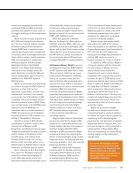
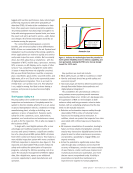
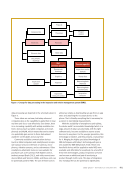
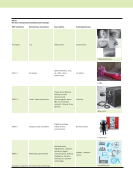
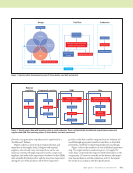
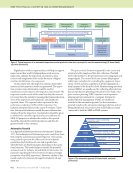
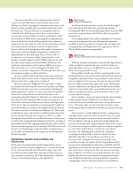
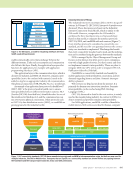
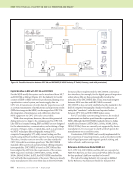
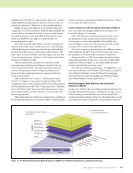
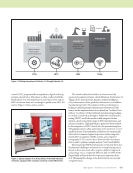
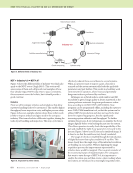
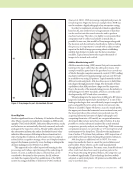
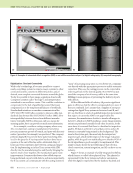
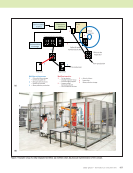
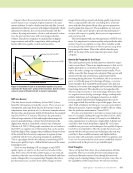
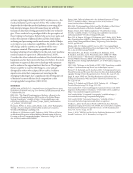
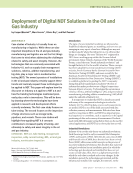
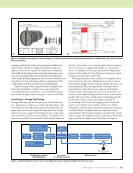
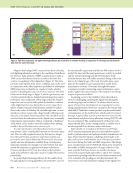
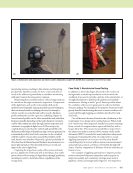
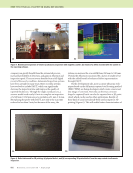
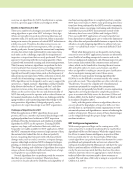
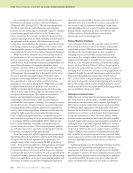
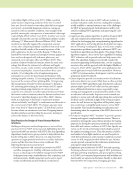
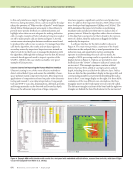
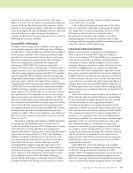
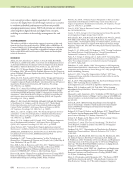
J U L Y 2 0 2 0 • M A T E R I A L S E V A L U A T I O N 867 discontinuities. In addition, these results have been used as input for fracture mechanics analysis (Adriano et al. 2019). Nozzles are an important class of joints used in pressure containing equipment. Because of their complex shape, nozzles are very difficult to inspect using ultrasonic tech- niques. Typical defects such as cracks and lack of fusion are highly sensitive to the beam orientation. Defects located close to the front surface often require the sound beams to be reflected off the backwall, making it very complicated when dealing with nozzles where the inside surfaces of the vessel are curved. Currently, the inspector has to estimate the local cross section of the complex 3D-shaped component in order to understand the location of received signals and interpret the position of the indications. CAD software already allows for the designing of complex nozzles thus, the operator can determine where to place its sensor, but there is no imme- diate combination of the ultrasound image and the actual geometry of the nozzle. Therefore, the inspection must be performed in a blind way and combined later with the geometrical design of the nozzle, which introduces delays and potential mistakes. A solution has been developed using augmented imaging, which uses the capabilities of simulated UT modeling and 3D CAD to produce understandable real-time images of the inspection. Using these models, the user can build a digital twin of the nozzle to be inspected and define the trajectory of the transducer to cover the region of interest (Figure 7). This solution was implemented on a portable PAUT unit (Figure 8). Its capability to read three-axis encoded nozzle scanners allows computing cross-section overlays as the operator moves the probe, which are superimposed with the ultrasonic data to produce real-time augmented imaging during the inspection. As all ultrasonic data are saved in the same file with synchronized probe positions and the digital nozzle, full analysis can then be achieved, as illustrated by Figure 9, which shows a 3D representation of the nozzle with detected indica- tions and related probe positions. The complete solution, including a nozzle scanner and selected transducer, has been successfully assessed by an inde- pendent research institute, who proposed a procedure for field inspection (Nageswaran 2016). This application matches well with the advent of the NDT 4.0 era by using combined digital models embedded in a portable system to provide understandable images to field operators. Conclusion The benefits of digitization are starting to show in NDT. In this paper, several case studies were presented with examples of digital integration. Each of the main features of Industry 4.0 is present in these cases: robotics, AI, AM, IoT, cloud computing, and integration into the inspection supply chain. Ultimately, it is the digital interconnection of these systems Figure 7. Screen display showing nozzle design and calculation of the probe trajectory. Figure 8. Nozzle inspection with a PAUT unit and specific scanners to hold the probe on the main pipe. Figure 9. A 3D view of the nozzle and detected indications related to probe position.

868 M A T E R I A L S E V A L U A T I O N • J U L Y 2 0 2 0 with one another, constantly collecting and sharing informa- tion, that will truly unleash the power of NDT 4.0. REFERENCES Adriano, V.S.R., S. Hertelé, W. De Waele, and O.J. Huising, 2019, “Proof of Concept of Integrating 3-Dimensional NDE Information into Finite Element Analysis,” 22nd Joint Technical Meeting on Pipeline Research, Brisbane, Australia. Kuznets, S.S., 1930, “Secular Movements in Production and Prices. Their Nature and Their Bearing upon Cyclical Fluctuations,” American Journal of Agricultural Economics, Vol. 13, No. 1, pp. 177–179. Nageswaran, C., 2016, “Phased Array Ultrasonic Inspection of Nozzles,” WCNDT, 13–17 June, Munich, Germany. Pearson, N., and M. Boat, 2012, “A Novel Approach to Discriminate Top and Bottom Discontinuities with the Floormap3D,” 6th Middle East Nondestructive Testing Conference & Exhibition, Kingdom of Bahrain. Perez, C., 2002, Technological Revolutions and Financial Capital: The Dynamics of Bubbles and Golden Ages, Edward Elgar Publishing Inc., Northampton, Massachusetts. Schumpeter, J.A., 1939, Business Cycles: A Theoretical, Historical and Statis- tical Analysis of the Capitalist Process, McGraw-Hill Book Co., New York, NY. Wassink, C.H.P., 2012, “Innovation in Non Destructive Testing,” doctoral thesis, Delft University of Technology. ME TECHNICAL PAPER w digital ndt solutions
ASNT grants non-exclusive, non-transferable license of this material to  .
All rights reserved. © ASNT 2026. To report unauthorized use, contact: customersupport@asnt.org