J U L Y 2 0 2 0 • M A T E R I A L S E V A L U A T I O N 793 Hosny, A., C. Parmar, J. Quackenbush, L.H. Schwartz, and H.J.W.L. Aerts, 2018, “Artificial Intelligence in Radiology,” Nature Reviews Cancer, Vol. 18, No. 8, pp. 500–510. ISO, 2019, ISO 56002:2019 Innovation management system — Guidance, International Organization for Stan- dardization, Geneva, Switzerland. ISO, 2020, ISO 56000:2020, Innovation management — Fundamentals and vocabulary, International Organization for Standardization, Geneva, Switzerland. Kim, W.C., and R. Mauborgne, 2015, Blue Ocean Strategy, Harvard Business School Publishing Corp., Boston, Massachusetts. Meyendorf, N.G., L.J. Bond, J. Curtis-Beard, S. Heilmann, S. Pal, R. Schallert, H. Scholz, and C. Wunderlich, 2017, “NDE 4.0 — NDE for the 21st Century – The Internet of Things and Cyber Physical Systems Will Revolutionize NDE,” Proceedings of the 15th Asia Pacific Conference for Non- Destructive Testing (APCNDT2017), Singapore, Singapore, Center for Nondestructive Evaluation Conference Papers, Posters and Presentations, 117. Singh, R., 2018, “Creating a Trend-Setting Vision for NDE Technology and Driving the Change,” invited lecture, ASNT Research Symposium, Orlando, Florida. Singh, R., 2019, “The Next Revolution in Nondestructive Testing and Evaluation: What and How?,” Materials Evalua- tion, Vol. 77, No. 1, pp. 45–50. Vaidya, S., P. Ambad, and S. Bhosle, 2018, “Industry 4.0 – A Glimpse,” Procedia Manufacturing, Vol 20, pp. 233–238. Vitale, M., B. Sniderman, A. Kamulegeya, and R. Fetscher, 2018, “The Smart Depot: Applying Technology to Improve Productivity,” Deloitte Insights, available at https://www2.deloitte.com/content/dam/insights/us/articl es/4735_smart-depot/DI_Smart-depot.pdf. Vrana, J., 2020, “NDE Perception and Emerging Reality: NDE 4.0 Value Extraction,” Materials Evaluation, Vol. 78, No. 7, pp. 835–851. CITATION Materials Evaluation 78 (7): 784–793 https://doi.org/10.32548/2020.me-04143 ©2020 American Society for Nondestructive Testing

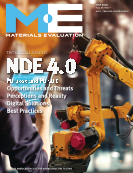
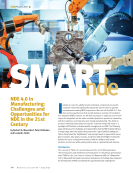
794 M A T E R I A L S E V A L U A T I O N • J U L Y 2 0 2 0 ME FEATURE w I ndustry 4.0 and the ability to tailor individual components to specific customer needs will significantly impact the way we need to provide nondestructive testing (NDT) inspections. We now call this NDE 4.0. This does not necessarily mean that we will develop a new type of nondestruc- tive evaluation (NDE) however, we will have to prepare or adapt our current tech- niques for integration into the cyber-controlled production process by networking with the machines and materials used during manufacturing. The ability to produce individual parts tailored to specific customer needs will result in a paradigm shift between industrial quality management and NDE. The following paper will discuss the challenges and opportunities that the NDE industry will face in today’s age, which the authors have named the “age of artificial intelligence.” This is characterized by “digitalization” and moving toward an exponential conver- gence of atoms, bits, qubits, neurons, and genes. Artificial intelligence will poten- tially be the key to creating smart machines with the ability to make smart decisions on their own while working side by side in a partnership with humans. Introduction The concept of “NDE 4.0” was introduced at the 2017 SPIE symposium “Smart Structures and Nondestructive Evaluation” in the plenary presentation titled “NDE for the 21st Century: Industry 4.0 Requires NDE 4.0” (Meyendorf 2017). Meyendorf discussed how various revolutions in technology have impacted the development of NDE and outlined the opportunities and challenges he NDE 4.0 in Manufacturing: Challenges and Opportunities for NDE in the 21st Century by Norbert G. Meyendorf, Peter Heilmann, and Leonard J. Bond SMART nde
ASNT grants non-exclusive, non-transferable license of this material to  .
All rights reserved. © ASNT 2026. To report unauthorized use, contact: customersupport@asnt.org