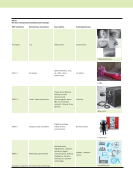
J U L Y 2 0 2 0 • M A T E R I A L S E V A L U A T I O N 791 training houses, and asset owners responsible for infrastructure safety. All of the guidance within this document is generic and intended to be applicable to all types of organizations, regardless of type, sector, or size all types of innovations (for example, product, service, process, model, and method), ranging from incremental to radical and all types of approaches (for example, internal and open innovation and user-, market-, technology-, and design-driven innovation activities). This is an overarching document that integrates all of the remaining ISO 56003-08 documents on innova- tion, which refer and eventually feed into one another for successful execution. It does not describe detailed activities within the organization, but rather provides guidance at a general level. It does not prescribe any requirements or specific tools or methods for innova- tion activities. This intent makes the application as broad as possible, including NDE 4.0, which also subjects the user to differences in understanding and interpretation. It is directly relevant, providing some level of understanding of the overlap across the funda- mentals of NDE and basics of innovation. ISO 56003:2019 – Tools and Methods for Innovation Partnership (published in February 2019) This document provides guidance for innovation part- nerships. It describes the innovation partnership framework and provides sample corresponding tools to use to decide whether to enter an innovation part- nership and describes how to evaluate and select partners and how to manage the partner interactions. Since NDE 4.0 requires serious collaborative activity across those who understand the physics of inspection systems and those who can connect them digitally, this standard is of value to innovation part- nerships. It starts with a gap analysis, followed by the identification, and engagement, of potential innova- tion partners and the governance of their interaction. The document addresses the essence of an innovation partnership required for NDE 4.0, where all parties must mutually benefit from working together in the context of the purpose defined above. ISO/TR 56004:2019 – Innovation Management Assessment (published in February 2019) This document will help the user understand why it is beneficial to carry out an innovation management assessment (IMA), what to assess, how to carry out the IMA, and how to maximize the resulting benefits, which are universally applicable. This document is labeled as ISO/TR (Technical Report), and contains information of a different kind from the standard ISO publication. It may include data obtained from a survey, for example, or from an informative report, or information of the perceived “state of the art.” This standard can be used to assess and prepare an organization for the NDE 4.0 journey. Together with ISO 56002, it is a “must use and conform” document with some level of interpretation. ISO 56005 – Intellectual Property Management (to be published by November 2020) This standard proposes guidelines for supporting intellectual property (IP) within innovation manage- ment. It aims at addressing the following topics concerning IP management at strategic and opera- tional levels: creating an IP strategy to support innova- tion in an organization establishing IP management in the innovation process and applying IP tools and methods in the innovation process. NDE 4.0 is a fertile ground for innovation and the creation of new IP. In general, any dependable existing IP management system is likely to be adequate. If not, then this document is of use otherwise, a cross reference might be enough. ISO 56006 – Strategic Intelligence Management (to be published by November 2020) This standard is a part of the innovation management system and through planning, deployment, measure- ment, and continual improvement, it provides guidance to organizations on how to develop and provide intelligence to top management, enabling decisions on the vision, mission, strategy, and innova- tion activities of the organization. Once again, at this time NDE 4.0 is still in the realm of “blue ocean strategy” (Kim and Mauborgne 2015), where the market boundaries and industry structure are not a given and can be constructed by the actions and beliefs of industry players. In general, any dependable existing strategic intelligence management system is likely to be adequate. If not, then this document can be referred to. The funda- mental model is the data–information–knowledge– intelligence cycle. And this needs to be applied to marketplace insight (consumers, competitors, and regulators) and PESTEL trends (Albu 2014). The inte- gration and interpretation of knowledge to generate intelligence is somewhat of an art, and you cannot completely depend upon ISO 56006. Hence, this standard should be used with caution. ISO 56007 – Idea Management (to be published in 2022) Ideas have the ability to make incremental improve- ments in the efficiency of an organization, up to

792 M A T E R I A L S E V A L U A T I O N • J U L Y 2 0 2 0 prompting a reevaluation of its entire business model. This standard provides guidelines for the management of ideas: the people who have them and the benefits they bring. It aims to address idea management at both the strategic and operational level through the culture and leadership of an organization, including opportunity and risk management, intrapreneurship, problem-solving, and tools and methods for managing creativity and ideas. This standard supports the innovation manage- ment system introduced in ISO 56002, and is absolutely necessary for NDE 4.0. Since the actual processes and techniques are still being discussed, it is too early for me to comment on its total relevance. However, some parts of the content are likely to have a strong influence on the successful outcome of the NDE 4.0 journey. Also, there are not many good books available on ideation. This document is expected to bring value to any aspect of a functioning organization. ISO 56008 – Innovation Operation Measurements and Metrics (to be published in 2023) This standard will provide guidance for the definition, implementation, evaluation, and further improvement of the measurements necessary to effectively manage innovation operations in an organization. This standard will provide guidance at a general level specifically, the selection of indicators to measure the progress of innovation activities and the performance of the innovation portfolio. Technical teams are excited about the intellectual and qualitative possibilities of NDE 4.0, but business leaders will likely struggle with the ability to track and quantify the projected success of such an initiative for some time. There are only a handful of innovation metrics, and companies that have successfully innovated have figured out the art, rather than the math, of relevant metrics. Once again, it is too early for me to comment on this standard’s applicability. The most popular financial metric is revenue generated from products and services that did not exist three years ago. From an NDE 4.0 perspective, look at it as a technology approach that serves existing business metrics at the top level. At the second level, one can include metrics that help quantify Safety 5.0—improved safety/reliability (POD) and economic value. Going Forward NDE 4.0 is the way to go, given the nature of the digital transformation taking place all around us. It includes the confluence of digital and physical technologies for assuring the safety of infrastructure, assets, and inspectors, as well as creating economic value for business owners, operators, OEMs, and service providers. All of this is quite possible, consid- ering the new opportunities associated with disruptive technologies and how thought leaders are coming together to guide the industry. For some, innovation is a process for others, it is a skill or a competency and for many, it is just an outcome of creative activity. Very soon, ISO standards will put that debate to rest, along with providing highly valuable guidance on execution, with relevance to the emergence of NDE 4.0. Just like in previous revolutions, we again have three options going into the fourth revolution. We can embrace purposeful NDE 4.0 for Safety 5.0, leveraging ISO 56000 guidelines adapt to the changes brought on us by Industry 4.0 and eventually hope to evolve or ignore it, and plan to retire or exit the business. What is your choice? ww ACKNOWLEDGMENTS First of all, thanks to Johannes Vrana of DGZfP for stimu- lating conversations on this topic on an almost-weekly basis. Next, I am grateful to various leaders at ASNT for providing me with a forum to develop and express a perspective on the emerging topic of NDE 4.0 through conversations, short courses, and invited lectures. These include Anish Poudel, Jill Ross, Scott Cargill, Mark Pompe, Barry Schieferstein, Roger Engelbart, David Mandina, Ralf Holstein, Kim Hayes, Joop Kraijesteijn, and Don Locke. I also appreciate the support of Frank Voehl and Rick Fernandez, who engaged me to participate in ISO/TC279 development of standards on innovation management, providing a unique opportunity to bring the ISO guidelines to the inspection world of NDE 4.0. AUTHOR Ripi Singh: Inspiring Next, Connecticut, USA ripi@inspiring next.com REFERENCES Albu, P., 2014, “A Strategic Management Framework: PESTEL,” Performance Magazine, available at https://www .performancemagazine.org/a-strategic-management-frame work-pestel. Aldrin, J., 2020, “Intelligence Augmentation and Human- Machine Interface Best Practices for NDT 4.0 Reliability,” Materials Evaluation, Vol. 78, No. 7, pp. 869–879. Bennis, W.G., and B. Nanus, 1985, Leaders: The Strategies for Taking Charge, HarperCollins Publishers, New York, NY. Bundesministerium für Wirtschaft und Energie (BMWi) (Federal Ministry of Economy and Energy), 2020, “Plattform Industrie 4.0,” available at https://www.plattform-i40.de. Government of Japan, 2015, “The 5th Science and Tech- nology Basic Plan,” available at http://www8.cao.go.jp/ cstp/english/basic/5thbasicplan.pdf. Hermann, M., T. Pentek, and B. Otto, 2016, “Design Princi- ples for Industrie 4.0 Scenarios,” Proceedings of the 49th Hawaii International Conference on System Sciences (HICSS), Koloa, HI, IEEE, New York, NY. ME FEATURE w purpose and pursuit of nde 4.0
ASNT grants non-exclusive, non-transferable license of this material to  .
All rights reserved. © ASNT 2026. To report unauthorized use, contact: customersupport@asnt.org