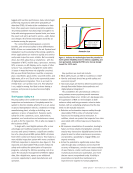
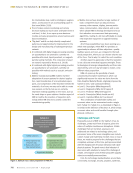
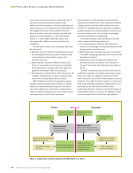
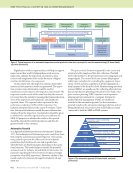
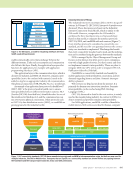
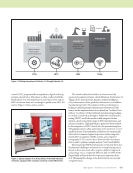
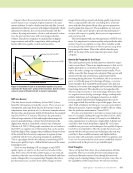
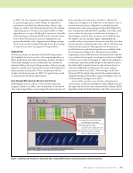
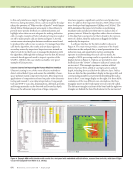
J U L Y 2 0 2 0 • M A T E R I A L S E V A L U A T I O N 859 Figure 9 shows the economies of scale of an automated system based on an exemplary implementation in the auto- motive industry. It can be clearly seen that with film (second industrial revolution) and even with digital radiography (third industrial revolution), the cost increases linearly with the volume. By using automation, robotics, and automatic evalua- tion, the unit cost decreases with increasing production volume. This allows companies to manufacture in higher- wage countries and still be competitive, while putting all human effort into quality control and innovation. NDT as a Sensor The data-driven trends of Industry 4.0 and NDT 4.0 are fueled by information provided by sensors. These sensors are omnipresent and range from discrete data points (such as temperature, time, position, etc.) to the most complex sensors that provide a much greater depth of information. An example found in NDT is CT systems, which have the potential to delivery large amounts of data and insight about inspected parts. In manufacturing, a current trend of interest is the digital twin, which is considered a virtual copy of the part (Madni et al. 2019). What people sometimes do not realize is that NDT can supply a lot of information that can be used to build this digital twin. Imagine the possibilities when you have all the as-built data for every component in a given system combined with the ever-advancing simulation capabilities. This is a paradigm shift for the industry, transforming NDT from a pure quality step to a full industrial sensor in the manu- facturing process. Once we stop thinking of X-ray images as only NDT quality inputs, we start to see the next level of value in this data. This is true of both 2D and 3D images, so we must ask ourselves, what else can we learn from the hundreds and thou- sands of images that we are generating? Imagine what else a production process can learn from subtle changes in these images that mostly go unnoticed during quality inspections. Then, compound this effect by correlating these small vari- ances with the data gleaned from other process parameters used to make that same part. The possibilities are vast, and the NDT world can be proud to provide that information— not just with respect to quality, but to process improvement and control as well. This development will raise the importance of NDT even more. It is important to evaluate quality and provide the infor- mation if a part is acceptable or scrap. More valuable would be to also provide information on how to prevent scrap from happening in the future. This is the added value that puts NDT on the map of the most important processes of any company. How to Be Prepared for the Future The initial question posed in this paper was related to oppor- tunity versus threat. There is no singular answer to this, as it is highly dependent on context, but this movement will, one way or the other, change our industry fundamentally. There will be a need for this change to be adopted. This process will stretch over the next several years, and pressure will be increasing during that time. Nevertheless, this is no reason to panic or to blindly grasp at technology offerings—everyone must remember that each NDT professional’s job, first and foremost, is to ensure part integrity and to prevent faulty parts from being delivered. This should never be jeopardized by efficiency improvements or new technology therefore, there is a requirement to develop a strategic change roadmap with realistic milestones and contingency measures. A careful process analysis will reveal low-hanging fruits that can be easily approached. Beyond the scope of this paper, there are other fields of Industry 4.0 that pose even more potential for efficiency increases. A great example would be the use of big data for predictive maintenance (Vrana 2019). It is also very important to not take too many steps at one time. For example, making the leap from film (2.0) to a fully automated ADR robot system (4.0) may be too difficult for some organizations to achieve in a single effort. A better way could be to first switch from film to digital RT (3.0), then establish new processes and techniques, then qualify all opera- tors before moving further. After the people have been accli- mated with the new processes and techniques, the next step could be to then carefully automate and digitize further process steps with automatic/assisted defect recognition, and so on. It is recommended to reach out to established solution providers early in the process to get valuable input. Final Thoughts There is a big fear that robots, AI, and automation will take away jobs. This fear is mainly driven by misleading media articles and futuristic movies. Even though the new tech- nology can do amazing things, it does not even come close to the capabilities of the human brain. We will not see these No investment Investment in DR Automatic evaluation (ADR) Production volume A Investment in ADR Digital X-ray system (DR) Inspection by film (RT) B C Figure 9. Economies of scale of an automated system: A, B, and C represent the “break even” points of the investment. From A it makes sense to invest in DR and from B/C to invest in automation. Costs per part

860 M A T E R I A L S E V A L U A T I O N • J U L Y 2 0 2 0 systems replacing professionals in NDT anytime soon—the medical industry is perfect proof of this. The reality is that despite the fact that the medical industry is now using AI to help interpret images, they still cannot keep up with the tsunami of data that is being generated by the new technolo- gies. There needs to be a paradigm shift in the perception of these helping technologies. Robots help us to move parts and reduce the amount of physical labor and the cloud makes archiving and processing results much easier, while AI helps us to improve our evaluation capabilities. No doubt, our jobs will change and the activities we perform will be more computer oriented. This requires requalification and learning/adopting of new skills, but in the end, every machine needs a human to supervise it (Meyendorf et al. 2019). Consider the other industrial revolutions like electrification: it happened, and we have more jobs than ever before. It is more important to approach this new technology with openness and to embrace the opportunities it has for us. The biggest threat would be to wait for the things to come and get disrupted by others who adopted them earlier. Industry experts even state that companies not investing in the emerging technologies face a significant risk of being put out of business by more efficient local competition or the emerging global competition (BDI 2015). REFERENCES ASTM, 2018, ASTM E2737 – Standard Practice for Digital Detector Array Performance Evaluation and Long-Term Stability, ASTM International, West Conshohocken, PA. BDI, 2015, “The Digital Transformation of Industry, a Report for the Federation of German Industries (BDI) produced by Roland Berger Strategy Consultants,” available at https://www.rolandberger.com/ publications/publication_pdf/roland_berger_digital_transformation _of_industry_20150315.pdf. Beaumont, P.W.R., C. Soutis, and A. Hodzic (eds.), 2015, “Radiographic Testing,” Structural Integrity and Durability of Advanced Composites, Woodhead Publishing, Cambridge, UK. du Plessis, A., I. Yadroitsava, and I. Yadroitsev, 2020, “Effects of Defects on Mechanical Properties in Metal Additive Manufacturing: A Review Focusing on X-ray Tomography Insights,” Materials & Design, Vol. 187, doi: 10.1016/j.matdes.2019.108385. Epicor, 2020, “What is Industry 4.0—the Industrial Internet of Things (IIoT)?” available at https://www.epicor.com/en-us/resource- center/articles/what-is-industry-4-0/. IFR, 2018, “Positioning Paper: Robots and the Workplace of the Future,” International Federation of Robotics, Frankfurt, Germany. Küpper, Daniel, 2020, “Embracing Industry 4.0 and Rediscovering Growth,” available at https://www.bcg.com/capabilities/operations/ embracing-industry-4.0-rediscovering-growth.aspx. Kurz, J.H., A. Jüngert, S. Dugan, G. Dobmann, and C. Boller, 2013, “Relia- bility Considerations of NDT by Probability of Detection (POD) Determi- nation Using Ultrasound Phased Array,” Engineering Failure Analysis, Vol. 35, pp. 609–617. Madni, A.M., C.C. Madni, and S.D. Lucero, 2019, “Leveraging Digital Twin Technology in Model-Based Systems Engineering,” Systems, Vol. 71, No. 1, doi:10.3390/systems7010007. Meyendorf, N.G., L.J. Bond, J. Curtis-Beard, S. Heilmann, S. Pal, R. Schallert, H. Scholz, and C. Wunderlich, 2017, “NDE 4.0—NDE for the 21st Century— The Internet of Things and Cyber-Physical Systems Will Revolutionize NDE,” 15th Asia Pacific Conference for Non-Destructive Testing (APCNDT2017), 13–17 November, Singapore, Singapore. OPC, 2020, “Welcome to the World of OPC,” OPC Foundation, available at https://opcfoundation.org/about/opc-technologies/opc-ua/. Perner, P., U. Zscherpel, and C. Jacobsen, 2001, “A Comparison between Neural Networks and Decision Trees based on Data from Industrial Radi- ographic Testing,” Pattern Recognition Letters, Vol. 22, No. 1, pp. 47–54. Singh, R., 2019, “NDE 4.0: The Next Revolution in Nondestructive Testing and Evaluation: What and How?” Materials Evaluation, Vol. 77, No. 1, pp. 45–50. Vaidya, S., P. Ambad, and S. Bhosle, 2018, “Industry 4.0 – A Glimpse,” Procedia Manufacturing, Vol. 20, pp. 233–238. VisiConsult, 2019, “VisiConsult Supports Automotive Sector with 100% Inspection by Real Inline CT Solution,” 19 December 2019, available at https://visiconsult.de/supports-automotive/. VisiConsult, 2020a, “Computed Tomography,” available at https:// visiconsult.de/technology/computed-tomography/. VisiConsult, 2020b, “Automated Inspection,” available at https:// visiconsult.de/technology/automated-defect-recognition/. Voelker, C., 2003, “If a Picture Is Worth 1,000 Words, then Pervasive, Ubiquitous Imaging Is Priceless: DICONDE, the Universally Compatible Nondestructive Evaluation Image File Format,” ASTM Standardization News, Vol. 31, No. 10, pp. 32–33. Vrana, J., 2019, “NDE 4.0 and Its Use for Predictive Maintenance,” ASNT Annual Conference, 18–21 November, Las Vegas, NV. ME TECHNICAL PAPER w ndt 4.0: opportunity or threat?
ASNT grants non-exclusive, non-transferable license of this material to  .
All rights reserved. © ASNT 2026. To report unauthorized use, contact: customersupport@asnt.org