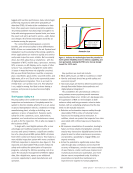
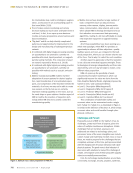
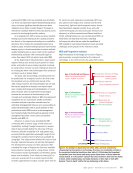
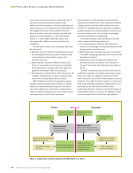
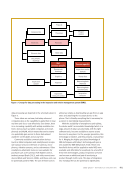
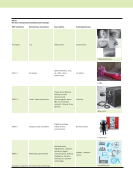
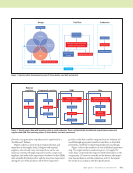
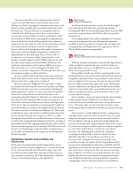
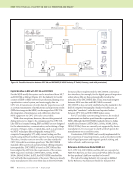
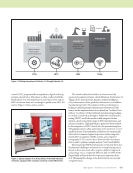
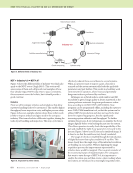
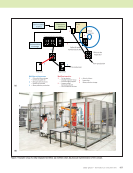
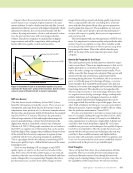
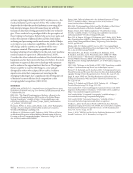
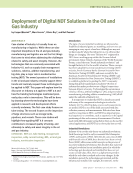
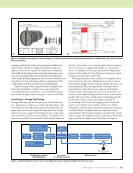
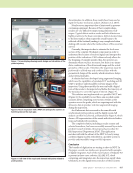
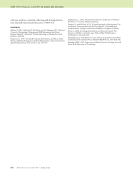
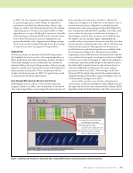
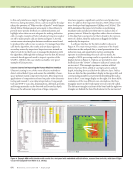
J U L Y 2 0 2 0 • M A T E R I A L S E V A L U A T I O N 857 Figure 7. Example setup of a fully integrated workflow: (a) workflow chart (b) physical implementation of the concept. Review station in office To production From production Skirts to be inspected Review station at storage Data server – database – pictures X-ray Rejected Approved Robot work area Inspected skirt storage Workflow sorting process 1 – Pick pallet from storage – Identify by pallet ID 2 – Remove rejected skirts – Identify by number 3 – Move pallet to production Workflow inspection 1 – Set up system – Change machine setup – Activate right program 2 – Prepare pallet – Generate pallet ID – Print numbered stickers 3 – Attach stickers 4 – Inspection 5 – Move pallet to storage 1 1 2 3 2 3 4 5 Pallet ID and numbered stickers (a) (b)

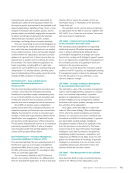
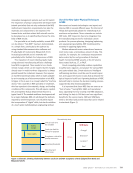
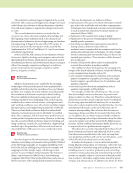
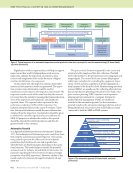
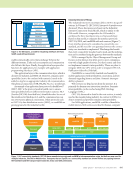
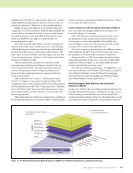
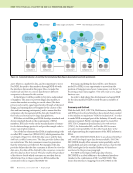
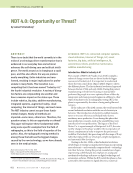
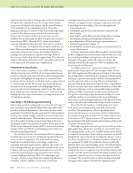
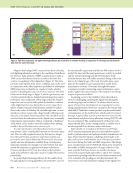
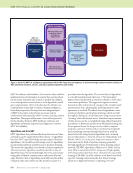
858 M A T E R I A L S E V A L U A T I O N • J U L Y 2 0 2 0 offline evaluation. This allows users to decouple inspection from evaluation and thereby parallelize it. This yields huge productivity gains. By introducing a single part flow and trace- ability based on serial numbers, the overall process safety is fully given at any time. By using the cloud, it is even possible to connect systems and sites into a world-spanning NDT network. This ensures that interpretation results and archived data are available to all employees of a global company every- where at any time. End customers can be easily integrated into the cloud and given access to the data from their parts. Figure 8 shows an example of such a setup. How Does This Affect Me? The world has never been more complex. As supply chains are expanding to cover every corner of the world, we see the rise of large-scale automation on the shop floor and beyond. Espe- cially Western economies face a growing competition from lower-wage countries that are quickly catching up in terms of technology. Many internal company departments have already been transformed by the digital disruption, and robots have become valued contributors in many areas. In every sector, from automotive to aerospace, the impact of automa- tion is undeniable. Companies understand that they are in a global competition these days, and that just continuing to do things the way they’ve always done them will most likely have severe consequences. NDT has traditionally been cautious when regarding change, and there are good reasons for it. In the end, all of us are responsible for the quality of the product that is delivered by our companies. Our work is far too important for thought- less experiments with technology. As the guardians of quality, the NDT industry has created a strong network of rigid stan- dards and regulations. The upside is an unprecedented quality system that protects our products, but on the downside these rigidities can often slow us down significantly. As a recent example, a supplier in the aerospace industry discovered substantial cost savings (roughly by a factor of 10) if they would switch from X-ray film to digital radiography, robotics, and computer numerical controls. The return of interest was amazing, and it would help the company to stay in business against its new competitors from Far East. Unfortunately, the project had to be abandoned as it was discovered that the parts were governed under a standard established in the 1970s, which could not be altered. Such situations are quite frequent in our industry and effectively destroy a huge amount of value that could be captured for our companies and countries. Even though such stories are common, our industry is already witnessing a fundamental transformation. New tech- nologies and approaches have been embraced in several industries like the automotive industry, which has less-rigid quality requirements than, for example, aerospace. To give a recent example, one of Germany’s leading automotive manu- facturers has just adopted an in-line CT system to inspect rotors for electric motors (VisiConsult 2019). The system uses an industrial robot for part handling and AI for the inter- pretation of the images. At the same time, the system is fully hooked up to the company’s cloud system and processes all the data in real time. The skill sets required for the operators of this system are completely different than what was required for the manual process of the past. It is important to realize the ongoing transformation and to invest in the new skills early. ME TECHNICAL PAPER w ndt 4.0: opportunity or threat? Figure 8. Example of a globally connected NDT operation. Each site has a number of X-ray systems that are linked to a central server. The servers are connected to the company-wide “NDT cloud,” which is also used as the central image archive. It is also possible to connect portable devices that can be used outside of specific sites. The interpretation can be done from anywhere in the world using a review software that is connected to the cloud.
ASNT grants non-exclusive, non-transferable license of this material to  .
All rights reserved. © ASNT 2026. To report unauthorized use, contact: customersupport@asnt.org