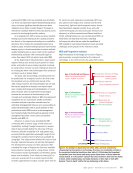
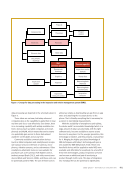
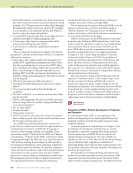
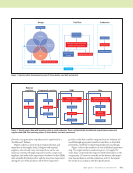
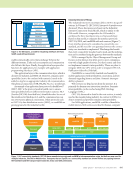
J U L Y 2 0 2 0 • M A T E R I A L S E V A L U A T I O N 843 The information flow for the planning of production comes from the ERP system and is broken down to the field/process level (meaning the communication starts at the top level of the pyramid and is communicated down to the bottom level). Once production is running, the data are collected at the field/process level, then condensed into several steps (into the different levels), and finally the KPIs are stored in the ERP system (meaning the communication starts at the bottom levels of the pyramid and is communi- cated up to the top level). In order for this information to flow in both directions, interfaces need to be implemented between the levels. Depending on the number of systems or devices in a level, the number of interfaces needing to be implemented can be exhausting. This is why in a lot of production environments, analog (paper-based) or not- machine-readable digital (email or PDF) solutions are still used for certain interfaces between levels. However, such solutions require human action and are highly error prone (like errors that occur when entering the 10-digit serial number of a certain component). This already shows the need for standard, machine-readable interfaces. In such an environment, the main interaction system for NDE is the MES system, as this is the point where all of the data from all of the equipment is combined. However, the idea of Industry 4.0 is not only to collect and analyze the data from all devices and systems (including PLM), but also that every device and system (including all NDE equipment) is able to communicate with one another. All of this is independent from the levels shown in the automation pyramid (Figure 4). Therefore, not only do inter- faces between two adjacent levels become necessary, but so do interfaces between all devices and systems throughout all of the levels. This would lead to an unmanageable number of necessary interfaces, and hence the implementation effort for all of these interfaces would prevent Industry 4.0. This is why standardized, open, and machine-readable interfaces become key for Industry 4.0 and why companies will have to shift from proprietary interfaces to standard interfaces if they want to survive the ongoing fourth industrial revolution. Looking at the member lists of the ongoing standardization efforts shows that most of the big players (for example, SAP, Microsoft, and Siemens) are beginning to understand this. Unfortunately, a lot of small- and medium-sized companies are still ignoring this development. Digital Twins, Semantic Interoperability, and Data Security Every asset (meaning every manufacturing device, sensor, product, software, operator, engineer, etc.), can be described in the virtual world with information like shape, type, func- tionality, material composition, operational data, financial data, interfaces, and more. All of this information combined creates a virtual representation—the digital twin. As discussed in the previous section, data for the digital twin comes from all levels of the automation pyramid including the MES for all manufacturing-related data, the ERP system for corporate data, and PLM for data from product development. For creating digital twins and for all Industry 4.0 commu- nication, it is important that the information is machine readable. It must be possible to interpret the meaning of the exchanged data unambiguously in the appropriate context. This is called semantic interoperability. With the semantic information stored in the digital twin, it will be possible to simulate the asset, predict its behavior, apply algorithms, and so on. A digital twin can also include services to interact with the asset. User profiles and all user activities maintained by social media platforms or data stored about individuals by insurance companies, other businesses, or government can be seen as a part of a digital twin of a person. Already, the data stored by just one of those entities has quite some value. All the infor- mation combined in one digital twin would hold incredible value for certain entities but is a great threat for society, as it leads to transparent humans. This shows the need for data security and sovereignty. Data security is a means for protecting data (for example, in files, emails, clouds, databases, or on servers) from unwanted actions of unauthorized users or from destructive forces. Therefore, data security is the basis for data-centric developments like the Industry 4.0 landscape discussed in this paper. Data security is usually implemented by creating decen- tralized backups (to protect from destructive forces) and by using data encryption (to protect from unwanted actions). Data encryption is based on mathematical algorithms that encrypt and decrypt data using encryption keys. If the correct key is known, encryption and decryption can be accomplished in a short time, but if the key is not known, decryption becomes very challenging for current-day computers (requiring several months or years of calculation time). Therefore, the data is secured from unwanted access. However, with computers becoming increasingly more powerful over time, encryption keys and algorithms need to become more challenging. As well, data encrypted with old algorithms or keys that are too short need to be re-encrypted after some time to keep it safe. The only measure ensuring data encryption over time is to use keys that have the same length as the data to be encrypted and are purely random. One of the few methods to creating such keys is quantum cryptography, which is still quite expensive in installation. Watch the video The Idea of the Digital Twin Watch the video Semantic Interoperability using Ontologies and Information Models

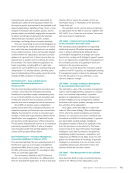
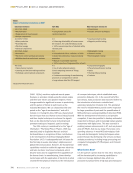
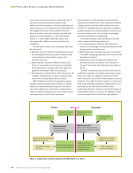
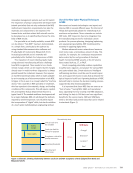
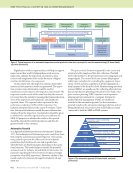
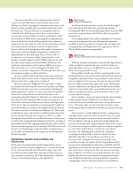
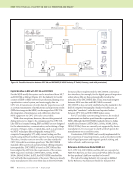
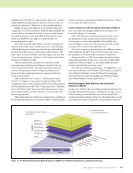
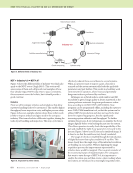
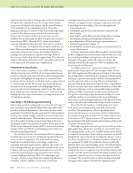
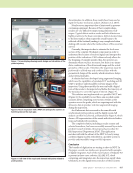
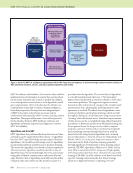
844 M A T E R I A L S E V A L U A T I O N • J U L Y 2 0 2 0 Where data security is the necessary basis, data sover- eignty goes one step further protecting data. Data sovereignty guarantees the sovereignty of data for its creator or its owner. Data itself, if not artistic, is legally not protected by any copy- right. Therefore, currently if a dataset is submitted to somebody else, only individual contracts can hinder the receiver from forwarding or selling the data (even if it is submitted using data encryption). Therefore, two measures have to be implemented to guarantee data sovereignty: (1) legal documents need to be prepared and (2) software and interfaces need to be implemented to restrict the use of the receiver in order to adhere to the rules of the submitter. In the industrial world, data sovereignty is assured by measures like the ones discussed at the end of this paper. This enables the creation of reasonable digital twins, leads to added value, and creates new markets. Industry 4.0 Asset Administrative Shell Plattform Industrie 4.0 started the development of the Industry 4.0 asset administration shell (AAS) in 2015 (Plat- tform Industrie 4.0 2016, 2018). The AAS is the virtual repre- sentation of each asset—its digital twin. An asset can be a device, but also a component, a plant, an entire factory, a software, or even a person/operator/inspector. Each AAS consists of a manifest and a component manager (Figure 5). The manifest is a table of contents that provides all of the information about the asset in the header. In the body, the manifest references all data stored by the asset and all functions that can be performed by the asset. The manifest is defined in XML or JSON (Plattform Indus- trie 4.0 2018). The component manager contains the actual implementations and realizes the interaction, functionality, and high-performance data queries. Each AAS and each individual asset must have a globally unique identifier (ID), which is stored in the header. The ID of the AAS is the ID of the type of component—for example, whether it is a drill or a conveyor belt. The ID of the asset is the ID of the instance—meaning whether it is drill 1, 2, or 25. AASs may be nested within one another. The AAS for a production line can reference the AAS of the various processing machines, inspection machines, and so on. The AAS for an inspection system can, for example, contain the AAS for the mechanical drives, the sensors, and the actual test system. People, such as operators or inspectors, are also repre- sented by an AAS. For example, there may be an AAS for a Level III UT inspector specializing in the inspection of castings. This inspector receives the assigned task via a tablet or an augmented reality platform, and the results are stored digitally by the inspector. This shows that Industry 4.0 is not striving for a deserted factory. For Industry 4.0, networking is crucial, and results must be available digitally. It does not require automation. For some work steps, especially repetitive tasks, it makes more sense to use automated solutions. But for other work steps, a human being is more effective. Interfaces The introduction showed the need for standardized, vendor- independent interfaces, and the AAS provides a standardized virtual representation of each asset describing the function- ality and interfaces offered by the asset. But what are the inter- faces in this context? Is it the question regarding the physical interface? The question regarding USB, Wi-Fi, or 5G? The question regarding transmission control protocol/internet protocol (TCP/IP), hypertext transfer protocol (http), exten- sible markup language (XML), or OPC UA? Before further discussion, the term “interface” must be defined in more detail. Open Systems Interconnection Model The open systems interconnection (OSI) model (Figure 6) gives an overview of the different abstraction layers of digital interfaces and helps to select the interfaces that are decisive for NDE 4.0. The lowest level represents the physical connec- tion, such as a cable or radio connection. The first OSI layer—the transmission of the individual bits—runs via this connection. The information to be transmitted is combined with transmitter and receiver addresses and other information in the data link layer to form frames. Information packets are “tied” in the network layer and combined into segments in the transport layer. The layers above are the so-called host layers. The session layer is responsible for process communication. The presenta- tion layer is responsible for converting the data from a system-independent to a system-dependent format and thus ME TECHNICAL PAPER w nde 4.0: perception and reality Figure 5. Industry 4.0 asset administration shell for an ultrasonic testing system (© Vrana GmbH, used with permission).
ASNT grants non-exclusive, non-transferable license of this material to  .
All rights reserved. © ASNT 2026. To report unauthorized use, contact: customersupport@asnt.org