on-site and automatically transmits results
to control centers or service personnel.
This decentralized processing enables
fast assessments while reducing the
volume of data transferred to cloud
systems, improving efficiency, data secu-
rity, and resource use. Railway facilities,
tunnels, dams, and other critical struc-
tures could also benefit from this tech-
nology in the future.
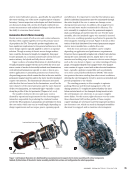
A real-world test site on the insti-
tute grounds in Saarbrücken demon-
strates the system in practice: sensors
at a parking lot entrance record vehicle
loads, supported by a weather station
and camera. Project partners EUROKEY
Software GmbH and WPM Ingenieure
GmbH analyze and visualize the data,
enabling real-time and predictive assess-
ments of how traffic and weather affect
structural integrity.
TRUEFLAW RECOGNIZED
FOR INNOVATION
AND RAPID GROWTH
Trueflaw earned two major national
honors last fall, highlighting both its tech-
nical leadership and strong business
momentum. The Finnish company—which
specializes in AI-based automated defect
recognition (ADR) systems for nonde-
structive evaluation (NDE) in industries
including nuclear power, aerospace, and
rail—was named a finalist for AI Innovation
of the Year by AI Finland, a national
network that promotes cutting-edge
artificial-intelligence (AI) development
across the country. The award recognizes
standout AI solutions and is presented
at the annual AI Gala, which brings
together leaders from Finland’s growing
AI ecosystem.
Trueflaw also secured the 30th
spot on Deloitte’s Technology Fast 50
Finland list, which ranks the country’s
fastest-growing technology companies
based on four-year revenue growth. The
Deloitte Fast 50 is considered a key indi-
cator of rising tech companies poised for
continued expansion.
CREAFORM OPENS
TWO NEW ISO 17025
CALIBRATION CENTERS
IN US AND MEXICO
Creaform, an AMETEK Inc. business
based in Lévis, Québec, Canada,
announced on 18 November the
opening of two new ISO 17025–
accredited calibration service centers
in Monterrey, Mexico, and Exton,
Pennsylvania. The facilities will provide
certified calibration for the company’s
HandySCAN 3D EVO, BLACK, and
MAX Series, giving customers in the
US and Mexico local access to services
that previously required international
shipping.
The new centers operate under test
protocols reviewed and approved by an
independent certified auditor, allowing
users to obtain calibration certificates
that meet their quality management
requirements while reducing equipment
downtime.
“The launch of this new service is
a major step forward in making certi-
fied calibration more accessible to our
customers,” said David Gagné, Vice
President of Operations and Customer
Services.
The openings are part of a wider
effort to expand Creaform’s service
network, which currently includes 17
service centers and four advanced
repair centers worldwide. Key mile-
stones in the rollout include global
ISO 17025 calibration availability for
the HandySCAN lineup in early 2026,
expanded coverage to MetraSCAN 3D
and HandyPROBE by mid-2026, and
on-site calibration for R-Series customers
later this year.
Creaform is also introducing a new
Performance Check Kit, enabling
users to verify system performance
directly on-site. Integrated with
Creaform.OS, the kit lets operators
run interim checks, generate reports,
and receive self-certification calibration
documentation.
NEW SOFT ROBOTIC
SKIN ENABLES
MILLIMETER-SCALE
VINE ROBOTS TO
NAVIGATE TIGHT,
COMPLEX SPACES
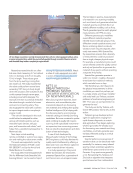
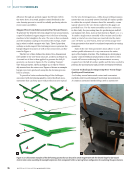
Researchers have developed a soft
robotic skin that enables vine robots only
a few millimeters wide to navigate convo-
luted paths and fragile environments. To
achieve this, the team integrated a very
thin layer of actuators made of liquid
crystal elastomer at strategic locations
in the soft skin. The robot is steered by
controlling the pressure inside its body
and the temperature of the actuators.
The researchers demonstrated that
a robot equipped with this skin could
successfully navigate a model of human
arteries. The robot also was able to move
through a model of the interior of a jet
engine.
The research team published their
results in the 15 October issue of Science
Advances.
“Our work represents a step toward
small, steerable, soft vine robots for appli-
cations in delicate and constrained envi-
ronments,” said Tania K. Morimoto, an
associate professor in the Department of
Mechanical and Aerospace Engineering
at the University of California, San Diego
(UC San Diego) and the paper’s corre-
sponding author.
Current steerable vine robots exist
at larger scales, typically centimeters to
meters in size. They tend to be steered
by pneumatic actuators, motors, or
tendons—methods that are difficult to
implement or inefficient at smaller scales.
The team overcame these limitations
by integrating a series of liquid crystal
elastomer actuators at specific locations
in a soft robotic skin. These actuators are
extremely thin yet strong, making them
suitable for steering at small scales. The
robot can be controlled by tempera-
ture, pressure, or both, with combined
control performing best. The researchers
embedded small, flexible heaters under
the actuators to adjust their temperature
and built a system to precisely modulate
internal pressure for steering.
SCANNER
|
INDUSTRYNEWS
10
M AT E R I A L S E V A L U AT I O N • J A N U A R Y 2 0 2 6
to control centers or service personnel.
This decentralized processing enables
fast assessments while reducing the
volume of data transferred to cloud
systems, improving efficiency, data secu-
rity, and resource use. Railway facilities,
tunnels, dams, and other critical struc-
tures could also benefit from this tech-
nology in the future.
A real-world test site on the insti-
tute grounds in Saarbrücken demon-
strates the system in practice: sensors
at a parking lot entrance record vehicle
loads, supported by a weather station
and camera. Project partners EUROKEY
Software GmbH and WPM Ingenieure
GmbH analyze and visualize the data,
enabling real-time and predictive assess-
ments of how traffic and weather affect
structural integrity.
TRUEFLAW RECOGNIZED
FOR INNOVATION
AND RAPID GROWTH
Trueflaw earned two major national
honors last fall, highlighting both its tech-
nical leadership and strong business
momentum. The Finnish company—which
specializes in AI-based automated defect
recognition (ADR) systems for nonde-
structive evaluation (NDE) in industries
including nuclear power, aerospace, and
rail—was named a finalist for AI Innovation
of the Year by AI Finland, a national
network that promotes cutting-edge
artificial-intelligence (AI) development
across the country. The award recognizes
standout AI solutions and is presented
at the annual AI Gala, which brings
together leaders from Finland’s growing
AI ecosystem.
Trueflaw also secured the 30th
spot on Deloitte’s Technology Fast 50
Finland list, which ranks the country’s
fastest-growing technology companies
based on four-year revenue growth. The
Deloitte Fast 50 is considered a key indi-
cator of rising tech companies poised for
continued expansion.
CREAFORM OPENS
TWO NEW ISO 17025
CALIBRATION CENTERS
IN US AND MEXICO
Creaform, an AMETEK Inc. business
based in Lévis, Québec, Canada,
announced on 18 November the
opening of two new ISO 17025–
accredited calibration service centers
in Monterrey, Mexico, and Exton,
Pennsylvania. The facilities will provide
certified calibration for the company’s
HandySCAN 3D EVO, BLACK, and
MAX Series, giving customers in the
US and Mexico local access to services
that previously required international
shipping.
The new centers operate under test
protocols reviewed and approved by an
independent certified auditor, allowing
users to obtain calibration certificates
that meet their quality management
requirements while reducing equipment
downtime.
“The launch of this new service is
a major step forward in making certi-
fied calibration more accessible to our
customers,” said David Gagné, Vice
President of Operations and Customer
Services.
The openings are part of a wider
effort to expand Creaform’s service
network, which currently includes 17
service centers and four advanced
repair centers worldwide. Key mile-
stones in the rollout include global
ISO 17025 calibration availability for
the HandySCAN lineup in early 2026,
expanded coverage to MetraSCAN 3D
and HandyPROBE by mid-2026, and
on-site calibration for R-Series customers
later this year.
Creaform is also introducing a new
Performance Check Kit, enabling
users to verify system performance
directly on-site. Integrated with
Creaform.OS, the kit lets operators
run interim checks, generate reports,
and receive self-certification calibration
documentation.
NEW SOFT ROBOTIC
SKIN ENABLES
MILLIMETER-SCALE
VINE ROBOTS TO
NAVIGATE TIGHT,
COMPLEX SPACES
Researchers have developed a soft
robotic skin that enables vine robots only
a few millimeters wide to navigate convo-
luted paths and fragile environments. To
achieve this, the team integrated a very
thin layer of actuators made of liquid
crystal elastomer at strategic locations
in the soft skin. The robot is steered by
controlling the pressure inside its body
and the temperature of the actuators.
The researchers demonstrated that
a robot equipped with this skin could
successfully navigate a model of human
arteries. The robot also was able to move
through a model of the interior of a jet
engine.
The research team published their
results in the 15 October issue of Science
Advances.
“Our work represents a step toward
small, steerable, soft vine robots for appli-
cations in delicate and constrained envi-
ronments,” said Tania K. Morimoto, an
associate professor in the Department of
Mechanical and Aerospace Engineering
at the University of California, San Diego
(UC San Diego) and the paper’s corre-
sponding author.
Current steerable vine robots exist
at larger scales, typically centimeters to
meters in size. They tend to be steered
by pneumatic actuators, motors, or
tendons—methods that are difficult to
implement or inefficient at smaller scales.
The team overcame these limitations
by integrating a series of liquid crystal
elastomer actuators at specific locations
in a soft robotic skin. These actuators are
extremely thin yet strong, making them
suitable for steering at small scales. The
robot can be controlled by tempera-
ture, pressure, or both, with combined
control performing best. The researchers
embedded small, flexible heaters under
the actuators to adjust their temperature
and built a system to precisely modulate
internal pressure for steering.
SCANNER
|
INDUSTRYNEWS
10
M AT E R I A L S E V A L U AT I O N • J A N U A R Y 2 0 2 6