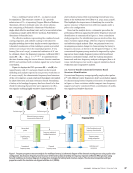
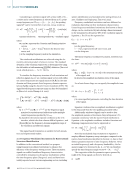
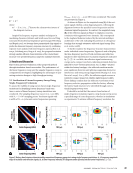
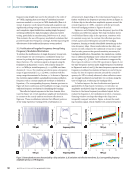
Considering an excitation signal with a time width of N c =
5 cycles and a center frequency f k selected from an N w -point
sweep-frequency set W sweep ={f 1 ,⋯ ,f k ⋯,fNw}, the probing
signal s t (k) can be written (Ren et al. 2023, 2025a, 2025b) as:
(2) s t (k) =exp
[
− t ⊙ t _
2 (N c _
2 √ _
2ln2 )f k ]
⊙ 0.5
{
1 − cos
[
2πt
(
N c
f k )]}
⊙ sin(2πfkt)
↓ ↓ ↓
Gaussian window w G Hanning window w H Oscillation signal
where
w G and w H represent the Gaussian and Hanning window
vectors,
t =[0,1/fs, ⋯ ,⌊ (N s − 1 )/f s ⌋ ]T denotes the discrete time
vector, and
f s is the sampling frequency used in the simulation.
The windowed modulations are achieved using the ele-
ment-by-element product ⊙ between vectors. The standard
deviation of the Gaussian window w G is determined by using
the full-width-at-half-maximum (FWHM) definition (Yan et al.
2024), which gives σ G =N c /2 √
_
2ln2 f k .
To visualize the frequency structure of both excitation and
reflection signals (s t ,r t ),we combine signal vectors with differ-
ent center frequencies into signal matrices (S t ,R t )in the time
domain and then generate their frequency-domain represen-
tations (S f ,R f )using the discrete Fourier transform (DFT). The
signal-based frequency response map can thus be formalized
as (Ren et al. 2025a Huang et al. 2022):
(3)
{
S f =DFT[s(1),⋯
t ,s
t
(N w )],|S f |=abs[Sf]
R f =DFT[rt1),⋯ (,r
t
(N w )]=DFT[st1),⋯ (,s
t
(N w )]⊙ h 0 ,|R f |=abs[Rf]
where
S f ∈ ℂ N w × N s ′ and R f ∈ ℂ N w × N s ′ are the frequency signal
matrices for excitations and reflections under multiple
center frequencies specified by W sweep ,
h 0 stands for the system response coefficient at the 0-th
interface, which is the first column of H in Equation 1, and
|S f |and |R f |are the frequency-domain magnitude maps of
the excitation and reflection signals.
This signal-based formulation is suitable for both simula-
tion and experimental studies.
2.3. Frequency-Modulated Excitations for Battery Band
Structure Identification
In addition to the conventional method, we propose
using frequency-modulated excitations to enhance the
efficiency of the frequency sweep process. These excitation
signals can exhibit broadband frequency characteristics
controlled by instantaneous frequency modulations within
the time-frequency plane (Yang et al. 2019) and have been
widely reported across various engineering sectors, including
system identification and nondestructive testing (Chen et al.
2019 Challinor and Cegla 2024 Tian et al. 2024).
Frequency-modulated excitations can have different for-
mulations depending on their modulation characteristics.
Linear frequency-modulated excitations, also known as linear
chirps, can be constructed by introducing a linear increment
in the instantaneous frequency (IF) of the oscillation signal in
Equation 2. The IF can be expressed as:
f inst =f 0 ∙ 1 +α ∙ t ∈ ℝ N s
where
f 0 is the initial frequency,
1 ={1}Ns1
i= represents the all-ones vector, and
α is the chirp rate.
The linear frequency-modulated excitation, therefore, has
the form:
(4) s t
(α,β) =w ⊙ sin{2π[(f0 ∙ 1) ⊙ t +α
2
∙ (t ⊙ t)]}
where
u1D6DF inst =2π[(f0 ∙ 1) ⊙ t +α
2
∙ (t ⊙ t)] is the instantaneous phase
of the signal, and
w denotes the amplitude modulation term of the signal.
For a basic linear chirp, we can specify the amplitude term
as:
(5) w =1 t≤β ={1 t i ≤β }i=1
N S =
{
1, t i ≤ β
0, t i β
where
β is a user-specified parameter controlling the time duration
of the signal.
Equation 5 indicates that no amplitude modulation is applied
to the chirp aside from the zero-padding associated with β .
Additionally, windowed signals can be used to alter
the amplitude patterns of the linear chirp in Equation 5. To
maintain consistency with the narrow-band tonebursts in
Equation 2, the amplitude modulator includes Gaussian and
Hanning components and can be expressed as:
(6) w =exp
[
− t ⊙ t _
2 (
β _
2 √
_2ln2) ]
⊙ 0.5
[
1 − cos
(
2πt
β )]
Note that modulated chirp excitations in Equation 6
employ different frequency sweep strategies compared to the
narrow-band tonebursts described in Section 2.2, due to their
distinct parameterizations of time-frequency behavior. Given
an initial frequency f 0 and a frequency bandwidth γ ,the fre-
quency range to be traversed is [f 0, f 0 +γ ].We can therefore
specify the time-frequency angle vector u1D6C9 =[θ 1 ,⋯ ,θ N θ ]T .
The waypoints within the parameter space spanned by
(u1D6C2,u1D6C3) of the chirp signals can then be derived as:
u1D6C2 =tan[u1D6C9]
ME
|
ELECTRICVEHICLES
48
M AT E R I A L S E V A L U AT I O N • J A N U A R Y 2 0 2 6
5 cycles and a center frequency f k selected from an N w -point
sweep-frequency set W sweep ={f 1 ,⋯ ,f k ⋯,fNw}, the probing
signal s t (k) can be written (Ren et al. 2023, 2025a, 2025b) as:
(2) s t (k) =exp
[
− t ⊙ t _
2 (N c _
2 √ _
2ln2 )f k ]
⊙ 0.5
{
1 − cos
[
2πt
(
N c
f k )]}
⊙ sin(2πfkt)
↓ ↓ ↓
Gaussian window w G Hanning window w H Oscillation signal
where
w G and w H represent the Gaussian and Hanning window
vectors,
t =[0,1/fs, ⋯ ,⌊ (N s − 1 )/f s ⌋ ]T denotes the discrete time
vector, and
f s is the sampling frequency used in the simulation.
The windowed modulations are achieved using the ele-
ment-by-element product ⊙ between vectors. The standard
deviation of the Gaussian window w G is determined by using
the full-width-at-half-maximum (FWHM) definition (Yan et al.
2024), which gives σ G =N c /2 √
_
2ln2 f k .
To visualize the frequency structure of both excitation and
reflection signals (s t ,r t ),we combine signal vectors with differ-
ent center frequencies into signal matrices (S t ,R t )in the time
domain and then generate their frequency-domain represen-
tations (S f ,R f )using the discrete Fourier transform (DFT). The
signal-based frequency response map can thus be formalized
as (Ren et al. 2025a Huang et al. 2022):
(3)
{
S f =DFT[s(1),⋯
t ,s
t
(N w )],|S f |=abs[Sf]
R f =DFT[rt1),⋯ (,r
t
(N w )]=DFT[st1),⋯ (,s
t
(N w )]⊙ h 0 ,|R f |=abs[Rf]
where
S f ∈ ℂ N w × N s ′ and R f ∈ ℂ N w × N s ′ are the frequency signal
matrices for excitations and reflections under multiple
center frequencies specified by W sweep ,
h 0 stands for the system response coefficient at the 0-th
interface, which is the first column of H in Equation 1, and
|S f |and |R f |are the frequency-domain magnitude maps of
the excitation and reflection signals.
This signal-based formulation is suitable for both simula-
tion and experimental studies.
2.3. Frequency-Modulated Excitations for Battery Band
Structure Identification
In addition to the conventional method, we propose
using frequency-modulated excitations to enhance the
efficiency of the frequency sweep process. These excitation
signals can exhibit broadband frequency characteristics
controlled by instantaneous frequency modulations within
the time-frequency plane (Yang et al. 2019) and have been
widely reported across various engineering sectors, including
system identification and nondestructive testing (Chen et al.
2019 Challinor and Cegla 2024 Tian et al. 2024).
Frequency-modulated excitations can have different for-
mulations depending on their modulation characteristics.
Linear frequency-modulated excitations, also known as linear
chirps, can be constructed by introducing a linear increment
in the instantaneous frequency (IF) of the oscillation signal in
Equation 2. The IF can be expressed as:
f inst =f 0 ∙ 1 +α ∙ t ∈ ℝ N s
where
f 0 is the initial frequency,
1 ={1}Ns1
i= represents the all-ones vector, and
α is the chirp rate.
The linear frequency-modulated excitation, therefore, has
the form:
(4) s t
(α,β) =w ⊙ sin{2π[(f0 ∙ 1) ⊙ t +α
2
∙ (t ⊙ t)]}
where
u1D6DF inst =2π[(f0 ∙ 1) ⊙ t +α
2
∙ (t ⊙ t)] is the instantaneous phase
of the signal, and
w denotes the amplitude modulation term of the signal.
For a basic linear chirp, we can specify the amplitude term
as:
(5) w =1 t≤β ={1 t i ≤β }i=1
N S =
{
1, t i ≤ β
0, t i β
where
β is a user-specified parameter controlling the time duration
of the signal.
Equation 5 indicates that no amplitude modulation is applied
to the chirp aside from the zero-padding associated with β .
Additionally, windowed signals can be used to alter
the amplitude patterns of the linear chirp in Equation 5. To
maintain consistency with the narrow-band tonebursts in
Equation 2, the amplitude modulator includes Gaussian and
Hanning components and can be expressed as:
(6) w =exp
[
− t ⊙ t _
2 (
β _
2 √
_2ln2) ]
⊙ 0.5
[
1 − cos
(
2πt
β )]
Note that modulated chirp excitations in Equation 6
employ different frequency sweep strategies compared to the
narrow-band tonebursts described in Section 2.2, due to their
distinct parameterizations of time-frequency behavior. Given
an initial frequency f 0 and a frequency bandwidth γ ,the fre-
quency range to be traversed is [f 0, f 0 +γ ].We can therefore
specify the time-frequency angle vector u1D6C9 =[θ 1 ,⋯ ,θ N θ ]T .
The waypoints within the parameter space spanned by
(u1D6C2,u1D6C3) of the chirp signals can then be derived as:
u1D6C2 =tan[u1D6C9]
ME
|
ELECTRICVEHICLES
48
M AT E R I A L S E V A L U AT I O N • J A N U A R Y 2 0 2 6