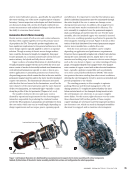
rework and root-cause analysis. The
tried-and-true technique for locating
a leak is to place the part under mild
overpressure and apply a soapy water
solution to the joints, watching for
bubble formation. For smaller parts, a
similar test with a bit more implemen-
tation complexity is immersion testing,
which involves submerging the part in a
tank, often containing water, and looking
for bubbles emanating from the joints
under test. For larger parts, such as
battery pack enclosures, a common tech-
nique after a global test is to fill the part
with helium and then scan externally to
find where the gas is escaping through
even very small leaks [28]. Helium leak
testing, however, presents some chal-
lenges for implementation in production
settings because residual helium from
previous tests can corrupt measurements
and lead to confusing results.
Electrical Insulation
It is no surprise that EVs contain many
high-voltage components. Electrical
insulation therefore plays a crucial role
in preventing electrical shorts between
high-voltage components, surround-
ing parts, and the vehicle chassis.
Maintaining effective isolation is vital, as
it guards against electric shocks, short
circuits, and thermal incidents, all of
which contribute to the overall safety
and performance of the system [29–32].
Insulation typically takes the form of a
dielectric—such as enamel or PVC wire
coating—or a polymeric potting material.
Insulation integrity can be tested via elec-
trical isolation checks [33–35] or visual
inspection techniques [36–38]. Examples
of components that require insulation
include wire harnesses, electric motors
and their subcomponents, power elec-
tronics, battery modules, and packs.
For components that use dielectric
paste, void content and wet-out con-
ditions are crucial. X-ray or acoustic
microscopy can be used to verify the
presence of dielectric material in critical
regions if part geometry and testing
constraints accommodate such tech-
niques. As noted in the previous section,
both X-ray and acoustic microscopy are
offline or audit techniques.
Electrical testing techniques are
ideal for isolation checks. High poten-
tial testing, or “hipot,” is commonly used
to identify isolation problems that can
lead to power loss, shorts, or damage
to sensitive electronics [39]. Isolation
issues can arise from insulation damage,
conductive debris around conductors,
spacing problems, or excessive moisture
buildup. Hipot testing is performed by
applying a higher-than-operation voltage
on a part and measuring for any result-
ing leakage current. Partial discharge
testing is another common insulation
integrity check for electric motors [40,
41]. An impulse voltage is applied to the
windings and incrementally increased
until a partial discharge is detected, which
occurs when the dielectric breakdown of
local air becomes ionized due to insuffi-
cient isolation. Detection is usually visual
and audible (if a spark is generated) or
may be performed with a UV camera [36].
It should be noted that both hipot and
partial discharge testing may not be con-
sidered as strictly nondestructive, as any
parts that fail these electrical tests cannot
be repaired and reused.
Other electrical isolation checks may
include electrical continuity, material
weight, and capacitance measurements
[42]. Electrical continuity testing can be
performed by placing probes between
components to ensure that conductive
elements are properly isolated. Material
weight is a simple check that involves
weighing components before and after
insulation material has been applied—for
example, weighing electric motor stators
after depositing the insulating varnish to
infer whether the varnish has properly
filled the slots. Finally, capacitance mea-
surements can be used to verify that a
sufficient amount of dielectric insulation
material is present [42] however, this
technique requires a high level of accessi-
bility for the capacitance sensor.
Conclusion
While battery cells remain the center-
piece of electrified vehicle design and
the primary focus of the literature in
nondestructive evaluation for EVs, it is
essential not to overlook the critical role
of non-cell components. Nondestructive
inspection for electric motors, power
electronics, battery modules, and other
EV component systems presents unique
challenges that demand rigorous evalua-
tion to ensure safety, reliability, and per-
formance throughout the vehicle’s lifecy-
cle. The intent here is to draw attention
to these important NDT applications
so that engineers and researchers can
better address the evolving demands of
electrified mobility.
AUTHORS
Megan McGovern: Staff Researcher, General
Motors Research and Development, Warren, MI
megan.mcgovern@gm.com
Erik Huemiller: Senior Researcher, General
Motors Research and Development, Warren, MI
Dmitriy Bruder: Project Engineer, General
Motors Research and Development, Warren, MI
Sean Wagner: Staff Researcher, General Motors
Research and Development, Warren, MI
Robin James: Researcher, General Motors
Research and Development, Warren, MI
Rashmi Prasad: Staff Researcher, General
Motors Research and Development, Warren, MI
CITATION
Materials Evaluation 84 (1): 26-31
https://doi.org/10.32548/2026.me-04542
©2026 American Society for Nondestructive
Testing
REFERENCES
1. McGovern, M., D. Bruder, E. Huemiller, T.
Rinker, J. Bracey, R. Sekol, and J. Abell. 2023.
“A review of research needs in nondestructive
evaluation for quality verification in electric
vehicle lithium-ion battery cell manufacturing.”
Journal of Power Sources 561: 232742. https://
doi.org/10.1016/j.jpowsour.2023.232742.
2. Gervillié-Mouravieff, C., W. Bao, D.
Steingart, and Y. Meng. 2024. “Non-destructive
characterization techniques for battery
performance and life-cycle assessment.” Nature
Reviews Electrical Engineering 1 (8): 547–58.
https://doi.org/10.1038/s44287-024-00069-y.
3. Chacón, X., S. Laureti, M. Ricci, and G.
Cappuccino. 2023. “A Review of Non-Destructive
Techniques for Lithium-Ion Battery
Performance Analysis.” World Electric Vehicle
Journal 14 (11): 305. https://doi.org/10.3390/
wevj14110305.
4. Gao, J., S. Wang, and F. Hao. 2024. “A
Review of Non-Destructive Testing for Lithium
Batteries.” Energies 17 (16): 4030. https://doi.
org/10.3390/en17164030.
5. General Motors LLC. “GM Powered Solutions”
[online]. Accessed 25 November 2025. https://
poweredsolutions.gm.com/products.
6. General Motors Corp. “GMC Pressroom” [online].
Accessed 25 November 2025. https://pressroom.
gmc.com/gmbx/us/en/gmc/pressroom.
NDT TUTORIAL
|
ELECTRICVEHICLES
30
M AT E R I A L S E V A L U AT I O N • J A N U A R Y 2 0 2 6
tried-and-true technique for locating
a leak is to place the part under mild
overpressure and apply a soapy water
solution to the joints, watching for
bubble formation. For smaller parts, a
similar test with a bit more implemen-
tation complexity is immersion testing,
which involves submerging the part in a
tank, often containing water, and looking
for bubbles emanating from the joints
under test. For larger parts, such as
battery pack enclosures, a common tech-
nique after a global test is to fill the part
with helium and then scan externally to
find where the gas is escaping through
even very small leaks [28]. Helium leak
testing, however, presents some chal-
lenges for implementation in production
settings because residual helium from
previous tests can corrupt measurements
and lead to confusing results.
Electrical Insulation
It is no surprise that EVs contain many
high-voltage components. Electrical
insulation therefore plays a crucial role
in preventing electrical shorts between
high-voltage components, surround-
ing parts, and the vehicle chassis.
Maintaining effective isolation is vital, as
it guards against electric shocks, short
circuits, and thermal incidents, all of
which contribute to the overall safety
and performance of the system [29–32].
Insulation typically takes the form of a
dielectric—such as enamel or PVC wire
coating—or a polymeric potting material.
Insulation integrity can be tested via elec-
trical isolation checks [33–35] or visual
inspection techniques [36–38]. Examples
of components that require insulation
include wire harnesses, electric motors
and their subcomponents, power elec-
tronics, battery modules, and packs.
For components that use dielectric
paste, void content and wet-out con-
ditions are crucial. X-ray or acoustic
microscopy can be used to verify the
presence of dielectric material in critical
regions if part geometry and testing
constraints accommodate such tech-
niques. As noted in the previous section,
both X-ray and acoustic microscopy are
offline or audit techniques.
Electrical testing techniques are
ideal for isolation checks. High poten-
tial testing, or “hipot,” is commonly used
to identify isolation problems that can
lead to power loss, shorts, or damage
to sensitive electronics [39]. Isolation
issues can arise from insulation damage,
conductive debris around conductors,
spacing problems, or excessive moisture
buildup. Hipot testing is performed by
applying a higher-than-operation voltage
on a part and measuring for any result-
ing leakage current. Partial discharge
testing is another common insulation
integrity check for electric motors [40,
41]. An impulse voltage is applied to the
windings and incrementally increased
until a partial discharge is detected, which
occurs when the dielectric breakdown of
local air becomes ionized due to insuffi-
cient isolation. Detection is usually visual
and audible (if a spark is generated) or
may be performed with a UV camera [36].
It should be noted that both hipot and
partial discharge testing may not be con-
sidered as strictly nondestructive, as any
parts that fail these electrical tests cannot
be repaired and reused.
Other electrical isolation checks may
include electrical continuity, material
weight, and capacitance measurements
[42]. Electrical continuity testing can be
performed by placing probes between
components to ensure that conductive
elements are properly isolated. Material
weight is a simple check that involves
weighing components before and after
insulation material has been applied—for
example, weighing electric motor stators
after depositing the insulating varnish to
infer whether the varnish has properly
filled the slots. Finally, capacitance mea-
surements can be used to verify that a
sufficient amount of dielectric insulation
material is present [42] however, this
technique requires a high level of accessi-
bility for the capacitance sensor.
Conclusion
While battery cells remain the center-
piece of electrified vehicle design and
the primary focus of the literature in
nondestructive evaluation for EVs, it is
essential not to overlook the critical role
of non-cell components. Nondestructive
inspection for electric motors, power
electronics, battery modules, and other
EV component systems presents unique
challenges that demand rigorous evalua-
tion to ensure safety, reliability, and per-
formance throughout the vehicle’s lifecy-
cle. The intent here is to draw attention
to these important NDT applications
so that engineers and researchers can
better address the evolving demands of
electrified mobility.
AUTHORS
Megan McGovern: Staff Researcher, General
Motors Research and Development, Warren, MI
megan.mcgovern@gm.com
Erik Huemiller: Senior Researcher, General
Motors Research and Development, Warren, MI
Dmitriy Bruder: Project Engineer, General
Motors Research and Development, Warren, MI
Sean Wagner: Staff Researcher, General Motors
Research and Development, Warren, MI
Robin James: Researcher, General Motors
Research and Development, Warren, MI
Rashmi Prasad: Staff Researcher, General
Motors Research and Development, Warren, MI
CITATION
Materials Evaluation 84 (1): 26-31
https://doi.org/10.32548/2026.me-04542
©2026 American Society for Nondestructive
Testing
REFERENCES
1. McGovern, M., D. Bruder, E. Huemiller, T.
Rinker, J. Bracey, R. Sekol, and J. Abell. 2023.
“A review of research needs in nondestructive
evaluation for quality verification in electric
vehicle lithium-ion battery cell manufacturing.”
Journal of Power Sources 561: 232742. https://
doi.org/10.1016/j.jpowsour.2023.232742.
2. Gervillié-Mouravieff, C., W. Bao, D.
Steingart, and Y. Meng. 2024. “Non-destructive
characterization techniques for battery
performance and life-cycle assessment.” Nature
Reviews Electrical Engineering 1 (8): 547–58.
https://doi.org/10.1038/s44287-024-00069-y.
3. Chacón, X., S. Laureti, M. Ricci, and G.
Cappuccino. 2023. “A Review of Non-Destructive
Techniques for Lithium-Ion Battery
Performance Analysis.” World Electric Vehicle
Journal 14 (11): 305. https://doi.org/10.3390/
wevj14110305.
4. Gao, J., S. Wang, and F. Hao. 2024. “A
Review of Non-Destructive Testing for Lithium
Batteries.” Energies 17 (16): 4030. https://doi.
org/10.3390/en17164030.
5. General Motors LLC. “GM Powered Solutions”
[online]. Accessed 25 November 2025. https://
poweredsolutions.gm.com/products.
6. General Motors Corp. “GMC Pressroom” [online].
Accessed 25 November 2025. https://pressroom.
gmc.com/gmbx/us/en/gmc/pressroom.
NDT TUTORIAL
|
ELECTRICVEHICLES
30
M AT E R I A L S E V A L U AT I O N • J A N U A R Y 2 0 2 6