Another benefit is the possibility to completely digitize the
as-is state of the vehicle. These volumetric datasets can be
compared against CAD models for design validation or used
to track geometric variations across different model genera-
tions or production runs. This digital-twin concept enables
lifecycle-wide traceability and structural integrity monitoring
throughout a vehicle’s development and use phases.
Initially we performed full-vehicle scans with the car in
normal street orientation. This worked for combustion-engine
vehicles, but the transition to electric drivetrains with their
massive underbody battery packs required adoption of the
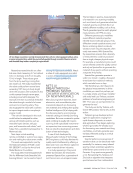
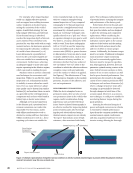
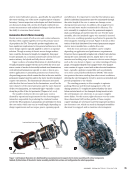
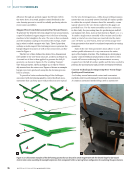
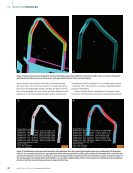
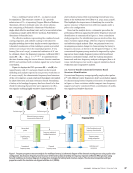
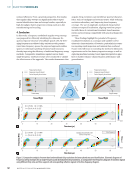
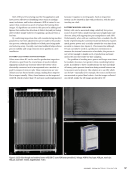
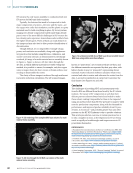
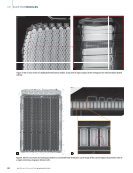
VERTICAGE scanning principle. In this approach, the car is
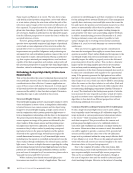
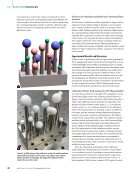
fixed in a steel frame and scanned in a rocket-like upright ori-
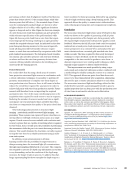
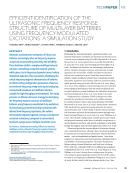
entation, as shown in Figure 6a. This dramatically improves
image quality of the battery pack due to optimized penetra-
tion length (compare Figures 6b and 6c). A detailed compari-
son of the two scanning configurations is given by Salamon et
al. (2019) [9].
This configuration, however, comes with several draw-
backs—namely increased demands for scan preparation and
handling, as well as challenges in performing metrology tasks
due to the altered direction of gravitational force on compo-
nents when the car is placed upright. Furthermore, all liquid
components (coolant, fuel, oil) shift position and therefore no
longer represent normal operational conditions.
Outlook: GiantEye System
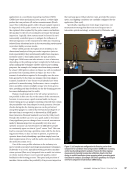
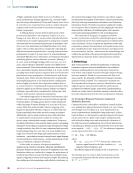
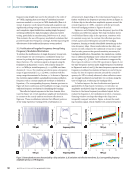
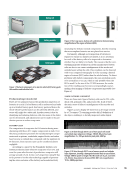
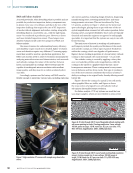
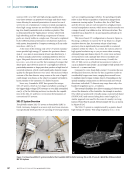
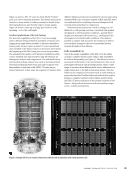
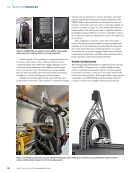
The aforementioned drawbacks are addressed in the next gen-
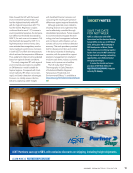
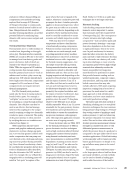
eration of XXL-CT systems: the so-called GiantEye system,
which is essentially a large gantry-based CT system inspired
by medical CT scanners, where the X-ray source and detector
rotate around the specimen. This design enables image quality
comparable to the VERTICAGE setup but without the need
to place the vehicle in an upright orientation. Instead, the
ME
|
ELECTRICVEHICLES
Figure 6. (a) VERTICAGE scan setup for electric vehicles image quality
comparison of (b) rocket orientation vs. (c) street orientation.
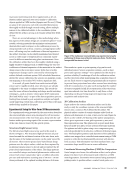
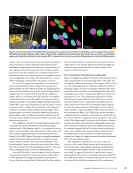
Figure 7. (a) The gantry-based XXL-CT system at RPTU Kaiserslautern, with a 9 MeV linear accelerator and a multidetector stage for concrete
analysis (b) the concept in larger form, for the GiantEye system.
66
M AT E R I A L S E V A L U AT I O N • J A N U A R Y 2 0 2 6
as-is state of the vehicle. These volumetric datasets can be
compared against CAD models for design validation or used
to track geometric variations across different model genera-
tions or production runs. This digital-twin concept enables
lifecycle-wide traceability and structural integrity monitoring
throughout a vehicle’s development and use phases.
Initially we performed full-vehicle scans with the car in
normal street orientation. This worked for combustion-engine
vehicles, but the transition to electric drivetrains with their
massive underbody battery packs required adoption of the
VERTICAGE scanning principle. In this approach, the car is
fixed in a steel frame and scanned in a rocket-like upright ori-
entation, as shown in Figure 6a. This dramatically improves
image quality of the battery pack due to optimized penetra-
tion length (compare Figures 6b and 6c). A detailed compari-
son of the two scanning configurations is given by Salamon et
al. (2019) [9].
This configuration, however, comes with several draw-
backs—namely increased demands for scan preparation and
handling, as well as challenges in performing metrology tasks
due to the altered direction of gravitational force on compo-
nents when the car is placed upright. Furthermore, all liquid
components (coolant, fuel, oil) shift position and therefore no
longer represent normal operational conditions.
Outlook: GiantEye System
The aforementioned drawbacks are addressed in the next gen-
eration of XXL-CT systems: the so-called GiantEye system,
which is essentially a large gantry-based CT system inspired
by medical CT scanners, where the X-ray source and detector
rotate around the specimen. This design enables image quality
comparable to the VERTICAGE setup but without the need
to place the vehicle in an upright orientation. Instead, the
ME
|
ELECTRICVEHICLES
Figure 6. (a) VERTICAGE scan setup for electric vehicles image quality
comparison of (b) rocket orientation vs. (c) street orientation.
Figure 7. (a) The gantry-based XXL-CT system at RPTU Kaiserslautern, with a 9 MeV linear accelerator and a multidetector stage for concrete
analysis (b) the concept in larger form, for the GiantEye system.
66
M AT E R I A L S E V A L U AT I O N • J A N U A R Y 2 0 2 6