SELF-DRIVING EV BATTERY QUALITY
SYSTEM: SHAPE OF THINGS TO COME
Background
Electric vehicles (EVs) are rapidly
becoming the backbone of decarbon-
ized mobility, yet their success hinges
on one fragile pillar: the lithium-ion (and
next-generation) battery. The battery
pack represents 30–40% of an EV’s cost
and is the single most significant determi-
nant of range, safety, and warranty expo-
sure. Today’s global demand for EV cells
is measured in gigawatt-hours per year
and is moving toward terawatt-hours,
leaving little room for trial and error,
scrap, or surprise failures in the field.
Battery quality is uniquely challenging.
Defects may be microscopic, hidden
within multilayer electrodes, or latent,
only emerging after months of cycling.
Conventional nondestructive evaluation
(NDE) methods—such as visual inspec-
tion, sampling-based testing, and end-of-
line electrical checks—are not able to
keep pace with the speed, complexity,
and cost pressures of gigafactories.
At the same time, new paradigms are
emerging: NDE 4.0, self-driving labs, and
mass-production methods that treat the
factory as a cyber-physical system rather
than a static assembly line.
The convergence of these trends
points toward a future where EV battery
quality is not simply inspected but contin-
uously learned, predicted, and optimized.
In this future, “self-driving” labs and
production lines will orchestrate experi-
ments, inspections, and process adjust-
ments autonomously, ensuring that every
cell is born “right the first time” rather
than salvaged at the end.
Up Until Now
NDE in EV battery manufacturing has
grown rapidly but remains largely evolu-
tionary rather than revolutionary. Factories
rely on a mix of established techniques
applied at discrete points: machine vision
for electrode coating and alignment,
X-ray or computed tomography (CT) for
detecting foreign objects and misstacking,
ultrasonic and acoustic methods for
delamination, and end-of-line electrical
tests to identify and eliminate gross
defects. This special issue of Materials
Evaluation covers many of these advances.
The current tools are powerful, but
they are typically deployed with an
Industry 2.0 or 3.0 mindset: localized,
recipe-driven, and loosely coupled
to the rest of the manufacturing data.
Anomalies are often found late in the
process, after value has been added,
and root-cause analysis is manual and
time-consuming. Process engineers may
occasionally conduct designed exper-
iments, but these are constrained by
scarce laboratory capacity and long feed-
back loops between R&D, pilot lines, and
mass production.
NDE 4.0 has begun to shift this para-
digm by connecting inspection assets
to the Industrial Internet of Things (IIoT),
leveraging cloud analytics, and inte-
grating digital twins of materials and
processes. Yet most implementations
remain partial [1]. Data from coating,
calendaring, cell assembly, and formation
is still frequently siloed, and the predic-
tive links between early-stage signals and
long-term performance remain weak.
In parallel, the idea of self-driving labs
has emerged in chemistry and materials
science: autonomous experimenta-
tion platforms that use robotics, high-
throughput measurements, and machine
learning (ML) to explore large design
spaces more rapidly than human-driven
workflows. However, these platforms
have so far primarily existed in research
settings, focused on discovering new
chemistries rather than managing quality
in high-volume factories where produc-
tion is paced by a fixed takt time—the
rhythm that determines how often a
finished cell must come off the line [2–5].
Meanwhile, EV battery manufac-
turing itself has scaled dramatically.
Gigafactories now produce millions of
cells per week, with yield and unifor-
mity becoming strategic differentiators.
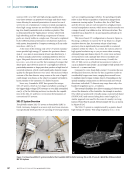
SCANNER
|
NDEOUTLOOK
Robotics
Gigafactory production line
Prescriptive
adjustments &
targeted inspections
Formation
AI/ML
Algorithms Self-driving
lab engine
Slurry preparation Coating Calendaring Assembly
Quality data lake
&digital twin
Self-driving lab
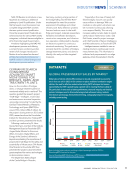
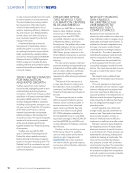
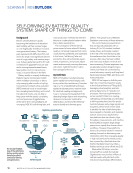
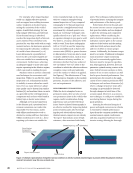
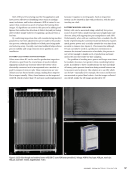
The circular feedback
loop of the self-driving
battery quality system,
featuring a cycle of
continuous learning
and optimization.
14
M AT E R I A L S E V A L U AT I O N • J A N U A R Y 2 0 2 6
SYSTEM: SHAPE OF THINGS TO COME
Background
Electric vehicles (EVs) are rapidly
becoming the backbone of decarbon-
ized mobility, yet their success hinges
on one fragile pillar: the lithium-ion (and
next-generation) battery. The battery
pack represents 30–40% of an EV’s cost
and is the single most significant determi-
nant of range, safety, and warranty expo-
sure. Today’s global demand for EV cells
is measured in gigawatt-hours per year
and is moving toward terawatt-hours,
leaving little room for trial and error,
scrap, or surprise failures in the field.
Battery quality is uniquely challenging.
Defects may be microscopic, hidden
within multilayer electrodes, or latent,
only emerging after months of cycling.
Conventional nondestructive evaluation
(NDE) methods—such as visual inspec-
tion, sampling-based testing, and end-of-
line electrical checks—are not able to
keep pace with the speed, complexity,
and cost pressures of gigafactories.
At the same time, new paradigms are
emerging: NDE 4.0, self-driving labs, and
mass-production methods that treat the
factory as a cyber-physical system rather
than a static assembly line.
The convergence of these trends
points toward a future where EV battery
quality is not simply inspected but contin-
uously learned, predicted, and optimized.
In this future, “self-driving” labs and
production lines will orchestrate experi-
ments, inspections, and process adjust-
ments autonomously, ensuring that every
cell is born “right the first time” rather
than salvaged at the end.
Up Until Now
NDE in EV battery manufacturing has
grown rapidly but remains largely evolu-
tionary rather than revolutionary. Factories
rely on a mix of established techniques
applied at discrete points: machine vision
for electrode coating and alignment,
X-ray or computed tomography (CT) for
detecting foreign objects and misstacking,
ultrasonic and acoustic methods for
delamination, and end-of-line electrical
tests to identify and eliminate gross
defects. This special issue of Materials
Evaluation covers many of these advances.
The current tools are powerful, but
they are typically deployed with an
Industry 2.0 or 3.0 mindset: localized,
recipe-driven, and loosely coupled
to the rest of the manufacturing data.
Anomalies are often found late in the
process, after value has been added,
and root-cause analysis is manual and
time-consuming. Process engineers may
occasionally conduct designed exper-
iments, but these are constrained by
scarce laboratory capacity and long feed-
back loops between R&D, pilot lines, and
mass production.
NDE 4.0 has begun to shift this para-
digm by connecting inspection assets
to the Industrial Internet of Things (IIoT),
leveraging cloud analytics, and inte-
grating digital twins of materials and
processes. Yet most implementations
remain partial [1]. Data from coating,
calendaring, cell assembly, and formation
is still frequently siloed, and the predic-
tive links between early-stage signals and
long-term performance remain weak.
In parallel, the idea of self-driving labs
has emerged in chemistry and materials
science: autonomous experimenta-
tion platforms that use robotics, high-
throughput measurements, and machine
learning (ML) to explore large design
spaces more rapidly than human-driven
workflows. However, these platforms
have so far primarily existed in research
settings, focused on discovering new
chemistries rather than managing quality
in high-volume factories where produc-
tion is paced by a fixed takt time—the
rhythm that determines how often a
finished cell must come off the line [2–5].
Meanwhile, EV battery manufac-
turing itself has scaled dramatically.
Gigafactories now produce millions of
cells per week, with yield and unifor-
mity becoming strategic differentiators.
SCANNER
|
NDEOUTLOOK
Robotics
Gigafactory production line
Prescriptive
adjustments &
targeted inspections
Formation
AI/ML
Algorithms Self-driving
lab engine
Slurry preparation Coating Calendaring Assembly
Quality data lake
&digital twin
Self-driving lab
The circular feedback
loop of the self-driving
battery quality system,
featuring a cycle of
continuous learning
and optimization.
14
M AT E R I A L S E V A L U AT I O N • J A N U A R Y 2 0 2 6