GET SOCIAL WITH ASNT!
ASNT's exclusive health coverage partner,
Gallagher, provides ASNT members with
affordable and comprehensive health insurance
and pharmacy solutions for individuals, families,
and business owners along with their employees.
Coverage is available
across the entire country. Visit asnt.org/membership/benefts to get started today!
January 2026
Volume 84 Number 1
JOURNAL STAFF
PUBLISHER: Neal J. Couture, CAE
DIRECTOR OF PUBLICATIONS/
EDITOR: Jill Ross
ASSOCIATE EDITOR:
Stefanie Laufersweiler
PRODUCTION MANAGER: Joy Grimm
DIGITAL PUBLISHING MANAGER:
Synthia Jester
DIGITAL CONTENT STRATEGIST:
Haley Cowans
ASNT MEDIA &EVENT SALES
Peter Roy, proy@asnt.org
1-614-384-2431
Sonny Hines, shines@asnt.org
1-614-384-2434
TECHNICAL EDITOR
John Z. Chen, KBR
ASSOCIATE TECHNICAL EDITORS
John C. Aldrin, Computational Tools
Sreenivas Alampalli, Alampalli
Engineering PLLC
Ali Abdul-Aziz, Kent State University
Yiming Deng, Michigan
State University
Dave Farson, Ohio State University
Jin-Yeon Kim, Georgia
Institute of Technology
Mani Mina, Iowa State University
Ehsan Dehghan-Niri,
Arizona State University
Yi-Cheng (Peter) Pan, Emerson Inc.
Anish Poudel, MxV Rail
Donald J. Roth, Roth
Technical Consulting LLC
Ram P. Samy, Consultant
Steven M. Shepard,
Thermal Wave Imaging
Ripi Singh, Inspiring Next
Surendra Singh, Honeywell
Roderic K. Stanley, NDE
Information Consultants
Matthew Webster, NASA
Langley Research Center
Lianxiang Yang, Oakland University
Reza Zoughi, Iowa State University
CONTRIBUTING EDITORS
Toni Bailey, TB3NDT Consulting
Megan McGovern,
General Motors Corp.
Samir Mustapha, American
University of Beirut
Hossein Taheri, Georgia
Southern University
UPFRONT
|
SCANNER
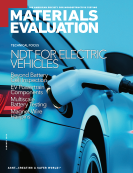
NDT FOR ELECTRIC VEHICLES
Driven in part by the growing demand for electric vehicles (EVs), nonde-
structive testing (NDT) technologies for lithium-ion battery cell inspection
have advanced considerably. This is indeed where much of the NDT liter-
ature in this domain is focused, as cell manufacturing inspection must
operate under multiple challenging constraints simultaneously, including
short cycle times, noncontact requirements, and complex multilayered
components.
For this Technical Focus Issue, I felt it was important to not only highlight
the technological advancements driven by cell inspection needs, but also
to cover the inspection demands of other oft-neglected (by the literature,
anyway) EV components beyond battery cells. The five papers in this issue
span various EV component inspection applications (e.g., electric motors,
battery cells, modules, packs, and power electronics) as well as an equally
varied set of NDT modalities (e.g., vision, ultrasound, and X-ray).
Our first article, “NDT for Electrified Vehicles: Beyond Battery Cell
Inspection” (page 26), provides a high-level overview of NDT for
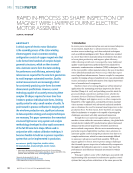
non-battery-cell EV components. In the second paper, “Rapid In-Process
3D Shape Inspection of Magnet Wire Hairpins during Electric Motor
Assembly” (page 34), Dr. Sean Wagner discusses NDT for another
important EV propulsion element: the electric motor. He presents a
noncontact structured-light system and analysis methodology for enabling
rapid assessment of the 3D geometric shape of electric motor stator wire-
forms, crucial for in-process verification.
Ultrasound is one of the fastest-rising NDT technologies for battery
cell inspection. The third paper, “Efficient Identification of the Ultrasonic
Frequency Response Structure of Multilayer Batteries Using Frequency-
Modulated Excitations: A Simulation Study” by Yuankai Ren et al. (page 45)
is a clear example of advancement in this domain. The authors present
an efficient strategy for identifying the ultrasonic frequency response of
battery cells using frequency-modulated chirp excitations. This work is
expected to establish some of the foundational groundwork necessary for
addressing high-throughput battery inspection needs.
X-ray continues to be one of the dominant nondestructive technolo-
gies for EVs. Accordingly, the last two papers cover X-ray for EVs. “Uses of
Radiographic Testing for NDT on EV Powertrain Components” (page 54) is
a review by Giles Gaskell et al. Readers will get a sense of the vast range of
EV-applicable X-ray technologies, from the newer liquid anode technology
for battery cells to high-resolution scans of active material coatings to MeV
systems for electric motors. Finally, in “XXL-CT for Multiscale Battery Testing:
From Modules to Complete Electric Vehicles” (page 61), Dr. Nils Reims
et al. present the capabilities of a 9 MeV linac X-ray, gantry-CT system for
assessing large parts such as battery modules and even fully assembled EVs.
As a final note, I extend my sincere thanks to all the contributing authors.
As readers will undoubtedly glean from the work presented in this issue,
NDT is quickly evolving alongside the rapidly changing EV landscape. My
hope is that readers of this issue gain insight into how their own technolo-
gies can adapt to meet the demands of this dynamic industry.
MEGAN MCGOVERN, PHD, PE
STAFF RESEARCHER, GENERAL MOTORS RESEARCH AND DEVELOPMENT
MEGAN.MCGOVERN@GM.COM
As readers will
undoubtedly glean
from the work
presented in this
issue, NDT is quickly
evolving alongside the
rapidly changing EV
landscape.
J A N U A R Y 2 0 2 6 M AT E R I A L S E V A L U AT I O N 7
Previous Page Next Page