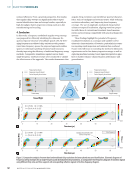
reduced efficiency. From a practical perspective, this implies
that angular chirp sweeps can significantly reduce experi-
mental identification time and storage burden, especially in
high-throughput battery inspection settings such as in-line
manufacturing and recycling.
4. Conclusion
In this study, a frequency-modulated angular-sweep strategy
was proposed for efficiently identifying the ultrasonic fre-
quency response structure of multilayer pouch cells. By lever-
aging frequency-modulated chirp excitations with parame-
trized time-frequency poses, the proposed approach enables
sparse yet informative probing of battery band structures,
thereby improving the efficiency of traditional frequency sweep
methods. Comparative simulations against narrow-band,
single-frequency toneburst sweeps were conducted to validate
the effectiveness of the approach. The results demonstrate that
angular chirp excitations can identify key spectral character-
istics, such as bandgaps and resonant zones, while reducing
excitation redundancy and improving time-frequency
coverage. The use of amplitude-modulated chirps further
enhances temporal localization, aligning waveform proper-
ties with those of conventional toneburst-based measure-
ments and increasing compatibility with practical diagnostic
systems.
These findings highlight the potential of frequency-
modulated excitations as a compact and scalable tool for
ultrasonic characterization of batteries, particularly in scenar-
ios requiring rapid inspection and minimal data overhead.
Future work will focus on extending the method to laboratory
experiments and in-line battery inspection setups, as well as
exploring machine learning–based signal interpretation pipe-
lines to further enhance characterization performance and
generalization.
ME
|
ELECTRICVEHICLES
Conventi
onal Proposed
Demonstration
0 10 20 30 40 50 60
Time trace (μs)
5
4
3
2
1
0
1
0.25
1
2
θ =[70, 60, 50, 40, 30, 20] T
:0.75 MHz :2.75 MHz 1 2 Critical frequency Bandgap characterized under
a series of chirp rates
0 10 20 30 40 50 60
Time trace (μs)
5
4
3
2
1
0
1
0.25
1
2
θ =[70, 60, 50, 40, 30, 20] T
:0.75 MHz :2.75 MHz 1 2
Frequency boundaries
Frequency range of interest
Center frequency of excitations
Time-of-flight
Linear sweep
Sweep
direction
Frequency boundaries
Frequency range of interest
Center frequency of excitations
Time-of-flight
Angular sweep
SweeppS
directionnd
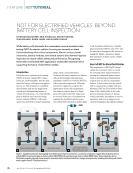
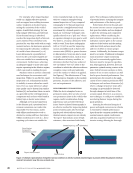
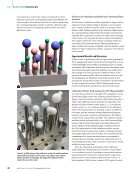
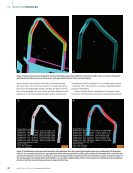
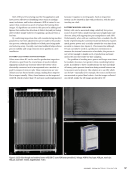
Figure 5. Comparative analysis of narrow-band and modulated chirp excitations for battery band structure identification. Schematic diagrams of
frequency sweep strategies for (a) single-frequency and (b) modulated chirp excitations (c) comparative time-frequency diagram of excitation signals
using different chirp rates and time supports (d) corresponding reflection signals in the time-frequency diagram.
52
M AT E R I A L S E V A L U AT I O N • J A N U A R Y 2 0 2 6
Single-frequency excitations
Frequency
(MHz)
Frequency
(MHz)
Frequency Frequency
Module
chirp
excitations
TFI (a.u.)
TFI (a.u.)
that angular chirp sweeps can significantly reduce experi-
mental identification time and storage burden, especially in
high-throughput battery inspection settings such as in-line
manufacturing and recycling.
4. Conclusion
In this study, a frequency-modulated angular-sweep strategy
was proposed for efficiently identifying the ultrasonic fre-
quency response structure of multilayer pouch cells. By lever-
aging frequency-modulated chirp excitations with parame-
trized time-frequency poses, the proposed approach enables
sparse yet informative probing of battery band structures,
thereby improving the efficiency of traditional frequency sweep
methods. Comparative simulations against narrow-band,
single-frequency toneburst sweeps were conducted to validate
the effectiveness of the approach. The results demonstrate that
angular chirp excitations can identify key spectral character-
istics, such as bandgaps and resonant zones, while reducing
excitation redundancy and improving time-frequency
coverage. The use of amplitude-modulated chirps further
enhances temporal localization, aligning waveform proper-
ties with those of conventional toneburst-based measure-
ments and increasing compatibility with practical diagnostic
systems.
These findings highlight the potential of frequency-
modulated excitations as a compact and scalable tool for
ultrasonic characterization of batteries, particularly in scenar-
ios requiring rapid inspection and minimal data overhead.
Future work will focus on extending the method to laboratory
experiments and in-line battery inspection setups, as well as
exploring machine learning–based signal interpretation pipe-
lines to further enhance characterization performance and
generalization.
ME
|
ELECTRICVEHICLES
Conventi
onal Proposed
Demonstration
0 10 20 30 40 50 60
Time trace (μs)
5
4
3
2
1
0
1
0.25
1
2
θ =[70, 60, 50, 40, 30, 20] T
:0.75 MHz :2.75 MHz 1 2 Critical frequency Bandgap characterized under
a series of chirp rates
0 10 20 30 40 50 60
Time trace (μs)
5
4
3
2
1
0
1
0.25
1
2
θ =[70, 60, 50, 40, 30, 20] T
:0.75 MHz :2.75 MHz 1 2
Frequency boundaries
Frequency range of interest
Center frequency of excitations
Time-of-flight
Linear sweep
Sweep
direction
Frequency boundaries
Frequency range of interest
Center frequency of excitations
Time-of-flight
Angular sweep
SweeppS
directionnd
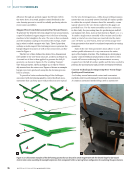
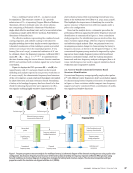
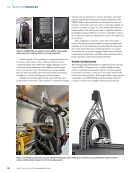
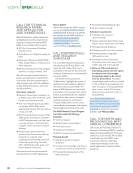
Figure 5. Comparative analysis of narrow-band and modulated chirp excitations for battery band structure identification. Schematic diagrams of
frequency sweep strategies for (a) single-frequency and (b) modulated chirp excitations (c) comparative time-frequency diagram of excitation signals
using different chirp rates and time supports (d) corresponding reflection signals in the time-frequency diagram.
52
M AT E R I A L S E V A L U AT I O N • J A N U A R Y 2 0 2 6
Single-frequency excitations
Frequency
(MHz)
Frequency
(MHz)
Frequency Frequency
Module
chirp
excitations
TFI (a.u.)
TFI (a.u.)