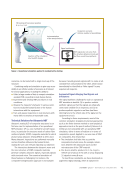
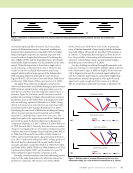
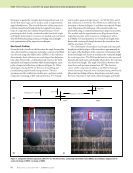
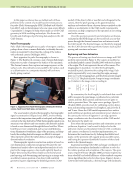
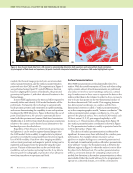
ME FEATURE w operational ndt simulations 40 M A T E R I A L S E V A L U A T I O N • J A N U A R Y 2 0 2 0 Introduction Nondestructive testing plays a crucial role in the safety assurance of aeronautical structures. In this context, the capability of NDT procedures is characterized by evaluating the probability of detection (POD). The basic concept of POD is to perform the NDT procedure a number of times in representative conditions with varying defect sizes and then statistically estimate the probability, as a function of the defect size, that the NDT procedure actually detects the defect. Probability is introduced since variability is inherent to the inspec- tion. Covering for variability is the core and essence of building a POD study. Among the major variability sources, we usually find the defect itself, the structure, the material, the procedure, and the human factor. Running experimental POD campaigns requires specimens with a significant set of defects that are inspected by several inspectors. These are generally highly expensive campaigns. In the last 15 years, the approach of using numerical models to assist in the evaluation of POD has been pushed. It is known as model-assisted POD (MAPOD), or simulation-assisted POD. In this case, data comes from simulations instead of real NDT experiments. This approach can dramatically decrease the cost of a POD but is frequently questioned in terms of the validity of the simulation model itself and the inability to account for human factors. The present work intends to give an answer to the question of how to take human factors into account in a MAPOD approach. The original idea is based on the concept of an operational simulator, applied to NDT (Dominquez and Simonet 2014). Many fields in which human factors are key have developed operational simulators for training and performance assessment. Using flight simulators for aircraft pilots is a well- known example. The aircraft environment is faithfully reproduced by a numerical simulation the risks and costs of flying a real aircraft are avoided. Similar systems are investigated to train individuals such as surgeons and nuclear power plant operators. Applied to NDT, the operational simulator could be used for training inspectors but also for including human factors in a simulation-assisted POD. In this approach, a real operator is performing the inspec- tion on a real aircraft structure. The only thing that is simulated is the signal coming from the virtual defects introduced in the structure. The technical and scientific challenges lie in the ability to simulate realistic NDT signals in real time. From the inspector’s point of view, the simulated NDT signals must be equivalent to real ones. Based on this idea, we have developed a prototype of such an opera- tional NDT simulator for the example of ultrasonic inspection of composite materials. The present paper describes the adopted strategy as well as a first analysis of the inspectors’ feedback in terms of user experience. In the first part, a detailed explanation of the operational simulation concept and its motivation is given. Then, the work undertaken to develop a prototype dedicated to ultrasonic NDT is presented. Our simulation strategy is explained in three aspects: the defect response simulation, the production of realistic noise, and the combination of real and simulated data. In the last part, results obtained from the implemented prototype are shown together with feedback from first users in terms of signal realism. Concept and Motivations The operational NDT simulation concept is illustrated in Figure 1. The surrounding environment of the NDT inspector is equivalent to a real one with real NDT equipment and a real structure hence, the inspector is in the actual conditions of a structure inspection. However, the signals displayed on the NDT equipment are not coming from the real part but from a simula- tion that is able to produce real-time realistic signals compatible with the position of the probe in the real world. With this approach, an infinite number of defect Applied to NDT, the operational simulator could be used for training inspectors but also for including human factors in a simulation-assisted POD.

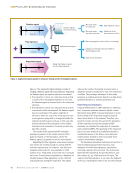
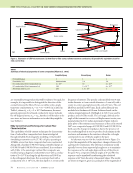
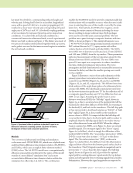
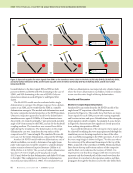
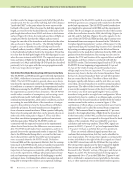
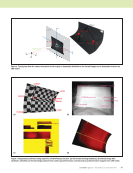
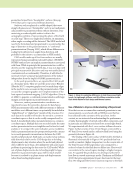
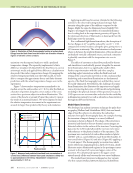
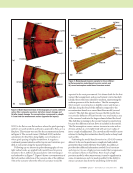
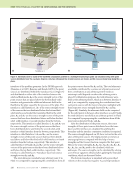
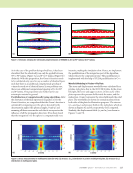
J A N U A R Y 2 0 2 0 • M A T E R I A L S E V A L U A T I O N 41 scenarios can be tested with a single mock-up of the structure. Combining reality and simulation to give easy acces- sibility to an infinite number of scenarios is of interest for several applications, including the ability to: l Collect a large number of data to compute simulation- assisted POD curves that include human factors. l Experiment and develop NDT procedures in real conditions. l Observe the inspector’s behavior in various condi- tions to study the human factors or the human interactions with the equipment. l Train and assess inspectors on real structures with many defect scenarios at reasonable costs. Technical Solutions for Ultrasonic NDT Ultrasonic testing (UT) of composite structures is our first use case for implementation of an operational NDT simulator. UT is a core method for aircraft inspec- tions, in particular for structures made of carbon fiber reinforced plastic (CFRP) composite materials for which phased array ultrasonic testing (PAUT) is often used. Many ultrasonic inspections are performed manually and are therefore influenced by human factors, making the use case relevant regarding our objective. The interactions between the ultrasonic wave and the inner structure of CFRP composite materials generate complex ultrasonic signals, especially signals with structural noise. The numerical simulation of these features is challenging. For instance, the composite homogenization approach is not suitable because it would generate signals with no noise at all, constant from one position to the other, which would immediately be identified as “fake signals” by any experienced inspector. Augmented Signals Merging Real Signals and Simulations The signal synthesis challenge for such an operational NDT simulator is twofold: (1) to produce realistic synthetic signals so that the signals are physically correct and credible for an inspector, and (2) to produce synthetic signals in real time (real time referring here to the refresh rate of the signal on the equipment screen). According to these requirements, most of the common simulation strategies (numerical approaches such as the finite element method or semi-analytical approaches such as the pencil method [Calmon et al. 2006]) are not compatible with an operational NDT simulation, either in terms of realism or in terms of computation speed. Applied to our use case of PAUT on composites, this means that: l The simulation shall take into account the composite structural noise for example, interac- tions between the ultrasound wave and the microstructure of the CFRP material. l One A-scan shall be produced in 1 ms, to get a refresh rate of about 30 Hz with an array displaying 32 signals in every B-scan. To meet these constraints, we have developed an augmented signal strategy, which is explained in Injection of the simulation into the NDT display 3D tracking of transducer position (x, y, z, ψ, θ, φ) Instrumentation of the manipulations Inspection scenario (infinite number of possibilities) NDT signals do not come from the structure (physical mock-up) but from a real-time synthesis. Signal synthesizer Figure 1. Operational simulation applied to nondestructive testing.
ASNT grants non-exclusive, non-transferable license of this material to  .
All rights reserved. © ASNT 2026. To report unauthorized use, contact: customersupport@asnt.org