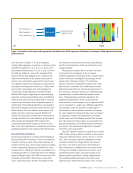
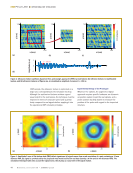
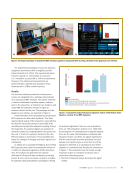
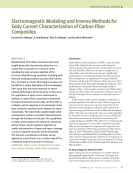
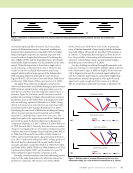
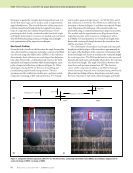
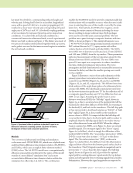
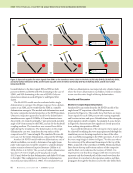
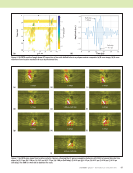
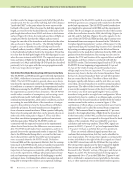
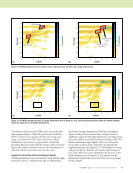
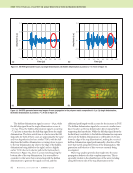
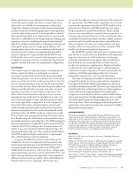
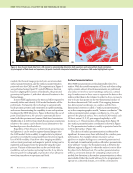
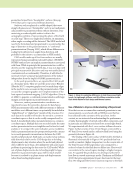
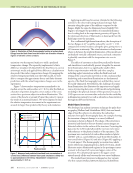
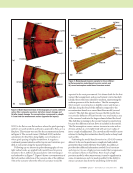
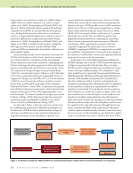
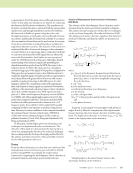
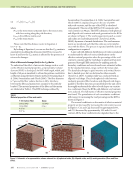
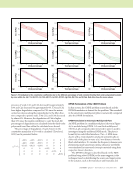
J A N U A R Y 2 0 2 0 • M A T E R I A L S E V A L U A T I O N 73 ME TECHNICAL PAPER w A B S T R A C T Measurement of the fiber orientation and areal weight along with discontinuity detection in a carbon fiber composite are crucial in under- standing the load carrying capability of the structure. Manufacturing conditions including resin flow and molding pressures can alter fiber orienta- tion, and hand or robotic fiber layup processes can be difficult to certify. Verification of the as-designed fiber layup thus becomes necessary to ensure optimal performance of the structure. In this work, the application of eddy current techniques for analysis of carbon fiber composites is presented. A proposed transmit-receive eddy current probe is modeled, and its response to an anisotropic multi- layer conductor simulated and compared to experi- mental data. The inductively coupled single-sided measurement enables composite characterization through the thickness of the part. The capabilities of eddy current analysis for advanced composites will be shown, and an inversion algorithm to enable determination of layup and impact damage across a composite structure will be presented. The fast and cost-effective technique can be applied as a spot check or as a surface map of the composite properties across the structure. KEYWORDS: eddy current, nondestructive evalua- tion, inverse methods, carbon fiber composites Introduction Carbon fiber reinforced polymer (CFRP) composites have been widely adapted in the aerospace and automotive industry, paying off on the promise of reduced fuel consump- tion and emissions. While the strength-to-weight ratio of carbon fiber composites has been shown to significantly exceed the more conventional metallic structures, potential fiber misalignment can significantly lower part reliability (Schrader and Kenich 2015 Wisnom 1990 Arao et al. 2011). Measurement of the fiber angles through the thickness of the produced part, along with detection of impact-related damage, is thus a critical quality assurance step. While surface damage and fiber angles can be optically evaluated, a fast and effective technique for the evaluation of subsurface plies is lacking. In this work, an eddy current technique is explored as a potential rapid and cost-effective way to address inspection requirements for advanced composites. Operating on the principle of electromagnetic induction, eddy current tech- niques are in general sensitive to the conductivity and perme- ability of the space near the probe. They are widely applied in the detection of surface-breaking cracks in metals along with noncontact measurement of electrical conductivity and coating thicknesses (ASNT 1986 Libby 1971). Following the increase in adaptation of carbon fiber composite structures, eddy current techniques for inspection of composites have also been developed (Wincheski and Simpson 2006 Winch- eski et al. 2016 Wincheski and Zhao 2018 Washabaugh 2013 Menana and Féliachi 2010), including efforts to refine eddy current techniques for the nondestructive evaluation of composites through computational electromagnetic modeling (Wincheski and Zhao 2018 Washabaugh 2013 Menana and Féliachi 2010). An Electromagnetic Model for CFRP Figure 1 illustrates the microstructure of a CFRP, with the fibers generally aligned in the x direction. The figure also shows that the fiber-to-fiber contact is random, so that the two electrical parameters that define the contact, sy and sz, Electromagnetic Modeling and Inverse Methods for Eddy Current Characterization of Carbon Fiber Composites by Harold A. Sabbagh†, R. Kim Murphy†, Elias H. Sabbagh † , and Russell A. Wincheski* † Victor Technologies LLC, Bloomington, IN 47401 USA *NASA Langley Research Center, Hampton, VA 23681 USA
ASNT grants non-exclusive, non-transferable license of this material to  .
All rights reserved. © ASNT 2026. To report unauthorized use, contact: customersupport@asnt.org