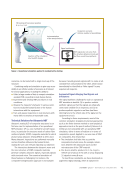
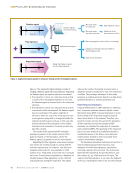
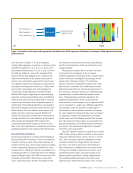
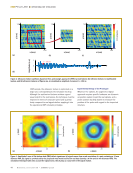
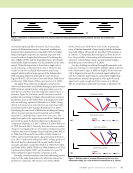
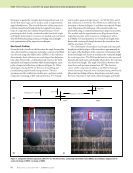
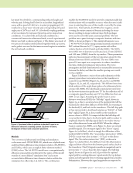
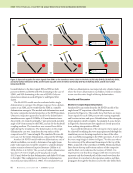
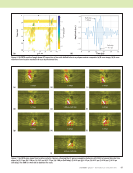
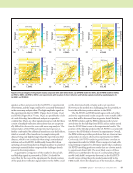
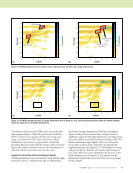
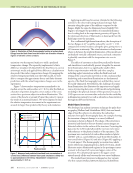
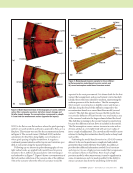
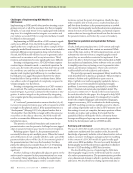
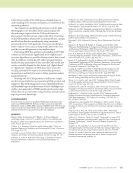
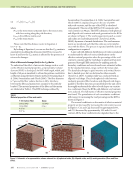
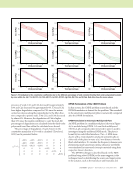
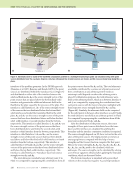
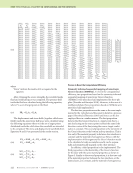
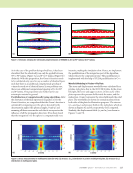
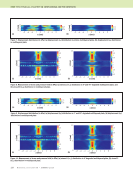
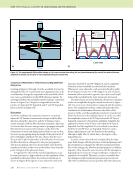
60 M A T E R I A L S E V A L U A T I O N • J A N U A R Y 2 0 2 0 NEW patents ROBERT E. SHANNON Associate Technical Editor US 10352909 Paired magnetostrictive transducers for non- destructive testing of tubular structures with selective torsional or flexural wave modes (S.A. Vinogradov, C. Duffer, and G.M. Light) One effective method for inspecting and monitoring a long length of pipeline is guided wave testing (GW) using a magne- tostrictive transducer (MsT). A common implementation of this method uses primarily torsional waves (T-waves), which are generated in a thin ferromagnetic strip placed around or in the pipe under testing. MsT testing can also be achieved with the direct generation of waves in the tested structure via electromagnetic force. To produce these T-waves, the MsT testing requires a perpendicular relationship between DC bias magnetic fields needed for MsT operation and AC magnetic fields applied to generate waves. The generated waves propagate along the pipe and are partially reflected by geometric irregulari- ties present in the pipeline, such as welds or corrosion defects. This technique can detect defects as small as 2% to 3% of the total cross section of the pipe wall. It is applicable to most cylindrical structures that are made of ferromagnetic material (such as pipelines), and can also be configured to test any shape of tube with a cross-sectional geometry that can be circular, rectangular, or other shapes, and can be closed or open-channeled. The testing process begins with inserting an MsT probe into the tube. The probe carries the MsT along the length of the tube, and the MsT transmits guided waves along the tube walls. The guided wave reflections are received, and data are collected. The conventional MsT system is composed of a ring-shaped ferromagnetic strip with an AC coil wrapped around its short dimension. A permanent magnet is located inside the coil with its poles parallel to the long dimension of the tube. The permanent magnet creates a biased magnetic field in the direction indicated. The ferromagnetic strip acts as a shielding material, dimin- ishing the time-varying magnetic field produced by the portion of the AC coil located on the inner surface of the strip. The portion of the AC coil facing the inner diameter of the tube will produce a time- varying magnetic field. When activated, the AC coil generates an alternating field that is perpendicular to the bias magnetic field. The direction of the permanent magnetic bias field, as well as the orienta- tion of the windings of the AC coil, is parallel to the direction of propagation of transversal vibration. If there is a disconti- nuity in the tube, a reflected torsional guided wave will be reflected back toward the AC coil, causing oscillations of magnetic domains in the wall of the tube. The AC coil will respond with what is known as the inverse Wiedemann effect, which will cause a mechanical impulse in the AC coil. The reflected torsional guided wave signal detected in the AC coil is received and delivered to a signal processor, which analyzes the signal to locate and estimate the size of the discontinuity. This patent describes additional features of the GW method when using a dual-coil MsT to produce both torsional and flexural wave modes. Instead of a single AC coil evenly distributed around the tube’s inner circumference, the MsTs have a pair of AC coils covering only segments of the tube’s inner circumfer- ence. The coils are activated at the same time, and, depending on the magnetiza- tion pattern and whether the coils are connected in phase or out of phase, the MsT generates either fundamental torsional or flexural wave modes. Unlike torsional guided waves, flexural waves have a nonuniform profile of energy distri- bution around the circumference of the tube. For this reason, they have a selective sensitivity to any anomalies located in certain quadrants around the tube’s circumference and can be used for characterizing the circumferential extent of the anomaly. The patent provides example dispersion curves for a 25.4 mm outer diameter tube with a 1.5 mm wall thickness. The fundamental torsional wave is marked as T(0,1) and has a constant velocity in all frequency ranges. The group velocity of flexural guided waves depends on frequency. There are different types of flexural guided waves, such as F(1,1) mode with lower peak velocities, or F(1,2) mode with higher local peak velocities. The system’s control is operable to reverse the current flow in at least one of the coils and the MsT probe generates guided waves, which are selectively either torsional or flexural. MsT probes having dual coils with a center biasing magnet will produce forces applied to the same direction around the tube circumference, producing an axially symmetric torsional guided wave. An alter- native mode of operation is also described where the control unit activates such that their currents flow in opposite directions. This out-of-phase operation results in flexural guided wave modes. If the current directions of the two coils are in opposite directions, then the patterns of applied forces and energy distribution are non- axially symmetric. The dual-coil MsT system can be fitted with side-biasing magnets or center-biasing magnets to provide generation of either torsional or flexural guided waves by selectively operating these modes using the control unit. When the coils are activated to operate out of phase, the MsT probe generates a torsional guided wave, and when the coils are activated to operate in- phase, it generates flexural guided waves. Because each coil activates only a narrow segment of the tube on the opposite side of the tube wall at a time, each A-scan can be attributed to the corresponding area of the tube. By rotating the dual coils radially, the image provided by MsT will be polarized vertically, horizontally, or by a

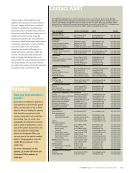
J A N U A R Y 2 0 2 0 • M A T E R I A L S E V A L U A T I O N 61 chosen angle. Combining the scans together, the data can be used to form a “B-scan” image of the tube’s condition, helping to identify the circumferential position and the circumferential extent of the discontinuity. Because T-mode is in an axially symmetrical mode, it quickly spreads around the tube circumference, and even a localized anomaly will produce a response covering the entire circumfer- ence of the tube. Even non-axially symmetric anomalies will produce an axially symmetric response. Unlike the T-mode, the flexural mode produces a peak of energy distribution that corre- sponds with the circumferential position of the discontinuity. This provides informa- tion about the location of the discontinuity around the tube circumference. w Contact ASNT The ASNT International Service Center is open from 8:30 a.m. to 5:00 p.m. Eastern time, Monday through Friday. Voicemail messages can be left 24 hours a day by following the recorded prompts. In the U.S. and Canada, call toll free 1-800-222-2768 or 1-614-274-6003 fax 1-614-274-6899. Email addresses for individual staff members are given below. If you prefer, write ASNT, 1711 Arlingate Lane, P.O. Box 28518, Columbus, OH 43228-0518. ASNT’s website is available at asnt.org. AREA OF INQUIRY CONTACT (EXTENSION) EMAIL PHONE Executive Offices Executive Director Neal Couture (201) ncouture@asnt.org 614-384-2451 Deputy Executive Director Tim Jones (204) tjones@asnt.org 614-384-2454 Accounting Controller Brad Pence (203) bpence@asnt.org 614-384-2453 Account balance inquiries Melissa Goe (214) mgoe@asnt.org 614-384-2464 Credit and collections Melissa Goe (214) mgoe@asnt.org 614-384-2464 Dues payment inquiries Tomeka McCutcheon (215) tmccutcheon@asnt.org 614-384-2465 Customer Service Customer service inquiries/ Kimberly Donaldson (242) kdonaldson@asnt.org 614-384-2442 book orders Trina Coakley (220) tcoakley@asnt.org 614-384-2480 Certification Director Donny Didion (240) ddidion@asnt.org 614-384-2440 Certification program manager Charles Longo (241) clongo@asnt.org 614-384-2441 Certification inquires Lisa Law (226) llaw@asnt.org 614-384-2426 Jennifer Harris (237) jharris@asnt.org 614-384-2437 Tricia Davis (219) tdavis@asnt.org 614-384-2469 Conferences and Meetings Director Barry Schieferstein (202) bschieferstein@asnt.org 614-384-2452 Exhibit sales Ruth Staat (227) rstaat@asnt.org 614-384-2427 Level III refresher courses Ruth Staat (227) rstaat@asnt.org 614-384-2427 CEU program James Bennett (250) jbennett@asnt.org 614-384-2450 Technical program Alicia LeMasters (213) alemasters@asnt.org 614-384-2463 Internet ASNT website Stephen Schaefer (222) sschaefer@asnt.org 614-384-2482 Advertising Jessica Miller (209) jmiller@asnt.org 614-384-2459 Marketing/Communication Director Garra Liming (211) gliming@asnt.org 614-384-2461 Advertising sales Jessica Miller (209) jmiller@asnt.org 614-384-2459 Social media/public relations Dana Sims (244) dsims@asnt.org 614-384-2444 Membership, Engagement, and Governance Director Heather Cowles (216) hcowles@asnt.org 614-384-2466 Awards and honors coordination Jessica Ames (233) awards@asnt.org 614-384-2433 Committee coordination Jessica Ames (233) james@asnt.org 614-384-2433 Governance administration Michelle Thomas (223) mthomas@asnt.org 614-384-2483 Membership coordination Pat White (217) pwhite@asnt.org 614-384-2467 Sections coordination Debbie Segor (235) dsegor@asnt.org 614-384-2435 Scholarships coordination Jessica Ames (233) james@asnt.org 614-384-2433 Volunteer coordination Jessica Ames (233) james@asnt.org 614-384-2433 Publications Interim Director Toni Kervina (205) tkervina@asnt.org 614-384-2455 Book development NDT Handbook Karen Balkin (207) kbalkin@asnt.org 614-384-2457 Educational materials Cynthia Leeman (225) cleeman@asnt.org 614-384-2425 Bob Conklin (275) bconklin@asnt.org 614-384-3106 Library Cara Schaurer (206) cschaurer@asnt.org 614-384-2476 Materials Evaluation Advertising Jessica Miller (209) jmiller@asnt.org 614-384-2459 Articles and papers Jill Ross (224) jross@asnt.org 614-384-2484 Buyers guide Jessica Miller (209) jmiller@asnt.org 614-384-2459 Calendar Cara Schaurer (206) cschaurer@asnt.org 614-384-2476 Employment service Cara Schaurer (206) cschaurer@asnt.org 614-384-2476 Ready Reference guide Jill Ross (224) jross@asnt.org 614-384-2484 Reprint permissions Cara Schaurer (206) cschaurer@asnt.org 614-384-2476 Section News Debbie Segor (235) presaward@asnt.org 614-384-2435 NDTMarketplace inquiries Cara Schaurer (206) cschaurer@asnt.org 614-384-2476 Advertising Jessica Miller (209) jmiller@asnt.org 614-384-2459 RNDE inquiries Jill Ross (224) jross@asnt.org 614-384-2484 The NDT Technician inquiries Jill Ross (224) jross@asnt.org 614-384-2484 Advertising Jessica Miller (209) jmiller@asnt.org 614-384-2459 Standards and Accreditation Director James Bennett (250) jbennett@asnt.org 614-384-2450 Quality Manager Brian Frye (218) bfrye@asnt.org 614-384-2468 Patents Have you been awarded a patent? If you have recently been granted a new patent by a government patent office, we invite you to let us know about it. We are looking for patents that describe innovations in the science and practice of nondestruc- tive testing. You can send a few paragraphs describing the invention and its range of applications, and a copy of the patent document (or if it was issued by the United States Patent and Trademark Office, you can just give us the patent number). Email to ndeguy@yahoo.com with “ASNT ME New Patents” in the subject line. For more information on the patents, go to the US Patent and Trademark Office website at uspto.gov.
ASNT grants non-exclusive, non-transferable license of this material to  .
All rights reserved. © ASNT 2026. To report unauthorized use, contact: customersupport@asnt.org